Estimated reading time: 48 minutes
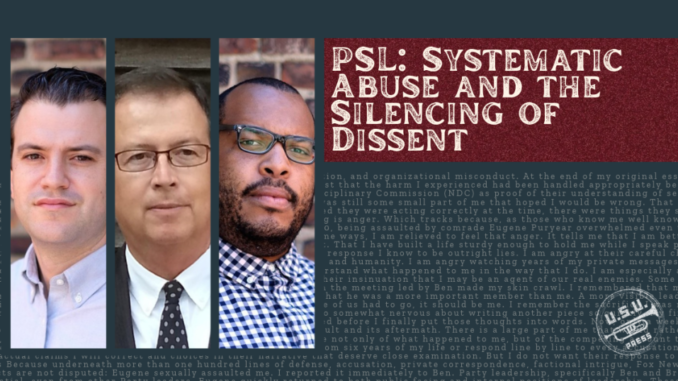
Editorial Note: Below are two separate pieces, a leak and a republication, respectively: the leak is another internal message from the Party for Socialism and Liberation (PSL), and the republication is a follow-up from ex-PSL member Marissa Sanchez to her last piece on leadership’s cover-up of Eugene Puryear’s assault of the author in 2020. Marissa’s piece can be found here.
As concerns rise within PSL over the systematic cover-up of sexual assault among the organizations leading figures the Central Committee has responded through a call for complete suppression of dissent across all clubs in the country.
Claiming to be a democratic organization that cares for the oppressed, the Leadership of PSL continues to make every attempt to cover up its long history of internal abuse through fedjacketing the rising number of members coming forward with their experiences, claiming that this flood of information is the result of fractions and the state department working to crush this party fighting for the people. Meanwhile tokenizing the few women who hold higher positions of leadership to claim that former members such as Marissa Sanchez have no right to speak out on the violent processes of “accountability” they were forced through as it met the party standards of the time—to argue that it was wrong is to break “party line.”
This is the behavior of a cult, not an organization working towards revolutionary struggle. Dissent and contradictions must be struggled through, not sidelined, erased, and further suppressed by those who’ve done wrong. The Central Committee of PSL claims that such violent tactics used against survivors is “Democratic Centralism” when in reality it is merely an attempt at ensuring abusers stay in power and while revolutionary energy goes nowhere.
Moving Forward
Message from the Central Committee to Local Leadership Bodies
Approved unanimously by the CC on September 15, 2026
Dear comrades,
We have heard from SCs in many areas that they have now had significant internal discussions on Marissa Sanchez’s letter, the NDC statement, the CC report, as well as the ongoing factional operation aimed at dismantling the Party. This has been discussed in units, branch committees and other expanded leadership bodies, internals, in one-on-one meetings, and other settings. The overwhelming majority of leaders and members nationwide are standing strong in defense of the Party that we have all collectively built together, and are eager to move forward with our important political work. This document offers you some guidance on how to do that. It is not for mass distribution to the membership.
Under democratic centralism, there is thorough internal discussion followed by decisions taken at the appropriate bodies, which have been elected democratically, and those decisions then become binding and executable.
NDC and Central Committee decisions
The all-woman National Disciplinary Committee been vested by the Party Congress with final authority on all disciplinary matters related to sexual misconduct, binding on all other leadership bodies and on all members. In 2026, the NDC thoroughly reviewed the 2020 disciplinary case involving former members Eugene Puryear and Marissa Sanchez. The incident took place prior to the NDC’s existence, when the Party, its depth of leadership, its staff and its institutions were much smaller.
The NDC review affirmed:
- That the disciplinary and accountability process in 2020 conformed with the Party principles and disciplinary protocols then operational. That if such an incident took place today, it would go instead to its all-women’s panel, and would follow the more thorough and elaborated processes related to sexual misconduct that the NDC currently uses.
- That people have the right to change their opinion on an incident, and on a disciplinary process they have been involved in. Marissa Sanchez, however, despite being involved in the creation of the NDC from its conception in 2021, for the next five years did not raise that she had changed her opinion, nor did she ask for the NDC to reopen the case.
The NDC’s review of that matter is now closed
The PSL Central Committee is the Party’s highest elected body between congresses. Its political and organizational decisions constitute the line of the PSL, and are binding on all PSL members as a principle of democratic centralism, and as a requirement of membership. The Central Committee, after thorough discussion, unanimously responded to the factional operation’s distortions in June. It also unanimously approved the “Comprehensive Report on the Marissa Sanchez letter” after a thorough discussion, laying out in far greater detail the support provided to her, how and why her relationship to the Party leadership changed, and how she intersected and coordinated with the factional operation. This report has been circulated to the entire Party membership and branches have had a week to adsorb its meaning and content. This report constitutes the CC’s definitive position on the matter.
Democratic centralism and defense of the Party
Under the Party By-Laws, “All members, including those who disagree, are duty bound to publicly defend and carry out these decisions.” That means anyone who cannot publicly defend the Party, its decisions, and the elected leadership bodies carrying them out, is in violation of the most fundamental tenets of Party membership, and must resign or be subject to expulsion.
The duty to defend the Party does not require each member to speak to each aspect of every decision ever committed in other people’s accountability processes from years ago. It means disputing the false narrative that the Party tolerates sexism in its ranks, and affirming that the Party has a strong record and strong processes that have empowered and developed women leaders at every level. It means disputing the narrative that the leadership is corrupt and undemocratic. It means standing by the legitimacy of the all-women’s National Disciplinary Committee, and the legitimacy of the elected Central Committee, which have comprehensively reviewed these matters and made their decisions, as they are authorized to do.
This duty to defend the Party does not stop our permanent task to improve the Party’s internal life and institutions. All conversations and proposals to improve the Party are welcome, if they are done in the spirit of making the Party a better instrument for our class, and premised on comrades’ own experiences with organizational life — not on the distorted “facts” or arguments of those who want to destroy the Party.
Individuals who cannot in good conscience carry out the duties of membership can still leave on friendly terms with the Party — but they cannot be members. If a member engages with these operations to destroy and dismantle the Party, joins in the effort to discredit or undermine the legitimacy of our elected leadership and institutions, or takes the side of the Party’s enemies over its entire elected leadership, they should not remain PSL Members.
Understanding the ongoing Attacks
Finally, we want to emphasize why defending the Party has assumed a particularly critical role in this stage of the class struggle. At a moment when the PSL is providing vital leadership on many fronts, NSPM-7 has reorganized billions of dollars in federal law enforcement resources to “dismantle and destroy” organizations it calls “domestic terrorists” based on their viewpoints and activism. COINTELPRO and other campaigns of state repression in US history primaily focused on covert attacks, to “foster factionalism” and “expose, disrupt, misdirect, discredit, or otherwise neutralize” a targeted organization. The main three targets in such operations historically were an organization’s 1) reputation, 2) leaders and 3) finances.
The targeting of the PSL by right-wing media, politicians, members of Congress, and the Department of Justice is real, although we may not know the full scope of it for years. According to media reports, a federal grand jury has been convened in the Southern District of New York, targeting left-wing organizations in New York City, and this also includes The People’s Forum, BreakThrough News, ANSWER and others. Grand juries operate in secret, compelling testimony from anyone they subpoena in environments without lawyers and where remaining silent leads to jail. According to media reports, the PSL was named by a senior Department of Justice official Harmeet Dhillon as a target to be “dismantled.” We have faced a broad and escalating range of state, legal, law enforcement and Congressional attacks in the last 9 months, with a new one almost every week.
There is also a previously secret factional operation, still ongoing after many months, composed of former PSL leaders and members, focused on trying to dismantle the PSL from within. The anti-Party grouping announced themselves to the world in June as if they were just committed to mass organizing, but appear entirely focused on recruiting people from our Party, and trying to destroy the PSL, rather than organizing towards their own vision. They have conspired to encourage small groupings elsewhere to conceal political differences and then resign. In one recent example, a factional member originally from New York used a false name to rejoin the Party in a new branch to help organize the resignation of members. Every day we receive new reports of these anti-Party forces probing current members, especially to uncover weak spots, gather grievances, identify salacious stories, and dig up details of past internal disciplinary proceedings. They want to find anything to drive a wedge between PSL members, to convince members they can’t trust their own experiences in the organization, and then combine all such stories into one singular narrative that the PSL leadership is nefarious and untrustworthy.
We are not asserting that these two operations to dismantle the PSL are necessarily connected. But either way, it is the most elementary duty of every Leninist to defend their Party in the face of any new attacks to destroy it. So long as these operations exist, and so long as the Party is a growing and formidable force, we can’t avoid that we will face different types of attacks. The Party would be weakened for the struggles ahead if it were to retain members who are not prepared to defend it.
The work of local leadership bodies
We have heard from all branches at this point. The developments of this week have understandably caused shock and distress. But our sense is that SCs everywhere are now determined to return to their work of strengthening the Party and organizing the working class. They are talking with whatever members locally they need to talk to, in order to make that happen. We recognize that some areas still have meetings planned around this matter, and these should proceed so that all members have an opportunity to understand the Party’s decisions, have their questions answered, and move forward in defense of the Party and our tasks ahead. Based on reports from around the country, we think this matter can be brought to a close in the next week. Those who want to dismantle the PSL have studied history, and know how organizations can simply become exhausted by internal issues and scandals. We will not permit that to happen, and have to return to the principles of democratic centralism to move forward.
We ask that your SC discuss this letter and reply in the next 24 hours to the National Organizational Department at pslnationalstaff@pm.me on the status of your area and next steps over the next week. We also encourage you to share your report with your national liaison. Please let us know if you need further clarification or assistance.
Who Gets to Write the “True Narrative”
Content note: Please note that this essay discusses sexual assault, rape, suicidal ideation, and organizational misconduct.
At the end of my original essay, I wrote about what I expected the PSL’s response to be. I expected them to defend their leadership and insist that the harm I experienced had been handled appropriately because I had agreed to the “process” at the time. I expected them to invoke the later creation of the National Disciplinary Commission (NDC) as proof of their understanding of sexual trauma.
In many ways, that is exactly the response they gave. And yet, I was surprised to realize that there was still some small part of me that hoped I would be wrong. That once faced publicly with the harm their decisions caused me, the Party might acknowledge that even if they believed they were acting correctly at the time, there were things they should have done differently.
That small part of me is sad and disappointed, but the larger feeling I am experiencing is anger.
Which tracks because, as those who know me well know, anger is much more comfortable for me than sorrow as an immediate emotional reaction. In November 2020, being assaulted by comrade Eugene Puryear overwhelmed even that instinct; I was not angry yet, only frightened, disoriented, and trying to survive what had just happened.
In some ways, I am relieved to feel that anger. It tells me that I am better positioned than I was then. That I have the capacity to confront their response rather than simply survive it. That I have built a life sturdy enough to hold me while I speak plainly about what happened and withstand the consequences of doing so.
I am specifically angry at things in their response I know to be outright lies. I am angry at their careful choice of language which diminishes my role and credibility while emphasizing Eugene’s stature, contributions, and humanity. I am angry watching years of my private messages, relationships, and behavior after my assault assembled into an argument about whether I am now entitled to understand what happened to me in the way that I do. I am especially angry that they would assert that my motivations are for some kind of personal or political gain. Or, worst of all, their insinuation that I may be an agent of our real enemies.
Some of their narrative affected me more viscerally than I expected. Their description of me “tearfully hugging” Eugene in the meeting led by Ben made my skin crawl. I remembered that moment, that room, and the person I was in it. I remember sobbing and telling them that Eugene mattered more. That he was a more important member than me. A more visible leader, a Black leader, a historian. I remember saying that if I couldn’t handle being around Eugene, that if one of us had to go, it should be me. I remember the sacrifice I was ready to make for projects I believed were bigger and more important than I was.
Apart from being angry, I am also somewhat nervous about writing another piece so quickly. My first essay took me a long time to write and even longer to decide to publish. I had years to think about what happened before I finally put those thoughts into words. Now, only a week later, I find myself responding in real time to an official Central Committee document about my own assault and its aftermath.
There is a large part of me that would rather not respond at all. But my original essay has over 36,000 views, and I know many people are trying to make sense not only of what happened to me, but of the competing account the Party has offered. I want to ask those readers to keep thinking.
I am not going to litigate every text message from six years of my life or respond line by line to every accusation about my motives and relationships. There are factual claims I will correct and choices in their narrative that deserve close examination. But I do not want their response to drag us away from the questions that matter most.
Because underneath more than one hundred lines of defense, accusation, private correspondence, factional intrigue, Fox News, and speculation about the state, the fundamental facts are not disputed: Eugene sexually assaulted me. I reported it immediately to Ben. Party leadership, specifically Ben and Brian, handled the response. The incident was kept confidential, even from other Party leaders. Eugene quickly returned to both public facing and internal positions of leadership.
These are not allegations. They are the Party’s facts too. The disagreement is now over what those facts mean.
The questions to be asked based on these facts are: Was the process that followed just? Was it actually survivor-centered? What does meaningful choice look like when someone is experiencing acute trauma? What responsibility does an organization have that cannot simply be handed to the person who was harmed? And what does the Party’s response tell us about how it understands accountability today?
The Central Committee calls its account the “true narrative.” I think we should look closely at how that narrative is being constructed.
The Decision I Never Should Have Been Asked to Make
On the one hand, the Party accuses me of distorting the PSL’s long history of taking sexual violence seriously and diminishing the important work done by the NDC. On the other hand, their own account acknowledges that when Eugene assaulted me, there was no NDC. They say there had “never been a charge against someone in the top leadership itself,” and that because I did not want Eugene to resign, “another accountability process would be devised in discussions with” me.
Their ultimate defense, in other words, is that I agreed to what happened after my assault.
In my original essay, I clearly stated that I said I wasn’t sure I wanted Eugene to resign. I wrote about participating in a meeting led by Ben and about additional conversations with Ben about me being assaulted. But what I understand now, and what I wish the Party would grapple with, is that I never should have been placed in the position of “deciding” what should happen with Eugene. That there is an important difference between giving a survivor agency and transferring organizational responsibility onto her.
Furthermore, Ben did not really ask me if Eugene should resign. The morning after being assaulted Ben told me Eugene might want to resign, and I responded that I wasn’t sure that is what I wanted to happen.
Most importantly, I was not considering that question from some neutral position. I was struggling to understand how someone I trusted and admired could have treated me so carelessly. I desperately wanted what had happened not to be real and for my life to return to normal.
I was also deeply embedded into the organization. I had built my entire life around the PSL. And in the days that followed reporting my assault to him, Ben was telling me in each conversation to consider how my choices could impact other comrades, projects and the Party’s political relationships.
I am not arguing that trauma rendered me incapable of making any decision for myself. Nor am I arguing that there was only one acceptable punishment the Party could have imposed. My point is narrower: my wishes in the immediate aftermath of being sexually assaulted should never have been treated as sufficient evidence that the Party’s response was just. Survivor agency does not mean making the survivor responsible for determining the future of the person who harmed her.
There is a reason for this. Victims of sexual assault are often very close to the person who harmed them. Even when a victim knows that what happened was wrong, they may still have complicated feelings about the person who assaulted them. They should not be placed in the position of carrying the responsibility for what happens to that person as a result of the assault.
Taking that decision out of the victim’s hands helps create a more impartial process and, just as importantly, removes an enormous burden from the victim. Who should be allowed to focus on their own safety, healing, and what they need rather than feeling responsible for the consequences their perpetrator may face.
The extent to which I was being placed in a position to “determine” what should happen to Eugene was in itself traumatizing. It created guilt, pressure, and additional emotional harm; especially because I was then asked for years to carry on having a relationship with him as if nothing had happened. To work with him. To be in space after space with him.
A trauma-informed and survivor-centered process would have recognized this dynamic, recognized I was having an acute trauma response, and not placed the burden of determining my perpetrator’s consequences onto me as the person who was assaulted.
The Party’s response repeatedly tells us: Marissa wanted this. Marissa did not want Eugene to resign. Marissa did not want him expelled. Marissa participated in determining the consequences. These claims are presented as evidence that the Party’s process was appropriate.
But those facts do not answer my criticism. They are my criticism.
If the Party truly had a long-established political understanding of how seriously sexual violence must be treated, and how it impacts people who have experienced it, then that understanding should have guided its response precisely when the person accused was one of its most important leaders.
Whether Eugene remained fit to exercise political leadership after sexually assaulting another member was a question the PSL had to answer for itself.
The truth the Party does not want to face is that there was no real process taken up to answer that question. And that given the immense social, economic, and emotional pressures I was facing, that the decision to keep Eugene in the Party, in prominent leadership, and in a public-facing role was truly and ultimately the decision of two Party leaders, Ben and Brian Becker.
How a Survivor is Supposed to Behave
A significant portion of the Party’s response is devoted to proving that, in the months and years after my assault, I behaved like someone who believed “she had been supported”. They point to my continued Party membership and leadership, my relationships with Party leaders, and messages in which I sometimes spoke to or thanked Ben warmly.
They also make a very specific accounting of the people who they say knew about my assault. Their response has forced me to reconstruct those disclosures more carefully than I had wanted to when writing my original essay. I can identify four people who I remember knowing, under very different circumstances, that I had been assaulted while being on staff for the Party in New York. The Party appears to describe five. I do not know who the fifth person is, and I will not invent a memory to resolve that discrepancy.
Originally when drafting this response, I wrote a description of each of these four partial disclosures. I say partial, because in only one of them did I even name Eugene, but after some reflection, I do not feel the need to expose myself further in response to the Party’s own invasion of my privacy.
The point I need to make is that knowing I had been assaulted in New York is not the same thing as being someone I confided in about how the Party handled my assault. None of these partial disclosures were with comrades with whom I was freely processing what happened. In fact, there were multiple times I asked Ben about if I could speak to specific people, for example Kei Pritsker, and was told NO.
The Party nevertheless uses the idea that anyone knew I had experienced assault to construct an image of me as someone who freely confided in multiple trusted comrades and repeatedly expressed satisfaction with how my assault was handled. That is the account I do not recognize and which I am calling out as a blatant lie.
The contemporaneous text they reproduce, in which I say my meeting with Eugene “went good,” I assume was to Chris Banks. The “friend” I wrote about in my original essay who Ben said he, “Rather I hadn’t told.” I do not dispute writing it. I believed it when I wrote it.
(An aside: One of the most painful parts of looking back on my experience is that when I confided in Chris, despite the fact that he was the person who recruited me to the PSL, a friend who knew my family, as well as, my history of sexual violence and someone who I had tirelessly defended, Chris did not stand up for me or question Ben about how my assault was being handled.
In fact, while I was spinning out, suicidal, calling him crying, Chris “comforted” me by telling me about how he resented the consequences he was given for his own sexual misconduct and womanizing. He commended the Party and me for not putting Eugene through the same “pain” of being suspended and isolated like he was in San Francisco.
At some of the lowest moments in my life, when I was frightened and confused the person I confided in was telling me about the lasting costs of punishment.
I also have to state how upsetting it is to know from reading their response that the Party leadership is actively relying so heavily on Chris in their response to account for my mental state after being assaulted. That they are asking him to look through our private messages for things that can be used to smear me. Especially because Chris is himself a “former member”, but who has been quietly moved by the Party to Atlanta, after again having sexually inappropriate conduct. I wonder where the sexually explicit text messages describing how he would like to sleep with different Party members in San Antonio are? How is it that the PSL leadership is still working with him in such a trusted way if he is both “not a member” and has shown repeatedly through his own personal conduct over years his failure to understand the role his actions play in the lives of women?)
There is a difference between saying I thought I was doing okay and actually being okay; between saying a meeting “went good” and concluding the Party’s process was just; and between telling someone I was assaulted and telling them the Party handled my assault well.
The same problem appears in their use of my relationship with Ben. Even after being assaulted, I had continued to consider him one of the most important mentors in my life and to care about his family. Those things are true. They are not the same thing as saying he and the Party handled my sexual assault appropriately.
They even go so far as to describe me as going through an “intense break-up” during this period. I wasn’t. I was in fact caught up in a painful and unhealthy situationship. I was not in a committed relationship. It sounds like a small distinction, but the Party uses Ben’s supposed knowledge of my personal life as evidence of how closely he was caring for me. Instead, the error made me realize how poorly he was tracking what was happening with me even when I was right in front of him.
This is the larger problem with their “evidence”. I could have seen Ben as a leader and friend, while still feeling confused and upset by his actions. I could have remained committed to the Party while struggling with something that happened inside it.
Most troublingly, they write: “This is not the behavior and words of someone who was shunned or grievously wronged.” What, exactly, is someone who has been grievously wronged supposed to look like?
Was I supposed to leave immediately? Stop loving people I had loved for years? Stop participating in political work that structured my life? Was I supposed to understand my trauma instantly and perform that understanding consistently enough that, six years later, there would be no contradictory text message for the Party to find?
Too many women already know how dangerous this logic is. We know women in our families, our communities, and our own lives who were raped or abused by husbands and boyfriends and did not immediately leave. Some stayed for weeks. Some for months. Some for years. Some continued to love the person who harmed them, defended them, slept beside them, depended on them, or tried desperately to make the relationship work. None of that means the violence did not happen. None of it means they were not “grievously wronged.”
We know better than to ask a woman, “If he really harmed you, why did you stay?” We should know better than to ask me the institutional version of the same question.
My continued attachment to the Party is not evidence that the Party did not harm me. I loved the comrades. All of my closest relationships were inside the PSL. My livelihood was at times tied to it. I had spent years building the Party and believed deeply in the political project it represented. If we understand that a survivor’s continued attachment to a person who harmed her does not negate that harm, we should be capable of understanding that continued attachment to an organization does not either.
This is why I do not see the Party’s response as evidence that it has developed a deeper understanding of sexual harm in the years since my assault. I see evidence of the opposite. Six years later, they are still evaluating my account through how well my behavior conformed to what they apparently expect from someone who was harmed: Did I stay? Did I hug him? Did I ever thank Ben? Did I continue leading? Was there ever a moment that I said I was okay? This is not simply a misunderstanding of trauma. It reproduces a deeply gendered and, I would argue, misogynistic way of evaluating women who experience sexual violence: searching their behavior after the harm for evidence that the harm, or their later understanding of it, should be taken less seriously.
“Former Member Marissa” and “Long-Time Party Leader Eugene”
Language matters. Political organizations, perhaps more than anyone, should understand that.
The Party introduces me as “former PSL member Marissa.” In the same sentence, Eugene is “a long-time Party leader.”
Neither description is false, but neither is neutral. Wasn’t I also a long-time Party leader? I joined in 2015, spent a decade organizing with the PSL, worked full-time for the Party, helped build branches, recruited and trained members, served in various national leadership roles, and was twice elected to the Central Committee. Not to mention, Eugene is also a former PSL member, so to position us using these terms begs the question: Why am I defined by my departure while he is defined by his importance?
This is not because leadership status determines credibility. It doesn’t. I raise it because the Party chose these descriptors, and that framing continues throughout the response. My history is largely presented as evidence to be examined: my relationships, private messages, changing relationship to the Party, and behavior after the assault. Eugene’s history, meanwhile, is presented through his political value: his recruiting, mentoring, work in the Black freedom movement, skill as a communicator, and knowledge as a historian. None of his accomplishments tell us whether the process following my assault was just. Yet readers are repeatedly reminded of his value to the organization. Concern for his health is even raised.
That is one way a “true narrative” gets constructed: not only through which facts are included, but through whose authority is emphasized, whose is diminished, and how readers are implicitly taught to understand each person involved.
I Am Not Part of a Faction
I want to be unequivocal: I am not part of a faction of former PSL members organizing to destroy, dismantle, or split the Party. My essay was not written or published as part of a coordinated factional campaign.
Am I in contact with people who have left the PSL? Of course I am. I spent ten years there. Many people I knew, loved, worked alongside, and organized with have since left too. And yes, some of us talk about the PSL. We also talk about art, our work, our families, and how terrifyingly hot it has been outside.
Talking with former PSL members has helped me process an emotionally difficult and disorienting experience. We compare memories, talk about relationships we lost, and support one another as people making sense of our time inside a closed political organization.
But I am not building another organization with these people, recruiting PSL members, or organizing a campaign against the Party. I have organizing work of my own that is based in my immediate community. “Decapitating” the PSL is not it.
However, that does not mean I condemn former members who have chosen to build other political projects. I don’t. I am still a communist and a Marxist. I want communists organizing, experimenting, building organizations, and finding ways to make revolutionary politics meaningful to more people. If people who have left the PSL build organizations that contribute something valuable to the movement for socialism, I hope they succeed. That does not make me a member of those organizations.
More fundamentally, I reject the premise that the success of revolutionary politics must mean the success of one particular organization. People leaving one communist organization to organize elsewhere should not automatically transform them into enemies, wreckers, or agents of the state. If our politics are actually about building a movement capable of transforming society, then there must be room for different organizations to exist, experiment, disagree, and still find ways to struggle together.
The Party’s vehement condemnation of any member who decides to leave and continue to organize in any capacity outside of the PSL is to me proof of how deeply sectarian and competitive their attitudes actually are.
My Essay Was Mine
There is another irony in their response. The women Central Committee members accuse me of portraying them as “pawns or pieces to be moved by some small cabal of men” and as “extensions of the desires of our male comrades.” I have never said that.
I find that characterization itself belittling to those women. I knew and worked alongside them for years. I considered them my friends. They are intelligent, experienced political leaders with agency of their own.
That is precisely why I hold them each accountable for putting their names on the Party’s response. The same way I hold myself accountable for signing other such Party responses when I was on the Central Committee and NDC.
What is striking is that while accusing me of denying these women’s agency, the Party constructs a narrative that denies mine. In their telling, I did not independently spend years reconsidering my experience or arrive at a different understanding after gaining distance from it. I did not decide for myself that I wanted to write publicly. Instead, I appear as someone drawn into a faction and incorporated into a coordinated campaign against the Party.
I reject both frameworks. Women in the PSL’s leadership are political actors responsible for their decisions. I am also a political actor responsible for mine.
My essay was mine. I wrote it, decided what belonged in it, decided when I was ready to publish it, and I take responsibility for every argument I made in it. The suggestion that someone else told me what to say or how to understand my own experience is an insult added to injury.
There is something circular about the Party’s argument. Former members describe harmful experiences and talk to one another about them. Their talking to one another is then offered as evidence that their accounts constitute a “coordinated attack”. If people leave separately and remain isolated, their experiences can be dismissed as individual grievances. If they compare experiences and discover commonalities, their agreement becomes evidence of “factional coordination”. When is anyone leaving the PSL ever going to be seen by PSL leadership as leaving with genuine grievances?
From Criticism to Conspiracy
The factional accusation does not exist in isolation. It’s the bridge to the most extraordinary part of the Party’s response.
Follow the progression of their argument: They begin by acknowledging that Eugene sexually assaulted me. They then dispute my understanding of how Party leadership handled that assault. From there, they question my motivations and connect me to a supposed faction of former members. Then come right-wing activists and Fox News. Finally, the response zooms out to discuss state repression, NSPM-7, infiltration, disruption, and the history of COINTELPRO.
By the end, a story about how the Party handled the sexual assault of one of its women leaders by one of its male leaders has been placed inside a narrative about threats to the revolutionary movement and the repressive apparatus of the state.
None of this answers the questions I raised. It instead creates an environment of mistrust and paranoia that serves to distract people from the reality of what happened, and in doing so is serving to make people complicit in harm that was done.
I am a communist. I do not need to be convinced that the capitalist state surveils, infiltrates, disrupts, and represses revolutionary movements. Nor do I need to be convinced that reactionaries will seize on real contradictions within left organizations and exploit them for their own purposes. They will.
But the exploitation of a contradiction does not make the contradiction false.
If former members of the PSL, or leftists long critical of the PSL; share my essay, that does not determine whether what I wrote is true. If Fox News finds my story politically useful, that does not determine whether what I wrote is true. Even if some agents of the state were delighted by internal conflict within a revolutionary organization, that would tell us nothing about whether the criticism at the center of that conflict is true.
And there is something painfully familiar about this framing.
In 2020, in the immediate aftermath of being sexually assaulted, I was asked to think about what accountability for Eugene might mean for the Party and the political projects he was responsible for. My trauma was placed beside the needs of the organization.
All these years later, after I finally decided to speak publicly, the Party is doing something remarkably similar. This time, people are being asked to consider what my disclosure might mean for the Party: who might exploit it, what political forces might benefit from it, and how it might intersect with broader attacks on the left.
What is “good” for the PSL is once again being placed beside and weight against the harm I experienced.
That should trouble anyone serious about building revolutionary organizations capable of self-criticism. If an allegation becomes politically suspect whenever an enemy can exploit it, what criticism of a revolutionary organization could ever be safe to make?
Our enemies will always exploit our failures. That is an argument for confronting those failures more rigorously, not for treating the people who expose them as possible instruments of those enemies. An organization protects itself from political attack not by refusing to examine its contradictions, but by developing the capacity to confront and transform them.
What Accountability Could Have Looked Like
I want to be clear about what I am arguing, because at several points the Party’s response frames the dispute around whether the consequences imposed on Eugene were sufficient.
That is not my argument.
I do not think that there could have been one perfect consequence that would have made what happened just. Accountability is not simply a question of how severely we punish someone. Accountability is not the same thing as consequence.
So what might a different process actually have looked like?
For starters, comrades who did not have a conflict of interest based on their relationships with Eugene and I could have been tasked with handling the process. I could have had someone independent of Eugene’s political relationships whose primary responsibility was supporting me. I could have been given time before being asked to weigh in on permanent consequences.
Most importantly, the Party could have had clear standards for what committing sexual assault meant for someone’s fitness to exercise leadership at the highest level.
Additionally, someone could have continued checking in with me after the immediate crisis had passed, when I had enough distance to understand what had happened more clearly.
Confidentiality could have been structured around protecting my privacy, rather than containing knowledge of what happened. This distinction matters. Especially, because in their response, the Party repeatedly points to concern for “my privacy” as a rationale for keeping knowledge of me being assaulted by Eugene so limited. Which is ironic considering that they then also proceed to share my private messages and make false assumptions about my personal life.
There is a difference between confidentiality that gives a survivor control over her own story and secrecy that gives a Party control over who is allowed to know about its failures. A trauma-informed process should have protected my right to privacy. It should not have made me responsible for keeping what Eugene did institutionally contained.
A principled trauma-informed response from the PSL would not have then violated my privacy further.
The Real Role of The PSL’s National Disciplinary Commission
The Party points repeatedly to the later creation of the NDC as evidence of its serious approach to sexual violence. I do not. As I described in my original essay, my experience serving on that body did not convince me that the Party had developed an independent, trauma-informed process.
Reading the NDC’s publicly leaked protocols as part of the Party’s response to my original essay only reinforced that criticism. Rather than demonstrating that the Commission is structured primarily around the needs of people who have experienced sexual harm, the protocols reinforce my concern that the NDC’s main function is to protect the Party from criticism and contain information that could damage it.
The protocols give three reasons for the Party’s highly confidential approach to cases involving sexual harm: protecting the privacy of the impacted person, protecting the privacy of the accused, and protecting the Party from “misinformation campaigns and machinations of the repressive state apparatus, and other anti-Party forces.” They further state that members who violate “the confidentiality of the proceedings” will face disciplinary action.
Protecting a survivor’s privacy and protecting an organization from its political enemies are not the same objective. When both are presented as reasons for confidentiality in a process dealing with sexual violence, we have to ask whose confidentiality is actually being protected, who controls it, and what happens when a survivor’s need to speak conflicts with the Party’s desire to contain information?
The protocols also leave unresolved how the NDC prevents someone who has experienced sexual harm from being made to carry the weight of the Party’s own responsibilities. They state that the “reporting party” should be offered the opportunity to participate in determining the “accountability process and consequence.” Survivor participation can be an essential part of a trauma-informed process. But the protocols never explain where giving a survivor meaningful agency ends and making her responsible for determining the consequences for the person who harmed her begins.
Nor do the protocols describe what care or support is offered to the harmed person throughout this process. They do not explain how the Commission accounts for the fact that someone experiencing an acute trauma response may not be prepared to make consequential decisions about accountability, or how asking her to do so too early could itself compound the harm she is experiencing.
More broadly, the protocols provide little indication of how the Commission understands the complicated ways trauma can shape a person’s behavior after sexual violence. These are not peripheral questions for a trauma-informed process. They should be at the center of one.
Instead, the publicly leaked NDC protocols tell us a great deal about the Commission’s disciplinary authority. They tell us which cases it investigates, who must submit to its decisions, what consequences it can impose, and that it consists of “long-time women cadres.” They tell us nothing about what qualifies those cadres to respond to trauma or how the process is designed around the needs of someone who has experienced sexual harm.
Being a woman does not by itself confer expertise in trauma. Being a survivor does not either. And placing women in charge of responding to sexual violence does not automatically make that response survivor-centered. Representation is not accountability. Women are also not the only people who experience sexual violence. And making women comrades disproportionately responsible for the difficult work of responding to sexual harm is itself a questionable and deeply gendered division of labor.
Creating a disciplinary body is not the same thing as creating a culture capable of accountability, nor is it the same thing as creating a trauma-informed process.
The existence of the NDC therefore does not resolve the questions I am asking. Institutionalizing a disciplinary procedure is not the same as institutionalizing an understanding of trauma, much less developing a serious political understanding of how sexual violence operates within our organizations and our class.
The questions I want our movement spaces to take up are these: What structures, practices, and political culture would actually allow an organization to respond to sexual violence without transferring its responsibilities onto the survivor or subordinating the survivor’s needs to those of the organization? What internal culture, training, and political development would be necessary so that women comrades are not disproportionately burdened with accountability work?
I do not see how the PSL’s National Disciplinary Commission, as described in its own protocols, answers either of these critically important questions.
Moving Forward
The Party is right about something. Something I tried to make clear in my own writing, which is that my understanding of what happened to me and how it was handled did change.
Time has given me distance and language I did not have then. Experiences outside the PSL have given me something against which to measure what happened inside it. Space has allowed me to reconsider relationships I once trusted and ask questions I did not know how to ask while I was living through their consequences.
I did not rewrite what happened. I did change what I understood my experiences to mean.
The Party says I am entitled to “change [my] feelings and opinions over time,” but then treats that change as something requiring explanation: Who influenced me? Which former members did I speak to? What faction did I supposedly join?
The simplest explanation is the one their narrative seems unable to accommodate: I changed because I learned, I reflected, I grew.
Revolutionary organizations must be capable of doing the same. We must be capable of giving survivors agency without making them responsible for deciding what justice requires; of protecting a survivor’s privacy without turning that privacy into institutional secrecy; of confronting harm without reducing people to monsters; of examining ourselves without treating criticism as attack; and of admitting that even when we believed we were acting correctly, we caused harm.
This is not separate from the work of defending our organizations and confronting our real enemies. It is a necessary part of it. We cannot build organizations strong enough to withstand repression, infiltration, and reaction if we are too afraid of our enemies to confront the contradictions within our own ranks.
Finally, I want to thank the many people who have reached out to me since I published my original essay. Some of you I have known for years; some I have never met. Some have shared with me their own experiences of harm within the PSL, and expressed how reading my story helped them better understand what happened to them. I am thankful for every kind message, every supportive comment, and to all who have told me that they hope I am surrounded by people who love and support me. I am. And I want you to know how much your care has meant to me.
I also want you to know that, despite how painful all of this has been, I am still hopeful. I am not an online person, I do not have social media accounts, and so watching the conversations and debates my essay has sparked online has been overwhelming at times. Getting to discuss the political meaning of these experiences with my own family, friends and comrades has honestly been healing.
I am proud to know that by telling this story more people are talking about trauma, sexual violence, accountability, organizational culture, and what we owe one another in the movements we build. My greatest hope when deciding to share my story was that by doing so I could help push exactly these kinds of conversations forward. If what happened to me can contribute in some small way to people learning, reflecting, asking harder questions, and building better practices for the future, then that matters deeply to me.
The Party may choose to respond to me again. They will likely continue to lie about my character. To invade my privacy. To call me ego driven, a wrecker, a state agent. I do not intend to enter into an endless back-and-forth in which every response demands another response, every private message another explanation, and every explanation another defense. I have said what I needed to say about their “true narrative”.
But I am not done writing about the questions it raises. I would like to write more about sexual violence, trauma, harm, accountability, and how we can build survivor-centered processes into our organizing spaces.
These conversations are larger than my experience, and they are larger than the PSL. They are conversations we need to have if we want to build organizations capable not only of surviving our enemies, but of becoming worthy of the world we say we are fighting for.
Also worth reading:
https://opportunismslayer.substack.com/p/a-marxist-feminist-polemic-on-the
Been loving reading cde. Marissa’s writing and the questions it has raised, especially on the basis from which organizations address harm in our ranks. To try and hide our errors and fuck ups out of fear of what the enemies might do is a disservice to the working class since inevitably as the vanguard party forms we would be open about these proceedings as those that would see us as leaders need to know their leaders will hold themselves accountable to their party, comrades, and the working class as a whole.
brief aside: if any reader might have recommended texts on trauma-informed/survivor-centered practices I’d really find that useful to bring to my own organizing spaces in the future