Estimated reading time: 40 minutes
The Action
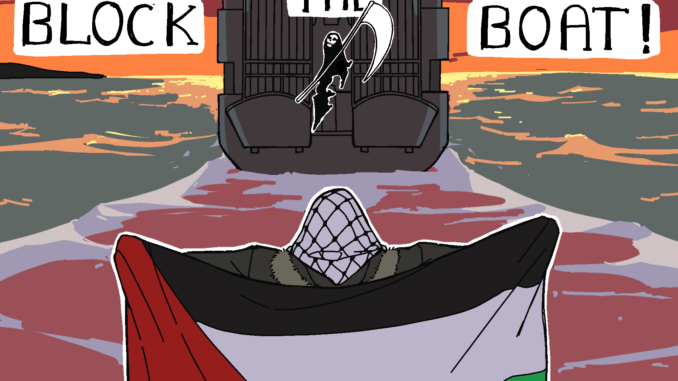
On November 3rd, 2023, the Ready Reserve Force’s ship, the Cape Orlando, left Oakland for Tacoma, Washington, where it would be loaded with weapons for its final destination: the Zionist entity. In Oakland, after hours of picketing, protesters had noticed that the gate to the dock was not fully closed. They took advantage of this opportunity to storm the boat to keep it from launching. Eventually protesters were detained and the Orlando was permitted to continue its journey. At both West coast ports the ship was met with resistance, and in both cases this failed to block the boat.
Working on intel reportedly leaked from a worker of conscience aboard the Orlando, organizations including Arab Resources and Organizing Center (AROC), Falastiniyat, Jewish Voices for Peace (JVP) Seattle, Students United for Palestinian Equality & Return University of Washington (SUPER UW), Samidoun Seattle, Resist U.S. Led-War, and The International League of Peoples’ Struggle (ILPS) Seattle announced that they would continue in Tacoma the fight Oakland had started. The Orlando’s docking was delayed, bumping it to Monday morning. Whether this was done in hopes of reducing the number of protesters able to join, as a way of pre-loading weapons onto the dock and staging police in advance, or both, remains uncertain.
On the morning of November 6th, 2023, a crowd gathered hours before dawn at the Port of Tacoma to block the Cape Orlando. Despite the risks many working people may have faced from missing shifts, hundreds of people turned out at 5 AM in the frigid rain. Pickets were set up at multiple entry points to the relevant dock. Longshoremen refused to cross the picket lines, leaving the military to load its own boat. As the day wore on more people joined, with some estimates putting the turnout at around a thousand participants. On the water, Puyallup Water Warriors, an Indigenous movement focused on restoring Indigenous relationship to and law of land, launched a small canoe blockade in an effort to prevent the ship from leaving. The protest continued with an outpouring of support from the community in the form of delivered food, drinks, and supplies. Around midday, a protester at the northwestern picket spotted people moving weapons along the dock. After a frustrating conversation with an on-the-ground organizer, marked by a yellow safety vest and megaphone, the protester left the demonstration broken-hearted and demoralized.
Unfortunately, despite massive turnout and early indications the boat was already being loaded, tactics remained much tamer than in Oakland. Between the layout of the port putting the ship approximately half a mile from the gate and police having staged in advance behind the gates, storming the boat wasn’t viable. Worse, the effort to block the boat from the shore had been outmaneuvered by pre-loading weapons onto the dock. Despite this early failure, there was no adjustment in tactics, no effort toward escalation. Instead, on-the-ground organizers announced victory late in the day, and told everyone to go home.
In the days that followed a number of public criticisms circulated, primarily through anarchist publications and private social media accounts. (For publicly available accounts see Shutting Down the Port of Tacoma: Reflections from the Salish Sea, Critical Reflections on Recent ‘Block the Boat’ Actions in Tacoma, Another reportback from the Tacoma Block the Boat action, and Reportback from the Port Blockade in Tacoma.) Conflicted and confusing information circulated. There was one consistent through-line in every critique, however, which we firmly agree with: the declaration of success voiced by on-the-ground organizers, distinguished primarily by safety vests and megaphones, was a false declaration in the face of a clear and decisive loss. Though accounts vary on what was or was not loaded onto the boat, the fact is that tools of genocide were loaded onto the Orlando that day, bound for the Zionist entity. As the protester who spotted the weapons being loaded said between sobs: “I am seeing tools for killing people going on that boat, I’m seeing it with my own eyes. What the fuck are we doing here?”
People had come to block the boat, not delay it an additional twelve hours. To hear loud declarations of victory while their own eyes told them they had failed left people feeling betrayed. The degree of demoralization that followed was a blow to the movement.
Though the effort to stop the boat ultimately failed, this remains one of the largest direct actions for Palestine in the Puget Sound since the Al Aqsa Flood, both in terms of community turnout, support, and duration. For this reason it’s worth analyzing and learning from its successes and failures as we continue developing not only the movement for Palestinian liberation, but anti-colonial and anti-imperialist movements everywhere.
As we move through this critique we want to acknowledge the amount of conflicting information that has circulated. Furthermore, the time elapsed since the action has resulted in foggy memories with limited ability to confirm finer details. Paired with a stark lack of transparency from organizers, this makes a robust critique difficult. There may be missing details in some areas and an inability to corroborate details in others. Nonetheless, we feel a study of this action can provide valuable insight despite gaps. This action was significant in the region’s movement for Palestine, and sits within the context of the region’s long history of port blockades and direct action. There were also social-cultural elements present that have proven to be recurring barriers to building sustained and sustainable movements for liberation more broadly that we feel are important to better understand. To glean important insights from this action we wish to celebrate the successes we did see, and provide constructive criticism to improve future actions.
Liberation will not come without collective action that effectively mobilizes the will of the people, whose labor power sustains the economies of genocide we’re fighting against. Participants dragged themselves out of bed before dawn not to work in service of capital, but to march into the frigid and cold Puget Sound autumn. In the wake of the George Floyd uprisings of 2020, it was uncertain what would unfold or what level of police repression should be expected, and still people came. Unfortunately the tendency to prioritize the symbolic over the material was on display in the false declaration of victory. This left participants visibly distraught at being unable to do more and vocally infuriated at being misled. The will exists, yet many people remain uncertain where to begin or how to become engaged with more meaningful action. As such, they are easily co-opted into liberal actions that primarily seek symbolic rather than material wins.
Energy and passion such as that seen at the Block the Boat action must be effectively stewarded, organized, and directed. This is best done by a well-organized revolutionary vanguard party with a strategy accounting for regional particularities in culture, material conditions, and needs. Our goal in writing this critique is to contribute to a body of knowledge drawn from direct experience and critical analysis, a body of knowledge which we hope will support the strategic elements of building just such a party.
Mobilization
Much of the success of this action was in mobilization. Riding high on Oakland’s courageous attempt to stop the boat, the people of the Puget Sound were eager for their chance to take direct action against colonial imperial forces.
Despite delays and fairly miserable conditions, around a thousand people turned out to stand up for Palestine. Given a deeply ingrained risk aversion that limits the capacity of many mass actions, and an uncertainty about how police would respond, this is a win. Actions such as this can be seen as opportunities to begin developing much needed risk tolerance. In addition to the value of building theoretical knowledge and experience via praxis, building risk tolerance is crucial in moving the masses toward greater revolutionary potential. No clash happened that day, but it remains significant that people were undeterred when police donned riot gear. Even more so, those experienced in the brutality of the George Floyd Uprisings were observed talking less experienced participants through ways to navigate violent escalation. This kind of cognitive practice can be effective in eroding risk avoidance and building confidence in those otherwise inexperienced in such risks.
The longshoremen’s respect for the pickets led to an additional twelve-hour delay and forced the military to deploy their own personnel to load the ship. This was widely understood as the primary success of the action and demonstrates clearly the strategic utility of keeping up-to-date knowledge about local union protocols. Identifying points of union influence in key industries and developing an understanding of how to apply pressure to these points can bolster our actions with minimal additional effort. Wherever we can build working relationships with local union members across diverse industries, all the better. Given the sharpening contradictions locally, nationally, and globally, building these inroads now may create future opportunities to re-capture union power that has been co-opted by neoliberal imperialism.
An additional success to be noted is the cost that both the delays and the need to bring in the military to load the boat must have incurred. While no hard numbers are available for assessment, the raised cost of business is important in sabotage-oriented strategies, which we’ll return to later.
Indigenous Leadership
The day prior to the action there was an impromptu pre-brief facilitated by the Water Warriors. This came about due to community members missing updates about delays to docking and arriving early. The Water Warriors demonstrated exemplary leadership by calling all who had arrived together, namely representing Freedom Road Socialist Organization and Unity–Struggle–Unity Press as well as some others who were unaffiliated.
The Water Warriors laid out a detailed plan while avoiding over-disclosure to preserve security. Their outlined plan for a water-based canoe blockade prioritized concrete, material impact and demonstrated strategic foresight and a commitment to effective communication, collaboration, and action. They shared their plan to take their canoes into the bay and hold the line for as long as possible. They also shared with the group how they could be supported, including keeping watch from the land and sharing pre-brief information with comrades so other protesters could plan accordingly. The meeting was brief, perhaps twenty minutes or so, before the Water Warriors departed for a prayer ceremony, which meeting attendees were invited to join.
Despite the explicit request of the Water Warriors to communicate information from the pre-brief to comrades, concerns later arose about a lack of effective communication and coordination between organizers and the Water Warriors. Many protesters on the ground had no idea that the Water Warriors were going to be conducting a water-based blockade. While it’s not always necessary for every protester to be kept in the loop about every move, the request of the Water Warriors that information be passed along clearly indicates a desire for as many people as possible to be kept in the loop. (While this author recalls reading a critique focused on this subject, it has since proven elusive so we’re unfortunately unable to provide additional citations. If any readers are familiar with this critique we ask that you share it.)
Here we again see a need for improved communication, as well as an increased attunement to Indigenous leadership. There is also a clear indication for non-Indigenous organizers and participants to ask Indigenous leadership how to best support their action(s). We must endeavor to gauge the willingness for escalation as well as the degree of violent retaliation oppressed parties are willing to bear. This is key not only to following Indigenous leadership but to centering the most oppressed and therefore most affected among our ranks.
The lost potential of this pre-brief to improve collaboration and communication reminds us of the importance of pre-briefs. Pre-briefs have repeatedly proven to be vital to participant coordination and collaboration as well as action success in other instances. For this reason, we should always strive to coordinate an accessible and well-communicated pre-brief as an expected part of praxis. This is best done with a structure that facilitates effective communication and cooperation not only between participants but also between participating groups, and even across ideological lines. This creates opportunities for improved collaboration toward a much-needed united front.
The settler-colonial relation continues to determine the form of advanced capitalism we organize against. The sovereignty of Indigenous nations everywhere is routinely violated to bolster capital and facilitate further violations elsewhere: the sovereignty of Adivasi nations in India is violated to plunder resources that fuel weapons production. The Puyallup nation’s sovereignty over their own land and water is violated by the transit of military weaponry made using those same resources. All this for the purpose of violating the sovereignty not only of Palestine, but of West Papua, the Philippines, La Guajira, and many, many more. For this reason it is vital that revolutionary groups and movements build solidarity and coalitions with the Indigenous nations whose territories we are collectively struggling on. Colonialism and capitalism are symbiotic, violent, extractive dynamics which threaten us all, regardless of skin color or national origin, due to rising fascism and the worsening climate crisis. As such, revolutionaries must build strong coalitions with all of their natural allies. The success of the social revolution hinges on the liberation of all oppressed people.
An apparent lack of intentional and direct collaboration with the Water Warriors fundamentally weakened this action. A parallel failure to broaden the scope of the struggle for Palestine by centering the relationship between Palestinians and the Indigenous nations of so-called America was a failure to bring to light the underlying causes of genocide faced by both peoples. Explicit and intentional collaboration with the Water Warriors undoubtedly would have strengthened this action and elevated both its material and social-cultural impact.
Bearing in mind that Indigenous communities are not a monolith, those of us who are settlers must endeavor to connect with and build good relationships with the nations whose lands we occupy. No opportunity to engage with Indigenous nations should be missed. Social investigation to not only better understand the priorities of Indigenous nations and leadership, but also to locate and build coalitions with the most politically advanced individuals and groups within these nations, is necessary. Their knowledge and perspectives should shape the struggle against imperialism in the belly of the beast. This is especially vital given that this struggle is unequivocally a struggle against the foundations of settler colonialism as embodied and enforced by the so-called United States both locally and abroad. Even if Indigenous peoples aren’t able to participate in the action itself, inviting an opening ceremony led by representatives from local nations (as seen in Seattle’s Marches for Palestine collaboration with radical members of the Duwamish nation) supports the building of these much needed relationships and coalitions.
Community Care
There was an abundance of care on display at this action. Car shuttles, coordinated autonomously in some cases and with support from Democratic Socialists of America in others, decreased worry about parking, walking long distances, towing, or surveillance by police. Overall this increased accessibility. Hot drinks and food were coordinated, as well as supplies such as umbrellas, dry socks and gloves, and hand warmers. Community members made multiple supply drops and participants helped distribute these across pickets.
This coordination additionally provided an avenue of participation for community members otherwise unable to directly attend without undue risk (parolees, for example). Such care-taking and socially reproductive labor maintains momentum and morale not only in one-off actions but for revolutionary movements more broadly. The importance of this often overlooked labor cannot be overstated: this socially reproductive labor is the backbone upon which sustainable and effective revolutionary movements are built. Without this labor, actions such as these become non-viable, and networks of communication, including organization relationships and coalitions, disintegrate. This is the work that can and should move us from spontaneous action toward long-term, structured organizing that sustains movements. This is the work that, when strategically and intentionally undertaken, can close the gap between who can and can’t join us in struggle.
However there were notable strategic and structural gaps in care. For example, while chants and rousing speeches are important parts of keeping people engaged at actions, we’ve spoken with many who report that these become draining and redundant at longer actions. While plenty of people on the ground encouraged one another to rest, there weren’t concerted efforts to create rest zones. Providing intentionally structured time and space for people to rest and recover also opens opportunities to invest in education and agitation. Similarly the construction of small fires to serve as warming stations supported participants to stay longer on a very wet and cold day. With improved structure and organization, such spaces could easily have been utilized toward social investigation and much needed coalition building.
Small educational groups bolstered by hot food and drinks could have elevated rest zones into spaces for reproductive labor in support of broader movements for liberation. As Mao said in The United Front in Cultural Work, the cultural and educational work required to “to transform the thinking of the masses” cannot be undertaken in haste, and must primarily center the needs of the masses. Meeting the basic human needs of food, drink, and rest at an action where the masses are present and already politically engaged is a prime opportunity to initiate this work. Pairing the tending of basic needs with education and agitation has a long history in revolutionary action globally, from the free meal programs of the Black Panther Party to the cross-caste Communist organizing of post-colonial Kerala, India and beyond. The potlatch of Pacific Northwest Indigenous peoples, of which sharing feasts and giving gifts are important aspects, were long banned in part due to their potential to facilitate the organizing of Indigenous resistance to occupation. These historic lessons should not be forgotten.
We must constantly ask ourselves, who are we implicitly excluding from our movements? Better understanding who we implicitly exclude and how we do so is vital to building a robust foundation for revolutionary care and reproductive labor. This must necessarily go above and beyond ensuring meals and water are available during lengthy actions. Increasingly working people don’t have the resources necessary to support taking time off work to participate in the struggle. If we’re not finding ways to address this, our actions and our movements will stagnate or shrivel. To this end we must consider what our organizations can do to support worker participation in our actions. What is needed to make our actions more accessible to workers who can’t afford to take the time off work? How can we organize to address those needs? In collaborating with Indigenous and other oppressed peoples, how do we ensure that we are safe and principled collaborators? Taking considerations like this seriously demonstrates that we do care about these communities and will devote time, energy, and labor not only to addressing their needs but also to making our movements accessible to them. This is key to building the foundational trust required for building meaningful relationships and effective collaboration.
At actions like these plenty of people deeply entrenched in liberalism will be content to march in circles, chant, and go home. What we saw on the ground demonstrates that these are not the only people showing up. The despair we witnessed as people realized weapons were being loaded, and the rage, bitterness, and even disgust expressed as people realized the failure of the action and dishonesty of on-the-ground organizers, tells us that there are many, many people whose passion needs a home. Even more than this, they deserves competent, professional leadership that is able to effectively direct that passion toward revolutionary ends. This means on-the-ground leadership capable of discerning these dedicated individuals from those entrenched in liberalism, who are able to conversationally engage them without succumbing to the pitfalls of lecturing or proselytizing, and get them plugged in to revolutionary organizing above and beyond the event that brought them into the streets. (We recommend Secrets of a Successful Organizer for specifics on what this can look like.) Vitally, we must ensure that our organizations are already well-structured, with clear programs outlining immediate goals and work. This will prepare us to meaningfully direct the time, energy, and labor of these individuals toward gaining material victories, enabling them to see the strength of their own impact sooner than later. This is necessary not only for getting buy in, but for meaningfully developing these individuals’ political consciousness and revolutionary potential.
As contradictions continue to sharpen, we must see it as our responsibility to connect with the people who are willing to put their bodies on the line, but may not know where or how to begin. These are people who are primed to develop a revolutionary analysis of current conditions and a robust understanding of what needs to be done to make meaningful change. With well-developed, experienced, accountable leaders and a well-structured party, we can be the leadership they deserve and prevent them being co-opted by liberal and/or reactionary forces. Too often we’ve seen Communists and Communist organizations regarding the politically underdeveloped masses with something like pity, or worse, disdain. These attitudes result in missed opportunities for meaningful education, agitation, and effective organization that can build out a revolutionary base in the pursuit of escalating revolutionary action. This is crucial as contradictions sharpen toward a breaking point.
Care for the people in our movements also requires honest and transparent communication. A false declaration of victory triggered rightful feelings of demoralization and grief. It prompted significant suspicion from those who had given their time and energy: were the organizers even on our side, on the side of Palestine? Some of the organizations involved here have been involved in other direct actions, such as AROC Bay Area organizing the more militant Oakland Block the Boat, or SUPER UW’s short-lived occupation of a Boeing-funded engineering building at the University of Washington. JVP Seattle is well known for their civil disobedience and non-violent direct action, including blocking the doors to Seattle’s federal building, and have supported more militant actions such as those conducted by SUPER UW.
However, it was unclear who the on-the-ground organizers were. Whether those individuals who carried radios, megaphones, and marked themselves with safety vests were members of the organizations who made the call remains unclear. While the spirit of community care would indicate a need for the kind of honest communication and effective critique that builds bridges rather than burning them with regards to the orgs that called for the action, it remains unclear whether on-the-ground organizers were “on our side.” We wish to treat these organizers not as enemies of the people, but as individuals with good intentions who were and are still learning how to most effectively translate those intentions into meaningful impact (as most of us are). Yet the lack of clarity with regards to on-the-ground leadership makes effective discernment here difficult to impossible. This indicates further the absolute necessity of ensuring leadership transparency. This isn’t only an essential aspect of ensuring that accountability is viable, it’s also essential to preventing the very real risk of infiltration and sabotage. The security risk of being unable to verify the affiliation of on-the-ground organizers cannot be overstated.
Without assuming association or alignment of on-the-ground organizers with any of the named organizations, the failure of these organizations to engage in critique of on-the-ground organizer conduct is important to note. This avoidance of critique in symptomatic of an organizing culture that prioritizes friction-less “unity” and relationships without tension. This betrays an internalized liberal tendency described by Dr. Martin Luther King Jr. in his Letter from a Birmingham Jail as a preference for “negative peace which is the absence of tension to a positive peace which is the presence of justice.” We need more than just friction-less relationships at the next action. We need a sustainable, long-term movement capable of learning from its mistakes and growing into a force that can stop a genocide. This is not possible in the confines of a negative peace. It requires generative tension, and leadership mature and experienced enough to navigate such tension without allowing it to devolve into infighting, drama, and movement fracturing.
Goal Construction and Considerations
Unclear or unattainable goals and ineffective strategy leads to confusion, failure, and disillusionment, and will negatively impact participants, actions, and the movement as a whole. As organizers we must ensure our goals are realistic and achievable, have sound strategies for achievement, and clearly communicate them to participants.
The prominent belief among protesters was that they were stopping weapons from being loaded onto the boat, which turned out to be non-viable. Even if weapons hadn’t been pre-loaded onto the dock, it’s important to be realistic about the military’s willingness to escalate against civilians standing between them and their weapons. A goal of fully stopping weapons loading with a blockade was likely a nonstarter – unless, that is, protesters had been ready and willing to escalate. In light of this we have to ask: were protesters prepared to escalate, and to what degree were they prepared to escalate?
This is incredibly challenging to assess on the ground, especially when you’re dealing with hundreds of people coming together across a range of ideologies and levels of political development. While there were those in attendance whose readiness and willingness to escalate was on full display, these individuals were in a stark minority. Realistically, a significant portion of new allies to the Palestinian cause in the Puget Sound are, by the nature of the region’s demographics, white and middle class. While these demographics are experiencing increasing politicization under fascism, worsening climate change, and increasingly sharpening economic contradictions, it’s important to understand where the political development and consciousness of these demographics is and the ways in which they’ve been historically shaped by liberal and reactionary politics. Despite their willingness to come out in the cold and rain and face police in riot gear, it’s safe to assume that the majority of protesters weren’t prepared for a violent escalation, let alone leading or participating in such an escalation themselves.
There were additional, physical factors curtailing the possibility of escalation without militant organization. The layout of the port made charging the docks difficult without individuals able and willing to scale fences, or alternatively cutting through the fence. Beyond the fence, the distance to the dock was such that making it to the boat without being intercepted was unlikely. The port overall is also particularly susceptible to kettling, and this would have been especially true on the dock.
Given these material realities, blocking the loading of weapons onto the boat was probably not achievable, even if it was an admirable intention. It’s clear in hindsight that there was a gap in understanding between many protesters and organizers on what blocking the boat meant exactly. Specificity would have set clearer expectations and may have prevented or reduced demoralization over the outcome. It could also have provided a clearer roadmap to what needed to be done to meet goals and what strategy and tactics would have best supported a successful and effective action. For example, a better understanding of what it would take to meet stated goals may have highlighted the tactical value of a water-based blockade, and thus the necessity of effective collaboration with the Water Warriors (though, as previously stated, this would ideally already be on the forefront of organizer’s minds).
Furthermore, establishing a clear metric for success would have better enabled organizers to assess and communicate the state of things. This would additionally have supported protesters in interpreting the outcomes on their own.
Setting the Terms of Engagement
Under the above conditions “blocking the boat” simply wasn’t tenable, but that doesn’t mean all disruptive action was a lost cause. Making something as costly and inefficient to do as possible is a useful mechanism of sabotage, made clear by the CIA’s own Simple Sabotage Field Manual. Successfully undertaking such a strategy requires first and foremost an honest assessment of our capabilities and limitations. In our assessment, a core factor undermining the ability to effectively execute such a strategy comes down to this simple fact: organizers allowed the enemy to set the terms of engagement.
The public call to block the boat in Tacoma allowed authorities to coordinate a preemptive response, as evidenced by pre-staged police with riot gear and advanced loading of weapons onto the dock. When delays were announced, organizers also delayed the onset of the action. In other words, the state was permitted to set the day and time of the encounter, which enabled them to pre-load weapons onto the dock and put cops in place to guard them. This ensured any attempt to block loading couldn’t be successful.
While it’s safe to assume there was planning behind the scenes during delays, there were tactical adjustments that could have been made during this time which were overlooked. Again, explicit collaboration with Water Warriors during this time may have brought to light alternate approaches, including a better supported and more robust water blockade. There are certainly more than enough people in the Puget Sound with their own canoes and kayaks who could have been recruited for deployment of a water-based blockade under the leadership of Water Warriors. On land there was significant risk of kettling, with the layout of the port providing little option for tactical withdrawal in the case of police or military escalation. Scouting during delays could have supported the development of more robust strategy including more tactically effective deployment locations, courses of action, contingency plans, redundancies, etc.
One alternate approach could have seen a blockade of railways leading into and out of the port (taking inspiration from the 2017 railway blockades in Olympia) deployed on the intended day and hour, refusing to capitulate to the state’s delays and endeavoring to prevent the weapons from being loaded onto the dock. With this approach, protesters could have been alerted to and prepared for a multi-day blockade. The community networks that mobilized could have additionally prepared for supporting a long-term blockade.
Bringing more tactics to bear would also have strengthened the action. There was functionally one tactic at play: a picket blockade. Without a robust strategy for escalation utilizing diverse tactics and an ability to adapt to changing conditions on-the-ground, this approach is extremely limiting. We’ve seen through other actions that multiple tactics can be deployed at once or at a steady escalation, reserving the ability for those unprepared for escalation to remain engaged at a tactical level matching their ability and risk tolerance. What we saw at this action was functionally a “green” picket with mass-mobilization, but this could (and should) be expanded on. While those ready to participate but not yet ready to escalate could continue participation in a green picket, a “yellow” option could have formed a buffer between “green” and “red” roles. Yellow roles could have occupied space in the form of die-ins or sit-ins, retaining the option to comply or refuse cooperation with dispersal orders. In this formation, “red” teams could build barricade structures (such as those built using pallets and other debris sourced from the port itself) and establish body-based blockades utilizing chains, sleeping dragons, and other tools to hold space for a much longer duration. In tandem with a water-based blockade, these different tactical approaches would have supported one another for a more deeply entrenched and militant action. As noted in our A15 critique however, it’s important to research the capabilities of local state actors when it comes to “apparatus removal,” and adapt accordingly. It would also be necessary to have contingency plans in case of preemptive arrests and suppression.
It’s important to critically reflect on factors that may lead to early arrests and how to mitigate these in order to hold the barricade for as long as possible.* Inspiration should also be taken from strategies and tactics such as those that allowed a 2021 blockade of the Port of Seattle to block unloading of an Israeli-operated cargo ship for nearly two weeks. This will help shape a more effective disruption of economies of genocide via more effective disruption of supply chains these economies depend on.
In consideration of alternate strategies, we shouldn’t ignore the fact that sabotage may have been the most effective means of blocking the boat. While we’ll leave the specifics of what sabotage could mean to the imagination, this does highlight again the necessity of considering the balance of willingness to escalate and risk aversion. This is a long-term and widespread strategic barrier which we should all endeavor to find ways to address according to the resources and limitations of our regionally-bound cultural and material conditions, in preparation for moments like these.
Any of these approaches to improved preparedness and setting the terms of engagement would have required significantly improved structural coordination between organizing groups and their leadership. Similar to concerns we had about the structurelessness of the A15 movement, a lack of structure here posed serious limitations. These include limitations on effective reconnaissance, strategic planning and implementation, and effective management of the forces that were mobilized, not to mention collaboration between participating groups and organizations. These are all necessary components of setting the terms of engagement and positioning ourselves with as much strategic strength as possible, and are best established through long-term, well-structured organizing.
Reflection and Feedback
In the face of serious criticisms related to declaration of false victory, poor communication, and lack of transparency, a member of ILPS offered to host a call via Signal to provide space for people to voice concerns and brainstorm improving future collaborations.
It’s unclear whether any on-the-ground organizers were involved in this session or not. It appears that, aside from ILPS, the organizations that made the initial call weren’t responsible for calling or hosting this meeting. Whether or not they had representatives present is unknown.
Nonetheless, the invitation to discuss criticisms and facilitate learning for future implementation remains a good model to use for all direct actions, not just those that go south. Creating spaces such as this for open discussion of critiques, facilitated with humility, are vital to maintain ongoing learning and growth. This is in turn vital to maintain an effective, adaptable, and ever-evolving movement in the struggle for liberation. We can’t improve without feedback, so we must always strive to ensure space and humility to receive it.
In that spirit, debriefs should always be incorporated into every action plan. They should be announced in such a way to ensure all participants are aware and have the ability to join if desired. In other situations we’ve seen debrief dates and times announced during pre-briefs or otherwise in private communications where all participants are present. Depending on the size of the action, multiple de-briefs at different dates and times to accommodate a variety of scheduling issues is effective for ensuring maximum participation and by extension, maximum feedback to learn from. In this case an announcement could have easily been made at the same time that loss was announced or via the announcements chat set up prior to the action. Planning in advance for debriefs would have supported the facilitation of multiple debriefs accounting for varying scheduling needs.
Unfortunately, barring notes from a comrade who was able to attend the meeting, it seems the results of this debrief weren’t made public. (If any readers are aware of published critiques from this session we invite you to share a link.) Given the highly public scrutiny of this action, criticisms and lessons from this reflection should have been shared publicly to support collective learning and growth. This would have also demonstrated improving communication and transparency. It may not have fully repaired the ruptures that occurred but it would have been a good start. Of course any such sharing would need to be done with optimal opsec in mind, with more sensitive information being shared through private communication networks between associated organizations. The lack of any public self-reflection or self-critique perpetuates the mistrust incited with the false declaration of victory and the ineffective communication surrounding it.
Final Thoughts
Tacoma’s Block the Boat action started as a potent, rich moment of empowerment for people across ideological lines and levels of political development. It failed to deliver on this promise, leading instead to substantial disillusionment, frustration, and broken trust.
Clear and direct communication is not optional. Poor communication between organizers and participants laid the way for demoralization and mistrust. Ineffective communication of goals led to significant misunderstandings and confusion. Failure to disseminate information discussed in the pre-brief left many out of the loop and resulted in a poorly-supported deployment of the Water Warrior’s blockade. Effective communication is best supported by clearly defined and understood structure, roles, and task delegation, all of which will ultimately improve action efficacy and movement sustainability.
Any success in revolutionary struggle requires exemplary coordination, collaboration, and communication, as well as heightened strategic and tactical consideration. It also requires that organizers have a good idea of what is required to escalate an action, in this case from a picket to an entrenched blockade, or potentially even sabotage. The capacity of the people to escalate, to meet the violence of the enemy, ebbs and flows. It changes with changing material conditions, which are rapidly evolving in the so-called United States, creating a moment ripe for revolution which we must not fail to meet. The revolutionary is a role emerging from the necessity of escalation. This role is fulfilled not only through the explosive and sometimes violent nature of revolutionary action, but also by educating, agitating, and organizing wherever we can during the lulls between escalations. As Communists in the belly of the beast, we must be both looking for opportunities to increase risk tolerance and political development in the people, while navigating the need to build a robust, revolutionary movement making use of current material and social-cultural conditions.
Finally, our actions and movements should, wherever possible, follow Indigenous leadership and take cues from Indigenous liberation movements and freedom fighters. Especially as settlers occupying Indigenous land, it is our prerogative as communists to elevate radical and revolutionary Indigenous leadership and consistently assess how best to struggle alongside and bolster our Indigenous comrades. We cannot effectively collaborate with our natural allies if we allow unconscious colonial bias lead us into the trap of co-opting or sidelining radical and revolutionary Indigenous leadership, actions, and movements. This is as much about the efficacy of action and sustainability of movements as it is about deconstructing colonial systems through our own actions on the ground.
We call on all radical organizations to earnestly assess their relationships to the Indigenous nations whose lands they occupy, and determine practical courses of action to build on or improve these where necessary. It’s additionally vital to assess our practices of communication, community care, utilization of revolutionary strategy and tactics, and political education. These assessments must be done regularly to ensure we are maintaining the most adaptive and revolutionary praxis. Only then can we begin to achieve real, material wins rather than the shallow, performative demonstrations our movement has historically tended towards.
*Endnote: Some resources for consideration in planning such actions include Instructions for an Armed Uprising (1868), Joint Doctrine for Barriers, Obstacles, and Mine Warfare (last updated in 1999), and Field Manual 3-90: Tactics—also see Guerilla Warfare and Marxist Revolution Index on Marxist Internet Archive. Information in these resources may need to be adjusted to account for changes in material conditions since the time of publication, but may provide some tactical inspiration.


Leave a Reply