Estimated reading time: 28 minutes
Editor’s Note: While the press organization largely agrees with this article, there are three points for us to address. First, since the publication of the original version of this article, the “Kansas Communist Party” (KCP) has become the “Kansas Communist Association” (KCA).
Second, though we recognize the author’s “survival probability framework” as a progressive effort at wrestling with the problem of revolutionary subjectivity that is crucial for all communists and misunderstood particularly in the Imperial Core, here the author swings too far in her corrective; nuances of Mao’s theorization of the rural semi-proletariat and peasantry, for instance, are glossed over in ways that risk the framework being reduced to just identifying the “lowest of the low” and determining them revolutionary for it, rather than treating their immiseration and class fury as a subjective variable of the whole. What can be a useful tool for identifying our friends and enemies, against Right opportunist trends, may easily become a broken compass pointing us too far afield in the opposite direction.
Third, it is the position of Unity–Struggle–Unity that the article does not go far enough to condemn the deviation being demonstrated by the KCA. A fundamental error in the KCA’s position is that farmers don’t actually own their land because they are debt-burdened — but most capital comes with a debt-burden, and it does not make it any less capital. The debt-burdened farmer with a parcel so small they have to work it by themselves who is merely a few seasons away from being proletarianized is merely a downwardly-mobile petty bourgeois; this does not in any way change their fundamental class character or transform them into a generalized class-ally.
Indeed, the KCA absolutely ignores the settler-colonial basis upon which all land ownership of the Euro-Amerikan “white” settler nation is held within the US (excepting the sovereign territories of the Indigenous Peoples). To that end, the original KCA piece is not merely incorrect, it is dangerously wrong, substituting an enemy class as an ally and ignoring the actual revolutionary masses. It is no wonder; the KCA is an offshoot of the terminally opportunist CPUSA, and is thus clearly plagued with the same types of fatal deviations.
Unless and until the “Kansas Communist Association” corrects these errors, it is firmly in the same camp as the Big Opportunists. Indeed, we may label it a Little Opportunist without losing much sleep about a tactical alliance until its fundamentals have been sufficiently altered to purge it of this dangerous, enemy trend.
Why the Kansas Communist Party is Wrong About Farmers
The original article may be found here. [Ed: Note that within the article is an appended reply to Cde. Persephone’s criticism, linking her original article. Do not click that link, which leads to a site possibly monitored by the FBI.]
It is sadly a common idea that “farmers” represent some kind of revolutionary class in USian society. This comes from a fundamental misunderstanding of Marxism. I wish to dissect this specific article to demonstrate why this type of political revisionism is a fatal error which sands off the revolutionary edges of communism and to provide clarity in answering the question of who the revolutionary subject is within the context of Kansas agriculture.
Part I: The Farmer is Not a Revolutionary Subject
What Marxism Actually Is
What is Marxism, as a philosophy, all about? Simply put, Marxism is about labor — who creates the value in a society. Society is made up of multiple groups determined by their relationship to labor. Are they laborers who produce value, or are they expropriators of value from laborers? Communists are partisans of the laboring classes, which are the only classes capable of bringing about revolution.
In the course of class struggle we must determine who our friends and our enemies are. In the first paragraph of this article, the author stresses the importance of “the question of how Communists might recruit the people […] to our great cause.” This question is indeed perhaps the single most important question we must ask, which leads us to another question: What makes someone become a communist? Why do people go all-in on a revolutionary movement with no guarantee of success? By answering this question we can begin to construct an answer to the other question posed by the author, as to “how [Communists] can specifically approach the farmer [class].”
In my view, the answer is simple: People choose to throw in with a socialist revolution because they see and understand that their probability of survival is higher with the possibility (not guarantee!) of a successful revolution, than it is with the guarantee of the perpetuation of the actually existing social order.
Those who are part of classes which would benefit from the revolution are part of the revolutionary subject that Communists must organize first. The revolutionary subject is the protagonist1 or driving, motive force of a revolutionary movement. Classes and not individuals, because individual members of classes can go any which-way. Engels, despite being a dyed-in-the-wool bourgeois, is undoubtedly a comrade and a friend to revolutionaries everywhere. Similarly, a working-class stiff who joins the police force for career advancement is a class enemy despite the fact that they come from a proletarian background and collect a wage for their paycheck. This may seem very obvious, but it is a common point of confusion I think exemplified by this article and needs to be stated explicitly.
With all that said: do farmers benefit from the existing order more than they would benefit from revolution?
Farmers as Landowners
According to one of the sources cited within the article, small, independent owner-operators hold 60% of the total farmland in the US. When the author writes that “[t]he personal interests of the farmer is the same as those of all the working class, being the basics of home, food, and the leisure [time] that comes from living in a peaceful society,” this has nothing to do with class interests. Humans, as a species of social mammal, generally have an interest in subsistence and play. But, it is class interests which determine behavior when you want to speak of classes.
Unlike proletarians and lumpenproletarians, the small rural landowning owner-operator farmer (or rancher) owns property. They have a literal investment in the capitalist system of private property. Whatever potential they have for anti-governmental politics is linked to their claim on their land, which belongs to them by right of being an “American.” (More on settler colonialism and how this “American” identity is built on the mass murder of Indigenous people later.) That is why the MAGA movement appeals to the rural landowner as an imaginary reclamation of the past far more than any liberation movement which challenges private property.
In the Grundrisse, Marx writes:
In history, other systems come before [the development of capitalism] and they form the material basis of a less complete development of value. Just as exchange value here plays only an accompanying role to use value, it is not capital but the relation of landed property which appears as its real basis. [emphasis mine]
Modern landed property, on the other hand, cannot be understood at all, because it cannot exist, without capital as its presupposition, and it indeed appears historically as a transformation of the preceding historic shape of landed property by capital so as to correspond to capital. It is therefore, precisely in the development of landed property that the gradual victory and formation of capital can be studied.
The relation between the industrial capitalist and the proprietor of land appears to be a relation lying outside that of landed property. But, as a relation between the modern farmer and the landowner, it appears posited as an immanent relation of landed property itself; and the [latter], as now existing merely in its relation to capital. The history of landed property, which would demonstrate the gradual transformation of the feudal landlord into the landowner […] would indeed be the history of the formation of modern capital.
Karl Marx, Grundrisse, pg. 252
Marx outlines two parallel ideas: 1) the historical development of the money form and the rise of the commodity, where its use-value is of a secondary concern to the exchange-value, and 2) the historical development of capital itself and its relationship to the land and who owns the land. In short, the modern landowners of the capitalist era descend from feudal landlords. The modern capitalist and the modern landowner are both aspects of the bourgeois class. There is nothing that farmers, as landowners, have in common with the oppressed masses of proletarians and lumpenproletarians insofar as the farmers are landowners. The farmer is opposed to the revolutionary masses because they own land. Their psychic anguish is because they fear proletarianization.
It is clear the article attempts to portray farmers as an untapped wellspring of revolutionary fervor, if only they could see the foolish error of their ways. It replaces the analysis of class antagonisms with an extremely condescending view of people — it assumes farmers are stupid and don’t know what’s good for them, that they’re being deceived and that’s why they buy into Making America Great Again.
People, broadly speaking, know their own material interests well enough. They know what they need and what’s good for them; nobody needs to tell a farmer (or anyone else for that matter) that a peaceful society of abundance would be a good thing for them. The farmers know very well what they need. Recall that farmers don’t have a natural solidarity with workers, but rather they revile them on some level because they have great fear and anxiety over becoming one of them. This is the root of why the MAGA movement appeals so much to rural conservative landowners. It’s not that the small landowners are deceived by the bourgeoisie — the farmers are extremely conscious of their status as landowners and they recognize that MAGA is their ticket to preserving their land ownership.
The Peasant Comparison is Historically Incoherent
The author explicitly and directly compares American farmers to feudal peasants. History from China and Guinea-Bissau — countries with actual peasant classes — can offer us a greater insight on not only what a peasantry is, but also why they have revolutionary potential, unlike farmers.
Chinese Peasants
Mao Zedong wrote the “Investigations of Peasant Societies in Hunan Province” analyzing the peasantry as a class and their revolutionary potential in semicolonial, semifeudal Chinese society. The historical context of this essay is one that is surprisingly applicable to our own discourse. Comrade Mao wrote this as a criticism of a rightist line led by Chen Duxiu’s faction.
Chen, much like the Kansas Communist Party, had a confused idea of the revolutionary subject. In a nutshell, Chen’s faction argued that:
1. China only had a fledgling proletariat of 3 million or so in a population of over half a billion at that time.
2. Karl Marx wrote that the proletariat is the revolutionary subject.
3. Marx did not write that the peasantry was capable of leading a revolution. His books state that it must be the proletariat who leads. (Ignoring that Marx did not closely study the Chinese context, which was very different from the European context Marx was in.)
4. Therefore, because the conditions went against what Marx had written, China must allow itself to naturally develop a proletariat. Only then can a revolutionary movement truly begin, because then things will be exactly as they were written about in a book.
The opposition to Chen’s line argued that the peasantry, although not the same as the proletariat, had a revolutionary character and could be drawn into an alliance against common oppressing classes.2
What gave the Chinese peasants their revolutionary character? Mao writes:
All those whom the gentry had despised, those whom they had trodden into the dirt, people with no place in society, people with no right to speak, have now audaciously lifted up their heads. They have not only lifted up their heads but taken power into their hands. They are now running the township peasant associations […] which they have turned into something fierce and formidable. They have raised their rough, work-soiled hands and laid them on the gentry. They tether the evil gentry with ropes, crown them with tall paper-hats and parade them through the villages […] Not a day passes but they drum some harsh, pitiless words of denunciation into these gentry’s ears. They are issuing orders and are running everything. Those who used to rank lowest now rank above everybody else…
Mao Zedong, Report on an Investigation of Peasant Societies in Hunan Province, The “Movement of the Riff-Raff”
Mao makes it clear that what gave peasants their revolutionary qualities was that they were the lowest of the low. Although it is true that within the peasantry there were strata of upper, middle, and lower peasants, the vast majority of peasants were “lower” peasants, meaning they owned no land and were worked to death by their landlords. They had a low life expectancy, of around 40 years of age. Most were illiterate and subjected to the brutal tyrannies of religious officials and spiritual clerics.
Compare this to the American farmer. Although the article makes it clear that Kansas farmers do face some struggles in life, as discussed above, the struggle of the farmer is the struggle to retain class privileges and thereby avoid proletarianization. Whereas with the Chinese peasantry, for them to be proletarianized would be an improvement in their lot of life and their material conditions.
In other words, American farmers stand to lose a lot in a communist revolution (their land and their privileged way of life) whereas for the peasants, the opportunity to be proletarianized was a blessing and an opportunity for improvement.
Peasants of Guinea-Bissau
The revolutionary Amilcar Cabral wrote a detailed analysis of the situation of Guinea-Bissau which offers us another point of comparison.3
First, Cabral outlines two social-ethnic groups in Guinea-Bissau: the Fulas and the Dyulas. The Bissau-Guinean peasantry resides primarily within the Dyulas ethnic group. What does Cabral say about the Dyulas peasantry and their revolutionary character? He cites their itinerant qualities as lending them a proclivity to revolution. Landowning Kansas farmers do not have an itinerant nature. The closest thing in American society we have to a Dyulas peasant would be the migrant farm worker — a population that is completely absent in the KCP’s article.
Among the Balantes — the other ethnic group with a peasantry4 in Guinea-Bissau, social standing and economic class was in large part determined by how much farm labor a family could contribute. This stands in contrast to the American farmer which, by the KCP’s own words, is defined by their ownership of land and capital. Not their subsistence from their labor. Simply put, the farmer is a net consumer and expropriator of value. Farmers extract from the land and human labor; peasants are the labor extracted from. This is true by the article’s own admission.
In both the Chinese and Guinea-Bissau examples, another factor present which is absent in the case of American farmers is their victimization by a colonial power. The peasants of China and Guinea-Bissau were both subject to a brutal regime of colonization. In the case of the Chinese peasantry, it was at the hands of the Japanese. In the case of Guinea-Bissau, it was at the hands of the Portuguese. Compare this to the situation of the American and Kansas farmer, in which case the farmer is the settler and is the colonizer.
What Farmer Rebellion Actually Looks Like
The peasants in China were revolutionary because they demonstrated a willingness to subvert authority and a militant attitude. Can we say the same of the American farmer?
Actually, yes. But it looks a lot different than down-and-out peasants suffering from the oppression of spiritual clerics and noble landlords.\
What does the rebellious insurrectionary spirit of the American farmer look like? It looks like none other than Ammon Bundy, the famous leader of the 2014 Malheur Wildlife Refuge occupation where Bundy led a group of American ranchers to take up arms against the federal government and successfully repelled the police.
What was the source of their complaints? Why did these ranchers and farmers decide to spontaneously rise up? It was because the feds had the utter gall to enforce environmental protection laws against illegal grazing on protected federal lands. These farmers wanted to effectively destroy endangered species and, in some cases, infringe upon sovereign Indigenous lands for the grazing rights of their cattle.
Is this really what the Kansas Communist Party wants to appeal to? The white chauvinists who ignore Indigenous sovereignty and who violate federal environmental protection regulations? This is what a rowdy uprising of American farmers looks like.
The Farmer as Settler
It is strange that in a discussion revolving around land, there is no mention of settler colonialism or colonization. Look at a map of Kansas’s counties to see how important the legacy of settler colonialism is to the state.
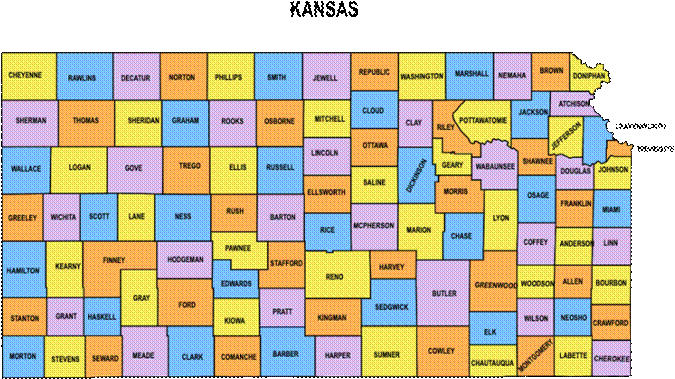
Notice how neatly the square territory is subdivided into equally neat square plots of counties. The landowning farmer this article sympathizes so heavily with exists within the context of the Jeffersonian system of land parcels, an orderly grid-like system where the principal concern is the apportionment and ordering of land-as-property rather than land-as-space.
We can consider this a symptom of the fact that farmers are settlers, just as the Boers were settlers and ‘israelis’ are settlers, who benefit from the genocide of Indigenous people and the continued expropriation of their land and their means of production. The American farmer has more in common with a zionazi settler manning a colonial outpost in occupied Palestine than they do with a downtrodden Chinese peasant suffering under the yoke of the Japanese Empire or a Russian serf brutally oppressed by the tsar.
J. Sakai details the connection between settler colonialism, whiteness and fascism in his book Settlers: the Mythology of the White Proletariat, but to recap: the settlers’ economic anxieties are rooted in downward mobility. They will do anything, and strike any bargain, to preserve what they have. This is in contrast to the lumpenproletariat and the genuine (non-labor-aristocratic) proletariat for whom authentic proletarianization would represent upward mobility and an improvement in status.
By pandering to the landowning petit-bourgeois settler farming demographic, what your organization has done in practice is to align itself with the mainstream “communist” organizations. What you are organizing is not the proletariat and its class allies, but instead the settler petit-bourgeoisie and the labor aristocracy. If you do not correct this ignorance and continue to refuse to confront settler colonialism, the end result, regardless of the intentions of your organization or membership, will be a social-fascist line.
A Note on Book Worship
Toward the end of the article, in footnote 38, the author writes “as we have seen throughout history and in to the current age, dogmatic adherence to Marxist values can often be a detriment to the overall goals of providing for the people.”
I would like to ask the author: in what universe is there an excess of adherence to Marxist “values”? Which values specifically are you speaking of? We know about book worship, the mechanical application of texts without regard for concrete conditions. But here, you adhere to a fabrication of Marx that ignores the method in favor of the conclusions. This article invokes “dogmatic adherence to Marxist values” as a mistake to be avoided with the purpose of abandoning class analysis altogether.
Chen Duxiu’s clique insisted that China must wait for a proletariat to develop because that’s what the European model described. Mao corrected this by applying Marxism — materialist analysis of concrete conditions — to the Chinese context. What KCP’s article does is book worship in a different key, distorting reality to fit into models taken from history. The article waves away the question of who produces value and who expropriates it, precisely because answering that question honestly would reveal that farmers are not the revolutionary subject the article wishes them to be.
The Marxist method would require asking basic questions about the political economy of Kansas’s agricultural sector. What are the material conditions of agricultural production in Kansas? Who performs the labor? Who owns the land and the machines? Who captures the surplus value? The answers do not favor the thesis of farmer-as-revolutionary. The article’s hedge against “dogmatic adherence” is therefore an evasion of the analysis that Marxism demands as a science.
Part II: The Migrant Laborer is the Revolutionary Subject
The Absent Protagonist
For an article about farmers, I thought that there might be some mention of the struggles of undocumented migrant workers, as well as migrant workers who have legal papers but are still subject to capitalist repression. Kansas might not be a border state, but it’s had its fair share of brutal raids by Immigration and Customs Enforcement.
I remember that when I still lived in Manhattan, Kansas, within a week of Trump taking office, the gestapo stormtroopers raided the community and hauled off dozens of people whose only crime was not having their papers in order. I don’t know exactly what these Manhattan residents did for a living, but I do know that in the US, many farm workers are undocumented. These are the people who grow our food and actually work the land.
There might be small farms owned by independent families, who have to work the land themselves, who could be drawn into an anti big-agriculture struggle. But it is also true that farmowners, big or small, employ and therefore exploit peoples’ labor. More times than not, these farmhands are part of the most vulnerable class in the US — undocumented immigrants. But the migrant laborers, who actually produce value in agricultural production, are completely absent from the analysis. This alone speaks to the settler viewpoint of the author.
The Material Conditions of Migrant Labor
Let’s apply the survival-probability framework I established earlier:
Consider the material conditions of the undocumented migrant farm worker. They own no means of production. They sell their labor under extremely precarious conditions. The state can snatch them from their homes, workplaces, and communities, and deport them to countries they might not have seen since they were a kid. Their wages are tiny because their undocumented status makes them vulnerable to coercion. The law ensures they cannot organize openly, appeal to the courts, or vote. They are less than proletarian, denied even the minimal legal recognition afforded to citizen workers. Revolution offers them the possibility of human dignity. They have nothing to lose but their chains.
What about the material conditions of farmers? The farmer fears losing their land and becoming a worker. The farmer desperately clings to their privileged position — the hope that MAGA or some other reactionary movement will preserve their petit-bourgeois status against the concentrating dynamics of capital. Compared to the migrant farm worker, the farmer has many things to lose.
This is what the article fundamentally misunderstands! When the author writes about farmers facing crushing debt and corporate consolidation, he fails to realize they are phenomena occurring within the bourgeois class, not between the bourgeois and the proletariat. The farmer being squeezed by Cargill or Monsanto is a small capitalist being squeezed by larger capitalists. Capitalism monopolizes over time, and trying to turn back the clock to a society comprised entirely of petit-bourgeoisie is definitionally reactionary.
Revolutionary Praxis
I established that migrant farm workers are revolutionary, as a class. What does their revolutionary consciousness actually look like? Unlike the Bundy rebellion, which was a reactionary defense of the right to exploit public lands and destroy ecosystems, revolutionary action by migrant workers is directed at their actual class enemies: the farmers who exploit their labor, the corporations that depress their wages, the state that terrorizes their communities.
The historical United Farm Workers, despite its later degeneration into a reformist organization, demonstrated that migrant and seasonal farm workers are capable of militant organization. More recently, strikes and work stoppages by agricultural workers during the pandemic, “essential” enough to risk their lives but not essential enough to receive protection or fair wages, show that this kind of workplace organizing is still alive. The networks of mutual aid and sanctuary that emerge in migrant communities in response to ICE raids demonstrate spontaneous forms of solidarity and resistance running ahead of the “communist” organizations.
On the Question of Tactical Engagement with Farmers
A Contradiction Worth Noting
Having established that farmers are not a revolutionary subject, and that migrant laborers are, I want to address what I think the KCP article wants to do: find some basis for engaging with farmers as an important element of the rural population, no matter how theoretically contorted.
There is a real contradiction in the situation of the landowning farmer. The farmer relies on migrant labor to work their land and harvest their crops. The state, through ICE and Border Patrol, periodically raids these communities and removes this labor force. This disrupts the farmer’s operations and cuts into their profit margins. The farmer therefore has, at least on this narrow issue, an interest that conflicts with the enforcement arm of the state.
Mao analyzed the national bourgeoisie in anti-colonial contexts. The national bourgeoisie, while still a capitalist class, had contradictions with imperialism that made them potential but unreliable allies in the anti-colonial struggle. They could be incorporated into a united front, but only under proletarian leadership and only on terms that did not compromise the fundamental class character of the movement.
However, this analogy can’t be stretched too much. The national bourgeoisie in anti-colonial contexts faced an existential threat from imperialism. Their contradiction with the imperialist powers was terminal. On the other hand, farmers can survive deportation raids. They simply face reduced profits and operational disruptions. They can hire new workers, or mechanize further, or sell their land to larger operations. Their survival as a class is not threatened by immigration enforcement.
This means any alliance with farmers is even shakier than the already shaky alliance with the national bourgeoisie that characterized New Democratic formations. The farmer’s commitment to opposing immigration enforcement extends exactly as far as it is profitable for them to do so. The moment it becomes more convenient to side with the state, so long as it preserves their land ownership, they will do so without hesitation.
The Conditions for Any Engagement
If the Kansas Communist Party (or any other Communist organization) insists on attempting engagement with landowning farmers, the following conditions are the minimum requirements for such engagement to avoid degenerating into tailism and class collaborationism:
First, the farmers’ contradiction with ICE is shallow. Farmers are a petit-bourgeois class with a narrow, temporary, self-interested reason to oppose one specific state apparatus. This must be stated openly. Tactical engagement on one specific issue does not transform the farmer into an long-term ally.
Second, any engagement must be premised on farmers providing concrete material support to migrant workers. This means: using their property to shelter migrants from ICE raids, contributing to legal defense funds, bail funds, mutual aid networks, refusing to provide information to ICE, refusing to allow ICE on their property, public advocacy, etc. Farmers must give actual useful aid.
Third, farmers cannot lead in any formation that emerges from such engagement. The migrant workers and their organizations must lead. The farmers’ role is subordinate and contingent on continued material support.
Fourth, the moment farmers begin to waver, to prioritize their property over the safety of migrant workers, the engagement ends. The farmers will betray the alliance when it becomes convenient. Plan for it in advance.
I am skeptical that even this can produce meaningful results, based on the class analysis outlined above.
Conclusion
The Kansas Communist Party’s article represents a fundamental confusion about Marxism and revolution. By misidentifying the revolutionary subject, the article veers into revisionism of the most dangerous kind, social-fascism. It is the kind of error that, if uncorrected, leads toward tailism, class collaborationism, and ultimately the evacuation of any revolutionary content from communist politics, as it has already done so within the mainstream “communist” organizations.
I have attempted to correct this error by going over basic Marxist principles, by which it’s obvious that farmers aren’t a revolutionary class. This doesn’t mean farmers aren’t useful, but the vast majority won’t be allies to any serious Communist organization. Farmers who wish to contribute to revolution have to offer material support for migrant farm workers. And even then, they’ll be short-term tactical alliances subordinate to the leadership of the revolutionary classes.
The Kansas Communist Party should immediately issue a self-criticism acknowledging the erroneous line of the original article, explain the theoretical confusion that led to this error, and rectify itself by studying the struggles of the undocumented immigrants and migrant laborers who produce the value that farmers expropriate. Investigate their conditions and their praxis. Build relationships with their organizations. Offer something real to support them in struggles they are already waging. That is where revolutionary potential actually exists, with undocumented immigrants and migrant laborers who face the full wrath of the ameriKKKan state, and who have every reason to fight for a different world.
- I use this word, “protagonist” with some hesitancy as it creates a temptation to view class struggle through moralistic lens. A protagonist drives a plot and sets things into motion but that has nothing to do with being the “good side” in a Marvel superhero comic-book-movie. ↩︎
- How do we know that the opposition was correct? We know it was correct because it succeeded in creating a revolution. The line opposed to Duxiu won. That is the evidence. Reality is the ultimate arbiter of whether or not a theory is correct. ↩︎
- It is true that Cabral was initially dismissive of the peasantry’s revolutionary potential. Cabral and the Guinea-Bissauan revolutionaries also demonstrably failed at revolution — therefore we can say on some level that although Cabral came much closer than most others, it is nonetheless true that Cabral’s analysis on some level was systematically wrong. This in no way is meant to degrade or slander the legacy of Comrade Cabral, who by all means was a committed and serious revolutionary whose works and legacy are worth engaging with. What matters is that Cabral had a thorough analysis of the peasantry’s material conditions which will offer great insight into why calling American farmers “peasants” is wrong. ↩︎
- The Dyulas and Balantes both have a peasant component, but by Cabral’s account, the peasantry composes a much greater percentage of the Dyulas than the Balantes. ↩︎

Leave a Reply