Estimated reading time: 23 minutes
An Unfair Deal
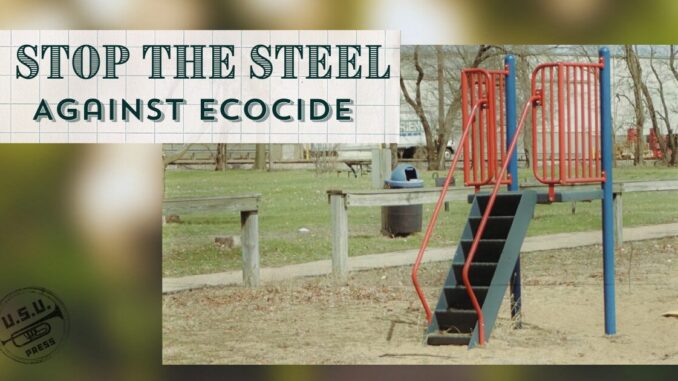
Peoria is an average, mid-sized city in central Illinois that boasts the largest park district in the state.1 Any resident of the city will tell you that these parks are used extensively for public events, by local clubs, associations, and anybody who wants to hike and/or bike through nature; all carefully maintained by an army of 144 full-time staff and around 1,400 part-time employees during the summer.2 Considering the benefit these lands bring to the public, it is no surprise that there would be public outcry when a case to facilitate the O’Brien Steel company’s purchase of part of Detweiller Playground was rushed through courts last November.3
O’Brien Jr., a trustee for the nonprofit in charge of (supposedly) maintaining the park property, is also the executive vice president of O’Brien Steel company.4 A man so principled in duty that he is selling the land to himself. It is no wonder, then, that such secrecy clouded the court case last year; the media exposure of these backdoor deals has put the company in a bind and raised citizen environmentalist opposition to the sale.
The citizen opposition to the deal, consisting of concerned local residents and activists, gets to the point: this was a shady deal done out of sight of the news media and the public. The citizen opposition makes the argument that this land is useful and good for the public, and this is true. Even on an overcast day with cool temperatures, anyone can sit at the picnic tables and observe ordinary families use the playground, take the trail, wander around the fields, or go down to the docks. Not only do humans derive enjoyment from the playground and marina, but other animals live there and enjoy the park too. The citizen opposition is correct in every sense of the word to oppose this deal.
The mysterious confluence of private for-profit and nonprofit interests we see is not exceptional to Peoria, or even to Illinois. This is how, on a fundamental level, capitalism works. And it functions excellently. It is well known that members of Congress trade in stocks in a lively manner, that hankering Wall Street investors and hedge fund managers watch Trump trade stocks to inform their own decisions, that elected politicians often end up on corporate boards after their term is up, that insiders and fraudsters of all types make bank on cryptocurrency and Polymarket gambling rings, and there are too many examples of backdoor deals that go on daily and hourly to list here.
Apologists for the free market insist that these are exceptions and surface blemishes on the ideal of capitalism. But to the contrary, we insist the only version of capitalism that exists is the one that is put into practice. People and things are not free-floating ideas in the consciousness of individuals; people and things are engaged in real situations and real relations. They must be judged from their practical results. It is only by starting from analyzing objective reality that we can discover how something works.
We must investigate: What are the practical results of capitalist society on this land? What are its peculiar characteristics?
The Settler Colony
In the so-called United States, capitalism is intertwined with settler colonialism. Capitalist development in Europe, kickstarted by the looting of overseas colonies and human trafficking, dispossessed massive amounts of peasants of their land and diminished prospects for the offspring of the artisan and merchant middle classes. Those who could not live off of the land or off their small crafts or off of trading had to go begging for jobs in workshops that expanded into factories. They made less than the money they needed to live, and when they did live, they lived in cramped, squalid conditions.
The conditions of proletarian poverty drove waves of land-hungry settlers to the “New World.” That meant rampant land speculation, the “clearing” and subjugation of the Indigenous peoples already inhabiting the land, and their reduction of numbers by genocide and the trafficking of enslaved (primarily, West African) labor to replace enslaved Indigenous labor. In North America, these processes resulted in the creation of the settler nation, glued together by the invention of “whiteness” and common experience in colonial conquest. The settler-colonial system ensures that the settler nation lives off of the exploitation of the Black nation (and other national minorities) and the remaining Indigenous nations which, starting from the New Deal onwards, have been given paper governments which primarily facilitate neocolonial resource extraction. Neocolonialism means that, despite paper promises for Indigenous sovereignty in the form of federally recognized tribal status and governments, the US government and the settler-corporations still dominate the lives of Indigenous people, politically, economically, and environmentally.
Running a settler colony is not easy: when people are oppressed so extensively, they will resist with whatever means are at hand. Within the US Empire’s borders, domestic discontent by propertyless settlers and, more crucially, by the colonized working class, had to be pacified; imperial loot was redistributed to the former and repression was enacted upon the latter. Internal conflicts of settler colonialism are, in essence, exported via imperialism, which means rape and genocide across the whole world. Imperialism lowers the cost of labor and raw materials in the Global South by force; this stolen wealth bolsters the working class wages of the US Empire. The imperialist distribution of these kickbacks itself is stratified on class and national lines predefined by settler colonialism.5 This is, fundamentally, how our society functions on a day-to-day basis. It is no question that settler colonialism and imperialism inform every granular detail of politics within the USA.6
The foundation of our entire government and our entire idea of what constitutes “private” or “public” property rests on the conquest of preexisting Indigenous nations, the enslavement of the Black nation, and the exploitation/liquidation of oppressed national minorities (like the Chinese workers who died building California’s railroads, or the Latine laborers who work in the fields and factories). The foundation of settler society is the betrayal of every single promise made to peoples deemed non-human or “uncivilized.” These are facts that will not change with a simple land acknowledgement, nor they are privileges that will go away with piecemeal reforms to make settler society “more inclusive.”7
That is to say, no matter how correct the citizen opposition is in its stance against the subversion of public interests, no matter how militant it is in the fight to preserve a public good that is used by the working and oppressed masses regardless of nationality, the citizen opposition is also limited by its own views and existence as a progressive faction of settler society itself. When it is said that this deal undermines democracy and this deal takes away a public good, we must ask, whose democracy is it? Who makes up the public?
The answer is simply the democracy of the masses of settlers and the settler public (plus, the national minorities graciously granted use of public facilities). Our democracy is a paper democracy where in theory everyone is equal before the law and in practice it is economic power which drives political power.8 Our paper democracy allows us “protest” and “freedom of speech” for the stolen “public.”9
What is the specific history of Detweiller Playground, the Detweiller lands themselves, and how does it relate to the history of the settler colony?
Thomas Detweiller’s Gracious Gift
Here is the story of how the Detweiller lands got into the hands of the public:
Let’s start with Captain Henry Detweiller, […] He was born in Larraine, France in 1825 and as a teenager found himself living here in Peoria, Illinois in 1837. He had a few jobs as a teen, but his heart and soul belonged to the Illinois River. He finally landed a job on one of the steamboats he loved so much and spent his life working on them, from deckhand to pilot to owner, becoming a local hero during the Civil War. In 1874 he finally retired from the river and went into the ice business here in Peoria, Illinois. […] Henry amassed a sizeable fortune as well as a lot of valuable land. His son and two daughters inherited all of the Captain’s assets, and set out to donate most of it to charities and the City of Peoria.
Thomas Hunter Detweiller took over his father’s business, and in consultation with his two sisters donated Detweiller Park to the Peoria Park District on July 23, 1927. The total land grant was 745 acres, and today the park board lists Detweiller Park as 601 acres. The gift later included some valuable riverside property where the old ice business once stood and an area set aside for a playground for children. Today there is a Marina within that land, and historians tell us that that was not the intended use of the Detweiller property.
The notable Illinois Riverboat Captain Henry Detweiller (d1907) had a deep love for the river, navigating riverboats up and down the Illinois. Upon retiring from navigating the river, he opened an ice business at the foot of Caroline St. The Captain was a successful businessman and accumulated wealth he left for his children. After his death, his son Thomas noticed “industry” was quickly taking over the Peoria riverfront and there was no place for the community to recreate and play along the river. As a legacy from the Detweiller family, Thomas set aside a piece of property that would belong to “the people” and be used for “public recreation and playground purposes”, in perpetuity.
Upon Thomas’ death in 1947, he gifted the land, the location of the Detweiller’s former ice works business, to the ‘People of Peoria’ through a trust—the “Detweiller Playground” (& Marina). A board of trustees and a trust fund was established in 1948 for care and maintenance of the land.
A classic American story! Henry, a young man from France, immigrates to the New World for a better life and becomes part of the working class of America. By hard work and ingenuity in running his small business he acquires land and a fortune to pass down to his son, who chooses to donate it to the public so that everyone can enjoy it.
Who were the workers who ran his ice business? From where did he acquire his land? What of the original inhabitants of the land, the civilizations that existed prior to Thomas Detweiller’s “gift”?
After the Taíno people encountered the bloodthirsty rapist Christopher Columbus in 1492, the European empires began to send colonists, soldiers, and traders who wished to make a fortune in the Americas. The nations that lived in what would become Illinois were related by the common Algonquian language family, including the Peoria People, whom the city is named for. The French gave these nations the name of the Illinois Confederation. Through germ warfare, trade, trickery, intermarriage, and divide-and-conquer tactics, the French colonizers staked out a vast claim on what would become the American Midwest and the interior of the American South. The purpose of this conquest was to secure a market for manufactured French goods in exchange for colonial raw materials, to boost nascent capitalist accumulation in Europe. This was no benign “natural market” but the seedling of imperialist domination.
This seedling would blossom fully into rampant settler colonialism with the inter-imperialist “French and Indian War,” after which the British Empire was “given” the French-claimed land in 1763 to expand their settler colonies. Decades before the land claims were transferred on paper, the nations of the Illinois Confederation already faced war and pressure from eastern nations, including the Iroquois Confederacy, who were themselves displaced by settlers. Disease and warfare from European settlers further slaughtered whole sections of the nations of the Illinois Confederacy. Although British defeats during the Seven Years’ War and the costs of garrisoning the colonies in general led to the empire restraining colonization and reserving the lands west of the Appalachian mountains for the Indigenous peoples, settlers continued to flaunt imperial law through murders and land-grabs no matter what their distant monarch said.
Two decades later, the inter-imperialist war of 1776, motivated in part by the class pressures of unlanded (and working class!) settlers seeking to breach the treaties set up by the British, would result in the independence of the US Empire. Unrestrained liberty to colonize what settlers viewed as “their” land, having already preemptively settled it in many cases with the accompanying violent means. The combination of unfettered colonization and knock-on effects from other nations facing settler aggression led to genocide waged on the Kickapoo People and other nations in Illinois, land concessions and displacement in 1819, culminating in the Indian Removal Act of 1830. The act enforced the eviction of Indigenous peoples remaining in the area, resulting in mass deportations and forced marches to reservations in Oklahoma, essentially clearing out “living space” for white settlers.
Not every single Indigenous person left. Those who were able to stay on their land often were digested into settler society as marginalized national and cultural minorities (whether recognized by the federal government or not in the form of tribal status or NGOs), benefiting later from reformist measures and carve-outs won by radical Indigenous movements. However, the bulk of their nations were removed due to the genocide, leaving the remainder a tiny minority in the territory west of the Mississippi River.
Indigenous resistance to colonialism existed at every juncture of this history in the form of guerilla warfare, espionage, and diplomacy. The pan-Indigenous alliance formed by Tecumseh and Tenskwatawa across so-called Indiana and Illinois drew in nations from north and south to militarily resist the US Empire from 1812 to 1813. The sum effect of Indigenous resistance delayed the bulk of dispossession until 1830. Continued guerilla warfare prevented settler control over swaths of territory for several more decades. The Seminole Nation, formed from the remnants of several Indigenous nations and escaped African slaves, was eventually fractured and dispossessed, but a small group in the Everglades was able to fight the US Empire until 1858.
Taking this history into account, we find that Henry Detweiller entered the scene just in time to benefit from decades of targeted ethnic cleansing and freshly opened-up lands ripe for settling and capitalist exploitation. He would have been part of the economy that serviced the masses of settler-soldiers and their garrison-towns up and down the Illinois river. His workers would have been fresh immigrants escaping European conditions, likely from Ireland or Germany, or “native-born” settlers seeking upwards mobility through land and capital ownership.
Was the land truly gifted for everyone? No, it was not, we can say. No matter how much the story is repeated over and over again, with the enshrining of yet another white man’s name on Indigenous land, the truth still lies at the bottom of the pile of settler mythology.
Why does this historical blindspot exist?
Environmentalist and conservationist organizations have historically gone hand-in-hand with unfettered colonialism and imperialism.10 How else would you secure the lands you must “preserve” other than by military conquest and garrisons? How can you imagine preserving land “unused” by humans in any other way than denying Indigenous inhabitation and subsistence on that land? Moreover, despite the promises of old conservationism to preserve natural resources for “future generations,” the liquidation of the natural world, piece by piece, is inevitable, as long as capitalism exists. As long as our entire society is ordered around the pursuit of profit, public parks and public lands will not exist in perpetuity but as banked resources to cash in when the going gets tough. The future generations are nothing compared to the present needs of unlimited expansion, which is the organizing logic of cancerous masses.
There is the root of the injustice and inequity we see before our eyes. It was not gifted to “everyone.” It was in fact taken away from its previous inhabitants, then declared to be special and set apart for the settler public to enjoy, neglected by rapacious capitalists through the instrument of the nonprofit board, and now, it is in danger of liquidation and conversion into capital, merely storage space, for the profit of a private company. From being a living thing, home to many other living things, it will be transformed into a dead space to pile on dead metal to furnish the conversion of more living things into dead things.
The Revolution Against Ecocide
Since the establishment of the first colony of the thirteen colonies that would eventually form the US Empire, the basic industries of the United States have been, in aggregate, an engine of Indigenous dispossession, Black slavery, and ecocide, the murder of the environment and the eradication of the ecosystems that make up this continent. What may happen to Detweiller Playground is yet another murder in a long spree of murders taking place all over the country, spanning more than two and a half centuries.
The citizen opposition to ecocide may succeed against capital. They may earn a stay of execution with their arguments even as the agreement hangs in limbo.11 Much like the struggle against the imposition of data center construction onto towns, which are the most egregious example of how even settler democracy does not give capital any pause, they might win.12 However, without opening the question of land and our human relationship to it as part of nature itself, without considering the aspects of class and nation, the only path of opposition to ecocide is incremental legalism, ineffectual protest, or occasionally, individual adventurism. The opposition, with their tools arising from settler-democratic norms and practices, may never need to reach for anything else for this battle. Peaceful protest and petition to the local settler government may be enough.
But capital and the profit incentive insists on growth for its own sake, like a cancerous mass, and the immune system cannot hold it back forever. The fundamental metabolic rift of capitalism is that the alienation from the land we live on, at the behest of increasing accumulation, has irreversibly disrupted ecological cycles and processes. The metabolic rift in the form of climate change manifests most severely: the earth is on track to surpass the 1.5°C average global warming benchmark as this year’s El Niño may herald even more warming in 2027 and bring more natural disasters. The imperialist genocide of the Palestinian people, fully supported, aided, and abetted by the US Empire, is an ecocide that is directly responsible for the acceleration towards climate disaster.
More than crude surgery, we need the most sophisticated forms of radiotherapy and chemotherapy to save the patient, our planet.
Our prescription is revolution. Revolution means the dismantling of the settler-bourgeois government and its privileges, the return of “public” lands and “private” property not to settler “public” ownership but to Indigenous stewardship and care. Revolution means that those who bleed and sweat every day in service to maintaining the vital functions of human society will have control over it. In short, revolution is the end of all forms of exploitation, of not only human but non-human living things, and the restoration of a relationship to the land which protects and nurtures the land, and each other as human beings. Revolution means dissembling the US Empire and the imperialist army, to give Palestine back to the Palestinians, to relinquish control over Indigenous land and make reparations to the oppressed nations of the world. Then, and only then, may the healing start at last.
“But the Indigenous people who live in Peoria are a tiny minority of the population and highly integrated into settler society,” one might say. “There is no war here to fight against settler colonialism, when the frontline is in Black Hills and Pe’ Sla is seven hundred miles away.13 How can we fight against settler colonialism in a place where it has already won?”
This is a small perspective. Peoria, like every other capitalist society, is sustained by exploited labor. The stratification of labor on national lines (Black and Latine workers, especially immigrants, face the sharpest class-national oppression) creates the conditions for the “middle class” indeed, settler society itself, to carry on as normal, while the labor of the petit-bourgeois and labor aristocratic middle classes furnishes imperialism at home and afar.14 The “middle classes” find their interests pulled both above in line with the capitalists and below in line with the lower working class; many of them become radicals from a combination of practical experience and Communist education.
Even settler workers, as a class actively bribed by both imperialism and settler colonialism, can find reasons to be dissatisfied with their current way of life. Pay attention to the numerous complaints of unsafe working conditions, abusive management practices, and racial abuse at O’Brien Steel itself! Do these workers support the expansion of their dangerous and exploitative workplace and more profits for their bosses, or are these workers the key element in stopping the deal, who can be drawn by the issues of workplace safety and disrespect from management and united with the citizen opposition to the land sale? It is Black and Latine workers here, who are forced to take the worst, most dangerous, yet the most important and critical jobs, who have the most leverage.
The settler nation, already full of fractures, must be further divided on class and gender lines.15 The settlers honest enough to see through the facade of settler society and to determine that their true interests lie in defection must be brought into the fold (by the truth and not by deceit!) of revolutionaries, and further developed into comrades and accomplices to the colonized peoples of the world. What we require to remake discontented settlers into freedom fighters is the political discipline that can only come from the Communist party with its roots in the class-national liberation struggles of the colonized working class, not a “Communist party” that represents the interests of colonizers.
If the US Empire’s early political economy was an engine fueled by Indigenous liquidation and Black exploitation, it quickly overflowed its borders to parasitize the rest of the world the moment its external fetters were loosened by the inter-imperialist war of 1776. Today the engine is one that profits handsomely from not only its internal colonies, but from international death and waste, and sustains its bourgeois class and its labor aristocratic working class on the dual pillars of the oppressed nations within the US Empire itself and the Third World peoples that global imperialism enchains. The very same machinery that drops bombs in Palestine, Lebanon, and Iran, and other “far” places is the one that is paving over the land within US borders.
To stop the engine, by any means necessary, is the highest political imperative of anyone who has continued interest in living on a habitable earth.
To the settler in opposition: motivated by your love of nature, your genuine commitment to democracy and the common good, however misled by settler society, we say that it is not too late. Commit yourself to landback, to Indigenous liberation, to decolonization and communism. Link your arms with the decolonialists and Communists and fight for their liberation. Betray your class and your nation and in doing so you will merely liberate yourself and the entire world.
- Peoria is so average that there was even a phrase coined: “Will it play in Peoria?” This refers to performing arts shows previewed in Peoria. As of 2024, the park district has 29 parks and 66 acres of parkland per 1,000 residents. ↩︎
- As of March 2026. ↩︎
- The Detweiller Playground Board was actually working on selling off part of the land as far back as April 2025, but the plan was approved by the Illinois Attorney General in November 2025. O’Brien is listed on the board as of 2024 tax filings. Of note is the amount of assets that the board owns and the yearly expenditures. If the park is dilapidated and unsuitable for use, why is it not being maintained with these funds? The playbook is clear: take a “public” good, neglect and degrade it, then use its poor condition to justify its liquidation! This is the same tactic that conservatives call “Starving the beast” whereby reducing expenditures on social services by cutting taxes, those services perform more poorly, thus justifying more cuts. ↩︎
- As of January 2025. ↩︎
- As according to statistics collected by the US government itself, Indigenous people consistently report nearly twice as much unemployment as do non-Indigenous people. This statistic worsens with Indigenous people who live on reservations, which are neglected by the US government when not seized in pursuit of resource extraction or to develop industries for the benefit of settlers and the Indigenous collaborationist bourgeois. Indigenous reservations and Black neighborhoods are also disproportionately food deserts. The key distinction between oppressed nationalities within the imperialist countries and oppressed nationalities outside of them is that the former can enlist in the imperial military and thereby benefit from imperialist rape. That ex-military members from oppressed nations in the USA are easily discarded once their usefulness runs out demonstrates that no amount of individual collaboration with the imperial armed forces is enough to save anyone. ↩︎
- See J. Sakai’s Settlers for a more or less comprehensive history of settler society. ↩︎
- The following section of Indigenous history draws upon this article as well as Roxanne Dunbar-Ortiz’s An Indigenous People’s History of the United States. ↩︎
- The Civil Rights movement, itself torn with internal factions but united on the question of Black integration into settler society, existed on the right of national liberation movements (exemplified by the American Indian Movement and the Black Panther Party) in the heyday of the 1960s and 1970s. The organizing of this era won concessions from settler society against legal segregation and public lynch terror. Nonetheless, economic and spacial segregation still exists deeply in Peoria, lynching remains a mainstay of police terror all over the country, and persists in the private sphere. ↩︎
- Working people have little free time to engage in electoral politics and oppressed nationalities are actively prevented from exercising even paper rights. The recent gutting of Section 2 of the Voting Rights Act, which used to (somewhat) prevent racial gerrymandering, will accelerate the latter trend even more. We are permitted to have “protests” in the form of liberal parades and rallies as managed by 50501 and the liberal-resistance complex. Protests that cause disruption or are escalated by the police are called riots instigated by “domestic terrorists.” Freedom of speech, especially of the kind proscribed by NSPM-7, is also on a contracting trend. ↩︎
- Theodore Roosevelt, arch-imperialist and general showboater, was also a great outdoorsman and committed conservationist. ↩︎
- As of April 25th, 2026, the issue would be revisited in mid-May, but this did not happen. ↩︎
- The rush to build data centers to resource more and more energy-intensive large-language models goes hand in hand with the monopolization of computing power and the apocalyptic Silicon Valley “General AI” ideological project. Of course, the boom in construction jobs satisfies the collaborator unions who represent the labor aristocracy and their hanger-ons. Incidentally, this represents the true face of trade-unionist consciousness held by these workers as they are unable to see past the short-term gains for their workplaces for the long-term negative effects of the increased energy and water usage of data centers and the monopolization of computing capacity under the control of a few corporations. Labor aristocracy is obviously associated with settlerism but is not a complete correlation— many degree holders imported from outside the USA become part of the labor aristocracy regardless if they are white or not. ↩︎
- As of May 4th, 2026, Indigenous youth successfully defended the Lakota sacred site Pe’ Sla from a mining company in the Black Hills region of South Dakota. ↩︎
- “Middle class” refers to the petit-bourgeois and the labor aristocracy, which in the context of the USA have porous boundaries. The petit-bourgeois are people who derive their income from owning the means of production and employing workers and usually also work themselves because of the smallness of their business. The labor aristocracy refers to the upper layer of well-paid workers who have good benefits and lead reformist trade unions and other groups which prevent the development of revolutionary working-class organizations as well as a “peripheral” labor aristocracy, a kind of unorganized reactionary flotsam whose inflated real wages and access to credit exceed the costs of living (healthcare, housing, transit, retirement, etc.) thus making their immediate interests the preservation of imperialism. ↩︎
- Simple exposure of settler workers to colonized workers in their workplace results in the subjugation of the interests of nationally oppressed workers to settler workers. Rather, there must be revolutionary, decolonial, conscious unions that aim to construct the Communist party as well as other organs which unite students, disabled people, and the unemployed population together. Gender oppression refers to both the oppression of women and to the oppression of LGBTQ+ people in general. The current exterminationist stances taken by the federal government against trans people means that, if organized properly, trans settlers will become an important asset in the fight for decolonization and for communism. ↩︎