Estimated reading time: 13 minutes
The following report was gathered from a series of interviews with student protesters in Connecticut who organized a protest and walk-out off their high-school campus. We are not disclosing the specific location of the protest or the name of the high school in order to protect identities. This goes against the wishes of the protesters, who very much wanted to share the name of their school and city. We applaud the students for their courage, and hope that this write-up properly conveys their accounts.
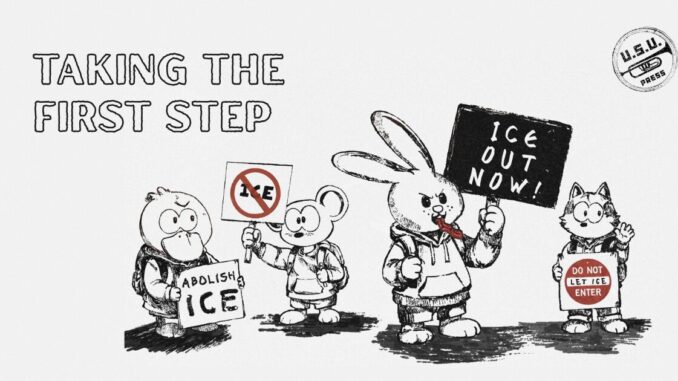
Taking The First Step
Students in the US have organized hundreds of protests in 2026 to speak out against ICE and school boards that allow agents to abduct students. Their mobilization is partly a response to the city deportation sweeps and concentration-camp detentions, not to mention the filmed killings of Minneapolis protesters Renee Good and Alex Pretti. More immediately, these sparks of mobilization come alive out of the palpable concern these students have for their “undocumented” classmates. ICE has kidnapped thousands of children, carrying them off to prison camps away from their families and any sense of enrichment. Families have described moldy, worm-filled food and undrinkable water. The trauma being inflicted against the kidnapped and separated families is unimaginable, and this is transmitted to their friends and classmates. Many radicalized students are now taking their first organizational steps and mobilizing protests against the deportation machine and their complicit schools. USU spoke to students in Connecticut who organized an “ICE OUT” protest from their campus to learn how students are organizing and what Decolonial Socialists can do to support them.
Many radicals can point to one specific world event or personal experience that permanently changed the way they see the world. For several of the Connecticut students, the killings of Renee Good and Alex Pretti marked a turning point in their consciousness.
“Seeing the murders of Renee Good and Alex Pretti was a radicalizing moment for me. It’s clear that ICE is an org that does not even care about the law at all. We have to stick together.“
Even for children growing up in an environment filled with police propaganda, subjected to constant diseducation and adult surveillance, there are moments when the star-spangled banner slips, exposing the true character of the settler police and military. Their violence is classically limited to the exploited nations: the Black nation, the Indigenous nations, Puerto Rico, and the millions of immigrants who came to Occupied North America seeking an escape from their countries even as Amerikan capital attacks them. The law as we know it today is expressly designed to oppress these national groups; not merely for the sadistic pleasure of oppression, but because it allows the white nation and its ruling class to steal more of their labor. The student protester above is correct to say ICE does not care about the law, but they should question what purpose the law serves at all in a settler colony like the US. It is clear that ICE agents are untrained, murderous cowards, but that isn’t really what makes them bad. A hypothetical ICE agency that performs the same tasks, but in a respectable and courteous manner, would still be equally reprehensible. Instead of attacking ICE for being law-breakers, we should attack them for breaking up families to sustain the regime of unequal labor that we have here.
The Protest
The protest was organized over the course of several weeks with social media and in-person conversations. A date and time was chosen and broadcasted. The generalized message of the protest: ICE OUT – Out of campus, Out of (the city), and Out of Connecticut. The students knew that their school would take steps to discourage them from walking out, but they were surprised by the Machiavellian manipulation the administration was willing to engage in. Administrators started off with the typical threats; whispers spread that students would be suspended or expelled for protesting.
“Leading up to the protest, our School Advisory Board announced that students could be suspended if they decided to protest or walk off campus. They definitely scared a lot of people away from protesting with us.”
But their real trick didn’t come until the morning of the protest. Before the first period, the school announced that a two-hour assembly would be happening that same day. They conveniently scheduled this assembly right before the student protest was set to begin. Some students weren’t sure if the protest was still happening. It was a deliberate attempt to corral all the students in the school into one location in order to mis-direct the protest towards a school-sanctioned event. The students knew what was happening, but some who planned to protest definitely got caught in the trap. One student shared their experience of avoiding the assembly police:
“It was bogus that they did that. Before the assembly started I got up and left. I tried to avoid the teachers and walked out. Then, right next to our meeting place, campus security and principals were standing. It felt like they were trying to intimidate us.”
These tactics from the school provide a great lesson for these protesters and all other students: the school will do anything to disrupt your protest if they feel like it could gain steam. They will call their own events at the time of your protest to confuse others, and intimidate you from leaving the assembly hall. They do this to co-opt your message, or destroy it entirely.
The protest itself lasted the entire rest of the day and ended after the sun went down. The students chanted on campus for around 30 minutes, then walked off. They marched down the adjacent streets toward downtown, continuing their chants and waving signs. Many drivers honked in support. One white man revved his diesel truck to blow exhaust at them.
The protesters went to city hall first to speak with representatives of the city. The protesters wanted to know if the city had a plan in case ICE showed up, what the plan was, and if the city had any information they could share.
“The city official we spoke to was very nice. They said they would create a website, prepare some Know-Your-Rights materials, and speak to their boss about releasing more information.”
This is not a plan at all. This is a promise to release information that is already publicly available, and will unfortunately not prevent ICE raids. Government officials will often use a bait-and-switch to mislead groups demanding change. A bait and switch refers to an appealing offer that sounds good, but ends up being illusory. Organizers are misled into a sense of comfort, and the sweet-talking local official ends up betraying the cause and siding with the enemy forces. For example, look to the federal government’s shuffling of ICE officials in the wake of the Minneapolis resistance. Officials get replaced, tactics are revised, but their mission does not change. ICE’s new plan for Minneapolis will still require the city to submit to DHS requirements and support more raids. And this is at the time when the city is still in a rebellious uproar. The local government might act like an ally when confronted by dozens of students, but the city would sooner collapse than disobey the ICE kidnappers.
After city hall, the protesters marched to the center of the downtown area, taking position on a roundabout with their signs. The attitude from the community was generally very positive. One driver even stopped so they could give the students larger signs they had sitting in their car. They remained there for several hours in the cold until it got dark. The students reflected on the emotions they felt that day.
“I had never gotten in trouble before, and I knew I would at least get detention. But our message was so worth standing up for that I would risk it for those more vulnerable. It was an incredible feeling to give voice to others who are too scared, and be their voice for the vulnerable.”
The school ended up giving the students two hours of detention for interrupting the school day and walking off campus. A worthwhile trade off for every student we interviewed. They were proud to receive the consequences of speaking up for immigrant families.
What Comes Next?
The school continues its attempts to divert the students’ protest into a dead end. Less than a week after the walkout, school administrators announced they would be leading their own so-called protest in support of immigrant students. Yes, you read that correctly. The same people who did everything they could to stop the original protest from happening are now giving their “support,” so long as they can control the protest’s environment and limits. The students are facing a blatant attempt at co-optation: to adopt the students’ idea or tactic for the school’s use. This is a classic tactic of counterinsurgency, which we saw deployed time and again during the 2020 June Uprisings surrounding the murder of George Floyd.
People may question, “Why is it bad that the school is leading a protest? Won’t this allow the message to spread further?”
The staff-organized protest would claim the students’ action, strip it of all its radical content, and deploy it themselves for all to participate. The first negative effect is to completely remove the outside community from the protest. The school wants to rob the protest of any visibility off campus, as this would make it look like the school is losing control of its students. Visibility also risks more residents getting involved off campus, especially if the students make connections with outside groups. A social media post of the original protest generated over 600 comments. This kind of publicity is bad for the school; they’d much prefer to keep the protest contained on campus. The students have already shown their organizing capabilities by organizing a successful event on their own despite snares from the school, which can only hold them back.
The second negative outcome of the staff-led protest will be a gross distortion of the original protest’s message. It lets the school paint themselves as allies to the students, rather than their immediate enemy. It lets the same people who would threaten and intimidate students act as if they are on the same side, resisting against the Bad Guys in the federal government. The students’ protest sought to agitate against a complicit school administration and city government. The adult-led protest will be a performance, re-enacting the student-protest with a non-confrontational spin.
What Can be Sustained?
Bonds between students and the community
The students were correct to take their protest downtown rather than stay on campus. Many people in the city certainly heard of the protest and the committed attitude of the students. The next step is to follow up on this initiative by solidifying ties with friendly groups in the community. Immigrant organizations and progressive churches are one place to start.
Bonds with other students
Campus will remain a good place to organize as long as the school does not take any extraordinarily repressive measures. Flyers, speeches, and targeted conversations are some tools students can use. Ultimately, the students are in the best place to understand what works and what doesn’t work on campus. They should “cross the river by feeling for the stones” — take one step and look around before taking another. Don’t be afraid to experiment, fail, and get even better.
Organized Structures
As summer approaches, the students will lose the daily connection that going to school five days a week provides. To make up for this, and to take their organizing to the next level, the students could double down and create a firm structure through which to carry out any work they decide to take on. This would involve defined roles, basic rules, and regular meetings. For more guidance, we recommend Tend the Garden, What is Organizing, and The Study Group.
Political Education
Most of what we learn in school is either a half-baked truth or an outright lie. In order to unlearn their myths and stand with all oppressed peoples, we need to develop an internationalist consciousness. This kind of thinking ties our organizing to the billions of people living under the shadow of Amerikan domination; it does not come naturally to people living in the US. Anyone who disagrees probably hasn’t studied the material conditions closely enough. Development requires us to actively study political texts from a wide net and share our findings with others, like in a reading group. This is a form of collective learning; it is the mirror opposite of the top-down instruction students receive in school. Internationalism is, of course, already at the center of what the protesters are doing. They are standing up for students made to feel vulnerable by the state. Political development will be absolutely essential for avoiding the many traps that catch organizers seeking to change the world.
We leave you with the conclusion from a student’s speech on that cold afternoon:
“You just need to take one step; people are always saying that, ‘I’m just one person, I alone can’t make a change,’ but if we ever found out we all think the same way just think of the endless possibilities of what we could do. In writing this I am taking the first step for all of us. So now I will say: stay out of our schools, stay out of our communities, and stay out of our states.”