
Estimated reading time: 35 minutes
Statement from the editors: We urge everyone reading this report to treat these lessons with the highest priority. The genocide against Palestine continues, the war against Venezuela escalates, and we must learn the lessons of our failures of both and rid the anti-imperialist movement of the tyranny of structurelessness once and for all.
On April 15, 2024, a series of coordinated but autonomous actions were conducted across the globe with the goal of disrupting the genocidal war machine propping up the zionist entity’s genocide in Gaza. The tactic of choice was economic blockade. Initially concentrated within the so-called United States, organizers hoped to have enough of an economic impact to force the imperial superpower to rescind its unconditional support of its colonial outpost. As word spread between organizers and activists internationally, the scope expanded to include a number of actions in other imperialist and settler countries. While the hope of forcing imperial powers to stop their support for genocide ultimately failed to materialize, there are a number of lessons to be drawn from this moment of decisive and principled escalation. We hope to highlight these lessons so that future actions may build upon them.
At the core of A15 was a dialectical navigation between national and local organizing levels. Organizers understood the necessity of collective action to effect meaningful change, and with this understanding started an ambitious project in the pursuit of a free Palestine. Recognizing the necessity for actions to be tailored to the material conditions of the regions in which they were occurring, organizers established a strategy of regionally-bound autonomous actions to facilitate collective national (then international) action. This resulted in an implicit national-local organizing structure lacking strong centralization, but which ensured action did happen.
It worked like this: national-level organizers spread the word of their intention to facilitate a nation-wide economic blockade. Organizers and activists from all over the so-called U.S. were invited to an initial online “All Cities” meeting where the idea was more thoroughly fleshed out: autonomous actions would be regionally organized against the largest, most influential, local economic target. The target didn’t have to be explicitly tied to the zionist entity and its genocidal pursuits, since the U.S. Empire’s war machine is ultimately powered by the entirety of the imperialist economy. The idea was to “stop pulling the levers of the machine,” even if only for a day, in the hopes of frightening the parasitic class facilitating genocidal violence. Actions were coordinated to occur symbolically on April 15th, tax day, in acknowledgment of the role U.S. tax dollars play in carrying out the genocide.
Several cities dropped out during the short period allotted for planning, but when April 15th arrived, dozens of cities around the world (including Melbourne, Dublin, London, and Toronto to name a few) saw blockades temporarily stop the flow of capital, or rallies, marches, and walkouts in solidarity with blockades. Participating groups took a variety of strategic approaches with different types of targets, but physical blockades emerged as a common strategy. Many arrests were made, and at time of writing, some legal battles are still being fought as a result of the A15 actions. For the purposes of this analysis, we will be focusing on national level organizing and the blockade of the SeaTac airport which was organized and executed in the Puget Sound. We invite those familiar with other actions to consider contributing their own regional analysis.
The ambitious scale and scope of A15 was admirable, and in some ways a wild success. Dozens of autonomous blockades were coordinated around the world, the significance of which cannot be overstated given the difficulties and barriers of mobilizing even one large group in one city. The size and spread of the mobilization garnered widespread mass media attention and, despite the undefined parameters, successfully centered economic impact as the primary strategy. At the same time as we celebrate the successes of A15, we feel it necessary to analyze its failures.
Critique is a necessary part of continuously improving our strategic orientation and tactical approach in order to learn and adapt in the pursuit of liberation. Through an analysis of available evidence, we’ll articulate both the successes and shortcomings of A15. Ultimately A15 proved the will of organizers and activists to escalate in their effort to shut it down for Palestine. Successes were shaped and limited by a number of strategic oversights and shortcomings, such as an extremely limited timeline for planning and execution. A number of social, cultural, and interpersonal barriers also emerged, including communication pitfalls, aversion to conflict and critique, and most prominently, the myriad troubles that emerge from a lack of coherent and mutually agreed upon structure. While A15 demonstrated the willpower and capacity of people to come together for wide-spread and coordinated collective action to stop a genocide, it also demonstrated prominent barriers the imperial core’s “Left” must directly address and overcome in order to effectively strike the beast from within its own belly.
Communication is Key
The A15 actions can claim a number of successes. At the national and international levels, organizers tapped existing connections to establish a broader communication network and coordinate collective action. Given the scale and number of actions, A15 quickly gained widespread media attention, presenting organizers an opportunity to make their actions double as propaganda. The communication network allowed organizers to coordinate support, resources, and messaging to the public. Here in the Puget Sound, local successes were due to existing affinity groups and informal activist communities. Their existing connections with one another and experience in mobilizing for previous movements supported quick mobilization. Ultimately, the execution of a collective action on such a scale proved its efficacy in terms of uniting a movement and proves the capacity for future actions.
An International Solidarity Network
One of the key factors in A15’s success at the national and international level was the establishment of an international communication network to coordinate collective action. National organizers had stated an intention to maintain the A15 network for the purposes of facilitating similar direct actions in the future. While this intention hasn’t manifested in the wake of the action, the network’s use leading up to and during the action contributed to the overall success of A15. Additionally, because of how widespread the A15 Actions were, organizers were able to garner substantial mass media attention, if only for a short time. The principal success of the A15 Actions at this level, however, was in demonstrating the strength of collective action and international solidarity, highlighting the strategic necessity of building these kinds of connections and strengthening our ability to do so.
Organizers were able to effectively collaborate and coordinate on a global scale because of the existing connections that organizers and activists built during previous mass movements, such as the George Floyd Uprisings. Information about the initial “All Cities” meeting was disseminated to different organizations and individuals in cities across the country, and eventually around the world. At this initial meeting individuals from the same city were able to connect with one another to build regional organizing teams which would then take the lead on planning an economic blockade tailored to their region’s material conditions. Communication networks that balance centralized coordination with regional autonomy enable organizers to collaborate and act collectively across regional boundaries, but the finer details must be determined at a local level to ensure the efficacy and relevancy of the action and its impact on the locale.
Routine national meetings ensured organizers across the world clearly understood the goals of A15 and dispersed ideas for what actions might look like, as well as a generalized understanding of the legal needs of direct actions, such as legal observers, bail funds, and other legal support. These meetings served to fortify the collective element of the action. During meetings some groups were connected to necessary legal resources (or given information on how to do so), and those with less organizing experience were able to connect with more experienced peers to facilitate knowledge and resource sharing. The A15 network was always intended to be a hub of support and solidarity and this was most evident in the early days of organizing.
At the time of this writing, the surviving A15 network exists in the form of an “All Cities” group chat. Members share updates about ongoing campaigns related to Palestine (such as one group’s project to bring potable water into Gaza) along with ways to support those campaigns and requests to connect with organizers in different cities or nations. For quite a while the chat appeared dead, but it came back to life on the night the Freedom Flotilla seeking to bring aid into Gaza was targeted by a zionist drone strike (the first of multiple such attacks) with detailed emergency calls to action being shared. Similar calls have since been shared. At one point, there seemed to be an effort to coordinate another mass economic blockade which failed to take off with the same gusto as the original A15 plan, with only a few responding to the initial proposal and discussion dying off rather quickly. To our knowledge, no action manifested from this, though the particulars of why this might have been remain unclear.
Just as important as internal organizing communications are external communications. Direct actions such as these pose a powerful opportunity to communicate to the world at large about our causes. Organizers should be adequately prepared to utilize captured media attention to this end, with materials designed to educate and agitate, not simply to spread awareness. It is therefore important to think about highly visible actions in terms of propaganda. As communists, our goal is to lead the masses in a revolution; such leadership requires trust that our actions are for their betterment. This is not to say that we should obsess over the optics of our actions, especially characterized by bourgeois media. Rather, consideration should be given to reaching the masses through an antagonistic media apparatus. Messaging should make our intentions clear in order to support raising bystander consciousness, cultivating understanding, and instilling revolutionary optimism. Creating a plan to interface with the public through media is critical to maintaining a level of trust with an organization and swaying other workers.
As a result of this national and international collaboration and solidarity, groups acting autonomously across the world executed dozens of direct actions despite short notice. This international coordination for Palestinian liberation was a potent indicator of what is possible through intentional, focused collaboration and unwavering solidarity. This was by and large only possible as a result of a communication network linking organizers together. Solidarity is our strength; we can’t build a new and just world alone.
The Strength of People Power
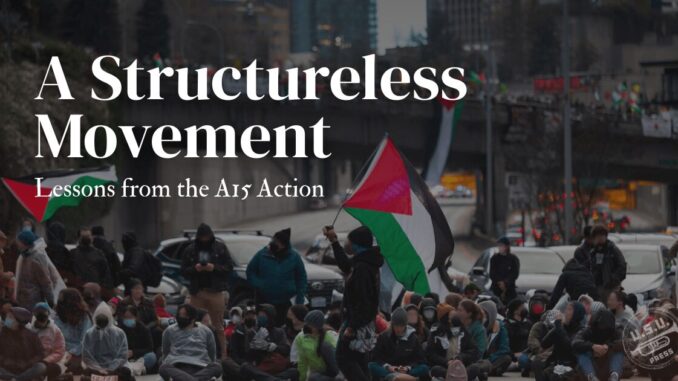
In the Puget Sound, major successes revolved around tapping established communities to quickly and effectively mobilize a significant number of participants. On very short notice, organizers were able to pull together an airport blockade that shut down traffic into the airport for around five hours with no injuries and no confirmed security leaks.
For this action, organizers cultivated maps of the target area to survey and select an ideal choke point. Later, reconnaissance was conducted to establish a more thorough understanding of the area, identify staging locations, and plan for action execution. Organizers tapped pre-existing affinity groups and reached out to some additional Palestine-focused organizations to rally forty-six people to participate.
Accounts of the action indicate that a car may have been used to create an initial stoppage in traffic, with organizers feigning that the car had stalled to create cover for deployment of the blockade. Protesters “locked in” at the site using the sleeping dragon tactic: they chained themselves together with their arms threaded through PVC pipes to ensure responding police couldn’t simply cut the chains. This lengthened the duration of the blockade and increased the resources required to remove the protesters from the site.
Operational security practices were implemented at a heightened level, with a keen awareness of the risk of leaks and potential impacts thereof. Encrypted Signal chats with disappearing messages were used for some communication early on, and a pivot was made to all in-person communication due to concerns about the spy-ware nature of much of modern communications technology.
The successes of the SeaTac airport A15 blockade were largely due to the numbers available to organizers. Not all actions will have as many organizers or participants available, nor do all actions require such numbers. The key take-away here is that actions must be scaled to the real capacity of the moment. This fact also works in tandem with the level of centralized organization required for particular actions. How many people do we need to be successful in a particular time frame? How centralized does the planning need to be to achieve its goals? What level of operational security is required to protect organizers and participants? Setting achievable goals allows for sustainable and consistent work and victories. As Mao teaches us in On Guerrilla Warfare, we must only engage in battles in which we are guaranteed victory.
Informal Structures and Movement Security
There were many lessons learned not only from the successes of A15 actions, but also from some critical failures in the planning phases that luckily did not result in worst-case scenarios. Excruciatingly short timelines bred a number of issues at the national level, from poorly considered media strategy to inability to fulfill promises and achieve unspecific, difficult to measure goals. On the local level in the Puget Sound, a complete lack of structure facilitated interpersonal breakdowns which posed a number tactical and strategic barriers. In consideration of these oversights and critical failures, there were many areas for improvement we can learn from. The most powerful lessons learned center on the necessity of giving ourselves time to develop effective strategies, be intentional in choosing targets and tactics, and more.
Communication is a Practice
At the national and international level, many identified shortcomings stemmed from the short timeline for planning and executing a national, then international, economic blockade. There was a little less than two months’ notice that there would be an “All Cities” meeting outlining the idea and intention behind a forthcoming national economic blockade against the United States — The Empire. Paired with the time needed to plan and host these initial meetings, this left organizers at the international, national, and local level with about a month and a half to identify targets, gather intel, set goals, plan, and execute.
On Urgency
The short time allotted for organizing these actions undermined the potential of a wide-spread and well-coordinated economic blockade in a number of ways. There is an undeniable urgency when people are being murdered en masse, but the way that urgency was treated in this case reflects a common tendency of organizers within the imperial core to treat the fight for liberation as a sprint rather than the marathon it is. Urgency requires not just timely action, but effective action. The minimal time allotted to plan and execute these actions had multiple impacts. Limited time to recruit participants meant many actions were quite small and therefore limited in what they were able to do. The pressure to pull together actions quickly meant that some organizers weren’t able to pull any action together at all, resulting in a number of cities dropping out altogether when they realized the severity of this limitation. Limited time to do recon and establish contingency plans also meant that riskier targets with larger potential impacts were off-limits for many. Finally, there were a number of actions which were sloppy and ineffective, not because the organizers themselves were sloppy or ineffective, but simply because they didn’t have the time to coordinate something better. The key takeaway from this is that we must be honest about and take seriously the time needed to effectively set our goals, plan for them, and accomplish them. Failure to do this undermines our efforts and betrays the people we are fighting for.
On Logistics
National organizers had offered in All Cities meetings to provide local organizers with support in accessing or connecting with resources including bail funds and legal support. Although never explicitly mentioned, offers of mentorship were implied. While some areas were able to receive support and guidance from the national level organizers, others in need of similar support were left with little or none. Many actions were able to coordinate their own support with the help of experienced organizers on their teams, but for others, the inability to access rigorous legal support was a deterrent to planning higher risk actions with more potential for greater impact. While the autonomous method of organizing was successful overall in this instance, more time and resources could have improved centralized organization and increased support and guidance from national level organizers. This would have supported better developed and more effective actions.
Furthermore, the economic impact of the blockades was much smaller than organizers had intended, and as a result, these actions were not successful in applying economic pressure great enough to threaten the Butchers of Gaza or their enablers. The idea of not limiting targets only to businesses directly participating in the slaughter of Gaza was simple, straight forward, and well intentioned. However, without greater numbers (both of actions and of participants) this spread the movement thin and diluted the message being sent. More time to plan and coordinate between cities would have enabled more robust, targeted actions, and as such, would have produced a greater economic impact. Consider the effect of multiple cities coming together to target their state’s largest weapons manufacturer rather than staying focused on unrelated industries in their own cities, for example.
On Propaganda
A banner reading “Our Taxes Are Funding Genocide” was displayed alongside Palestinian flags at the SeaTac airport blockade, highlighting the significance of tax day for the action and reminding onlookers of the way in which the United States government makes its citizens complicit. There was little planning or strategy for communicating to the media or the masses beyond this, however. Unfortunately, the opportunity to also highlight the ways in which the imperial core’s whole economy supports genocidal colonial and imperial violence, the intricacies of which aren’t easily recognizable or intuitively understood by the majority, was missed. In cases where targets aren’t explicitly related to the genocide in the same way a target like Boeing or Microsoft might be, it’s important to consider how to communicate these complex economic relationships in a way that is concise and accessible to your average working person.
Though there was mass media attention to the A15 actions, it was short lived and confused. Reporters identified that these blockades were coordinated and therefore connected, but at the outset not all reporting outlets seemed to understand that these were actions for a free Palestine (though eventually this was reported more confidently). This confusion spread to non-mainstream commentators as well, including supporters of a free Palestine, whose confusion or misunderstanding of the actions at times led to reporting and analysis that was frustrated and failed to recognize successes. Many actions lacked banners, signs, or other means of clearly communicating the causes and intended effects of the actions, leading to confusion rather than clarification. Ultimately these actions largely failed to utilize the opportunity for effective propaganda.
On Organization
This high intensity, unbalanced planning is a consistent habit of the imperial core’s “Left.” This strategy of reacting rather than acting leads to intense burnout among organizers and difficulties sustaining long-term activity. Paired with rumors of conflict and infighting among the national level organizers, it’s unsurprising that the communications network has declined to the degree it has. This all gestures to the problem of structurelessness that followed A15 from the beginning: with no clear roles, guidelines or expectations on conduct, and no system for accountability, the A15 movement inevitably became a one-off moment with minimal continuing impact or legacy.
Though the international network that was meant to be established through the course of this action technically still exists, its current form is a far cry from what organizers originally set out to build: a space for continued national and international collaboration for increasing escalation in the pursuit of a free Palestine. Some of this collapse reflects a general need in leftist spaces in Occupied North America to build conflict resolution skills, increase distress tolerance, and implement effective methods for addressing harm. It also demonstrates the importance of understanding and identifying roles, and formulating a clearly understood and articulated structure to support adherence to expectations around conduct, facilitate conflict resolution, and effectively make and execute plans. Unfortunately, these issues of interpersonal and structural development have been repeatedly observed as serious barriers to building or implementing successful strategy, let alone building a successful revolutionary movement in the so-called United States.
On Structure
The issue of structurelessness appeared at the national level as rumors of conflict and infighting, but was well and truly on display at the local level. Without a clearly defined structure for organizers and action participants to operate within, one member was able to flood the Puget Sound organizing committee with their previously existing Affinity Group (AG). This ultimately led to the abandonment of all democratic processes and the de facto establishment of an in- and an out-group. The seizure of power by this AG led to a litany of safety and security concerns for organizers, participants, and the general public, ultimately resulting in an insignificant economic impact despite being publicly celebrated as a resounding success. Many of the issues discussed here are a result not necessarily of bad strategy, but of structurelessness. In essence, the failings of the Puget Sound A15 action is a case study validating Freeman’s thesis: the absence of a formal democratic structure only invites an informal reactionary one.
Once the original planning committee was flooded by the AG and a de facto leader emerged, an implicit social hierarchy quickly followed. While there was no intentionally defined structure, that does not mean an absence of structure. Rather, what formed in the absence of openly discussed and agreed upon structure was an unspoken but recognizable in- and out-group dynamic with deference to the implicit leader, who was then able to assume control over planning. This resulted in the discarding of the democratic process in order to focus on the preferred target of the unspoken leader, as well as select participants enjoying the privilege of having their ideas, concerns, and suggestions regarded seriously. The original lack of structural development appears to have arisen out of organizer naivety, and many of these original organizers withdrew from the project or were pushed out by the toxic dynamics that emerged in place of well-considered structure.
Citing security concerns, the group pivoted to in-person communications only, including daily meetings and sometimes multiple daily meetings with no plan (or apparent intention) to communicate with participants unable to attend. As a result, a culture of exclusion emerged. Working individuals, individuals with disabilities, and individuals with care-taking duties were effectively barred from participation. This strongly favored members of the aforementioned in-group, with some members of the out-group not being alerted to in-person meetings due to text communications being almost entirely abandoned. As such, many individuals who were not members of the in-group were pushed out of planning altogether. In essence, heightened security culture practices became an implicit enforcement of in-group/out-group dynamics and functioned to assure in-group dominance in the organizing process. Poor communication also resulted in numerous people appearing to be on completely different pages about how to handle the issue of independent press on the scene, leading to questions of what else people weren’t on the same page about. When participants voiced concerns about inaccessibility and exclusivity, they were roundly ignored, and no effort was made to find a resolution, increase accommodation, or improve communication. There was no follow-up with the individuals leveraging these critiques after they left the group.
Structurelessness also resulted in inadequate responses to safety concerns. One stark example of this was the handling of concerns about the potential for vehicular violence. When a member of the out-group raised this safety concern, it was brushed off as a matter of privilege. Later, a member of the in-group raised the same concern and was praised for doing so (though it is not clear that this concern was addressed in any practical way). Not only did such incidents reaffirm the in-group/out-group dynamic, it highlighted a lack of regard for participant safety or sustainability in the movement for Palestinian liberation overall. Beyond the tactical value of striving for safety, this example also highlights the fundamental strategic oversight of valuing high-risk adventurism over actions designed with safety and efficacy in mind: quickly burning through the risk tolerance of participants runs the risk of ultimately reducing our own numbers in the name of a spectacle, fundamentally weakening our position in future actions.
Many of these shortcomings would have been avoided with explicit communications about roles, expectations, decision making processes, and issues of accountability. Explicit communication would have supported more intentional collaboration, more effective adaptation in the face of critique, and could have avoided pushing people out, increasing the number of on-the-ground participants.
As previously noted, a greater allotment of planning time would have likely yielded a more robustly designed action capable of achieving greater success — this too was directly impacted by structurelessness. Already working on a tight timeline, a democratically selected target was rejected during an in-person meeting where only a fraction of participants were present. The time and effort spent on the original target had to be scrapped and restarted for the new target, leaving organizers with just weeks to plan.
Rallying forty-six people to join an action like this is a feat on its own, but the action would have been even larger with more time to recruit. More time would have allowed organizers to connect with local orgs and build better working relationships. With more time organizers could have also expanded their network rather than solely relying on existing affinity groups, increasing access to support, resources, and recruitment. There would have been more time to establish contingency plans in case something went wrong, and more time to work on additional materials to support the barricade or create clear and effective messaging.
It’s also worth noting that the Seattle Police Department developed an Apparatus Removal Team specifically to deal with sleeping dragons, making them uniquely capable of dealing with this tactic quickly and efficiently. This highlights the necessity of knowing our enemy. If this particular method must be employed in the Seattle area, utilizing a more effective variation is preferable. Styles of sleeping dragon which utilize barrels filled with cement through which the PVC pipes and chains are threaded, creating additional barriers to removal, have been used elsewhere and could serve as inspiration for out-maneuvering the Apparatus Removal Team. Researching SPD capabilities, getting materials, building these more robust sleeping dragons, and establishing and practicing methods for transporting and deploying them quickly and efficiently would have been viable with more planning time. This could have greatly increased the amount of time required for responding police to remove the protesters, increasing overall economic impact. Imagine if there had been time to plan for deployment of such a tactic with sixty, seventy, or even eighty participants.
The ultimate financial impact of the action was estimated to be in the low hundreds of thousand of dollars. To us working people this is a lot of money, but for the corporate ghouls being targeted it is barely even pocket change. It is significantly less than what was hoped for, yet it was celebrated as a resounding success, echoing concerns such as the false victory claimed at the earlier Block the Boat action. These concerns indicate two main areas for growth: 1) the ways in which goals are established, and 2) the ways in which we evaluate success.
Too often we’ve seen actions designed without clearly articulated goals in mind, or alternatively, with unrealistic goals. Setting clear and concise goals not only supports organizers in designing and executing an effective action, it provides a metric against which success can be measured. In the case of the Puget Sound A15 action, the goal was simply to “have a financial impact.” The fact that as little as a $100k impact could be called a success highlights how vague the goal actually is; despite discussion of the financial impact organizers hoped to achieve, specific numbers were never mentioned. This was a significant strategic weakness in the action design and planning. Without a specific and measurable goal, it wasn’t possible for organizers to calculate how long a blockade would have needed to be held. As a result, organizers did not design the blockade according to any specific length of time intended to meet a realistic goal. Furthermore, organizers must have a truly honest assessment of their successes and failures — victories should not be inflated and failures should not be minimized. To do so would be avoiding criticism and self-criticism, which is an integral part of successful revolutionary organizing. Refusing to engage in this process of (self) criticism, we lose the ability to facilitate learning, growth, and greater future adaptability and success. If we are to be serious about the cause of liberation for Palestine and all peoples, we must be serious about how we engage with critique.
Many of the issues discussed in this section would have been minimized had organizers established even a loose sense of structure, with identified roles and responsibility, decision-making processes, and systems for accountability. This is largely an issue of naivete on the parts of different organizers, but the constraints of an extraordinarily short timeline certainly didn’t help. Organizations require structure in order to effectively achieve their goals, and democratic processes must be core to the pursuit of equitable and just interpersonal dynamics within an organizing group. Organizers must maintain clear and effective communication to ensure that people understand what is expected of them and what they should expect from the organization. Organizers must also ensure that no one gets left behind. Security culture should be practiced in dialectical balance with consideration to accessibility needs of the people who make up the masses, most especially those with jobs, disabilities, caretaking duties, etc. Barring this, an action will never become a movement, and will instead become a quickly forgotten historical blip.
It is vital to note that all of these issues aren’t only a barrier to creating a successful action or movement, they are a barrier to developing effective strategy at all. Without an effective strategic outlook or orientation, getting something as ambitious as A15 off the ground and meaningfully achieving goals is next to impossible — as we have unfortunately seen in the aftermath of the day of action.
Building Movement Resiliency
The metrics for success and failure regarding the day of action were ill defined, but ultimately we understand that the broader goal was to mobilize in support of a free Palestine; in that regard, the A15 actions succeeded. The failures and shortcomings of the A15 movement lie not in the mobilization, but rather in the organization. Throughout much of her work, Jane McAlevey details the distinction between the two (see No Shortcuts), but to put it succinctly, Kwame Ture teaches us that “mobilization [is] temporary. Organization is permanent and eternal.” A15 was able to mobilize, but it was not able to organize. Without a clearly defined and democratic structure — both of which are equally essential to the health, longevity, and power of an organization — we are doomed to repeat the same mistakes ad infinitum.
The reason we see so much turnover and burn out among our organizers is not from an inability to mobilize, but a critical failure in establishing and maintaining organization. This is why we continue to see these outbursts of activism (e.g., Battle of Seattle, Occupy Wallstreet, George Floyd Uprisings, etc.), but not a sustained movement that will lead to revolutionary change. To remedy this, we must learn these important lessons and move forward to build stronger organizations that are capable of winning while withstanding repression.
In light of the lessons learned from this study, both in terms of successes and failures, we propose the development of regionally-bound organizations to facilitate the development of militant cadres capable of rapidly and effectively responding to and leading mass movements. While organizers in this case were able to get the word out to various cities, there have been countless other such attempts which have either fallen far short of their goals or failed entirely. The success of such future endeavors cannot be left to chance. These new organizations — free from the capitulationist, revisionist, and dogmatic tendencies of our movement’s leading organizations — could facilitate such communications, disseminating empire-wide calls to action in a more secure way than posting to social media, and structuring a response in collaboration with local coalitions and other ideologically- or issue-focused organizations. Beyond simply acting as a means to mobilize, putting time and effort into such development will lead our movements toward permanent organizational structures that can be adapted to the needs of the moment, helping to avoid the pitfalls of structurelessness observed in this study. These organizations will need to develop themselves based on their local conditions: organizational needs, barriers, available resources, class composition, geographic context, as well as a continually updated understanding of friends and enemies in the area. Such development will improve our overall strategic position, facilitate ease of collaboration within and across regional boundaries, and bring us closer to the permanent revolutionary organization we need.
It is evident, now more than ever, that we need our Party — the Communist Party that will lead our revolution and the liberation of this continent from colonial occupation and the world from imperialism. But as we are now still disjointed, uncoordinated, and disorganized, we must build the structures necessary to allow for its formation. This is possible only through developing our local means and capabilities, thus elevating class consciousness and proving we are deserving of leadership. Furthermore, principled organizations must coalesce into Intermediate organizations — an organization of organizations. This is the embryo of our new, revolutionary party. But what is the Party, what does it do, and what does it look like?
The Party is the organized, conscious, and revolutionary vanguard of the working class — an essential instrument for the proletariat to seize and maintain power. Unlike our movement’s current leading organizations, who are unfit for revolutionary struggle, our new Party — a Leninist Party — will emerge as a militant, disciplined force prepared for revolutionary conditions. It is the most advanced organization of the working class, composed of its most devoted and politically conscious members. The Party leads, educates, and unites the working masses, serving as their leaders in the class struggle. It embodies revolutionary theory and action, guiding the proletariat beyond trade-unionism and reformism toward the overthrow of imperialism and the establishment of the dictatorship of the proletariat.
The Party is a tightly structured, disciplined organization with clearly defined and understood roles, centralized leadership, and structure that efficiently supports party work, mobilization, and both systemic and interpersonal conflict resolution. An ability to withstand internal struggle toward a unity of will is vital, with discipline toward minority compromise with majority will in the pursuit of much needed revolution. To support this, time and effort must be directed toward building robust, resilient communication networks, networks structured in consideration of striking balance between centralized coordination and regionally-bound material resources, needs, and autonomy. It is not a loose collection of sympathizers but a coordinated system of organizations bound by the principles of democratic centralism, adapting to shifting material conditions, and effectively coordinating collective action across regional boundaries. The Party functions as the highest form of class organization, uniting and leading all other proletarian institutions — trade unions, cooperatives, mutual aid networks, and more — under a single revolutionary direction. The work of the Party entails guiding the proletariat to power, consolidating socialist rule, and maintaining discipline by filtering out opportunist and reformist elements and investing the political education and development of its members and their associated communities. In short, the Party is both the mind and the will of the proletarian revolution: the organized force through which the working class acts as one to destroy the old order and build socialism.
We are not utopians, we are scientific socialists. Every action we take serves to better inform our practice. All self-conscious struggle brings us closer to fulfilling our historic task in overthrowing the imperialists. To end the tyranny of capital, we must first end the tyranny of structurelessness.

Leave a Reply