Estimated reading time: 15 minutes
There are numerous incorrect theories of revolutionary organizing that pervade the Communist milieux (we hesitate to call it a movement due to its extreme incoherence) in the US-Canadian bloc. The labor movement has been exhausted of its revolutionary potential, in most instances actually serving as a buttress for reaction and a pillar of imperialism, but because our Communists are mechanical in their application of historical materialism (often in the service of opportunism), they focus on recreating the precise tactics of past revolutionaries rather than drawing lessons from revolutionary history and applying them creatively. Thus, we have everything from blind political opportunism justified by misreading Lenin’s Left Wing Communism, to the incomprehensible “proletarian fusion” and direct entry into economic struggle that is the foundation both for the FRSO’s misguided strategy and that of the Gonzaloite fragments of the shattered Maoist Study Group.
The labor union, prior to the entry of the US-bloc into the capitalist-imperialist competition at the end of the 18th and beginning of the 19th centuries, served as the “school” of collective worker action in Europe. It was never so in the US, because the US capitalists simply sent restive workers westward to conduct the continental equivalent of European imperialism but amongst Indigenous peoples. The early 19th century unions were illegal, confrontational, and engaged in direct battle with the bourgeoisie and their capitalist states. Although the western countries reeled from this conflict, they were able to manage the contradiction by doling out the rewards of imperialist exploitation. In Europe this manifested as social democracy; in the US, it took the form of Indigenous genocide and the internal Black colony. By the beginning of the 20th century, it was increasingly in the form of the creation of a “white” (Euro-Amerikan, as opposed to the earlier Anglo-Protestant) national project.
By this time, labor unions had become instruments, not of working class power, but of labor discipline. Unions were legalized and given a stake and a share in the US imperialist project. In this way, the unions were “housebroken” and the mass of the labor aristocracy was broadened just as the frontiers were closed and entry into the petty bourgeois homesteader class was restricted. Failure to recognize this fact (which is obvious to anyone who bothers to investigate for even a moment; see, for instance, the rates of equity held by US workers in real property — the average home equity held in the US is $300,000 — has driven many would-be Communists directly into the arms of reaction.
But what were the features of the labor union that made it a school of communism?
- Workers were organized and developed experience organizing and running meetings, coming to collective decisions, and exerting power.
- Collective grievances were compared and conclusions could be collectively drawn as to their source — the contradiction between workers and owners.
- It was a venue through which the advanced elements and conscious Communist could draw intermediate elements and develop their class consciousness by propagandizing, not only the abstract, but around specific conditions affecting those particular workers.
- It was directly antagonistic to the continued existence of the bourgeoisie and their state, at least until it was captured.
Present-day labor unions do not possess any of these features. Meetings are pro forma affairs, ill attended, and run by bureaucrats. The unions themselves are managed by professional union hustlers whose job security depends on their capacity to (1) deliver beneficial contracts, (2) come to an agreement with management, and (3) not break any laws, like the ones making it illegal to advocate for revolutionary consciousness or suggest a strike unless the union contract is up.
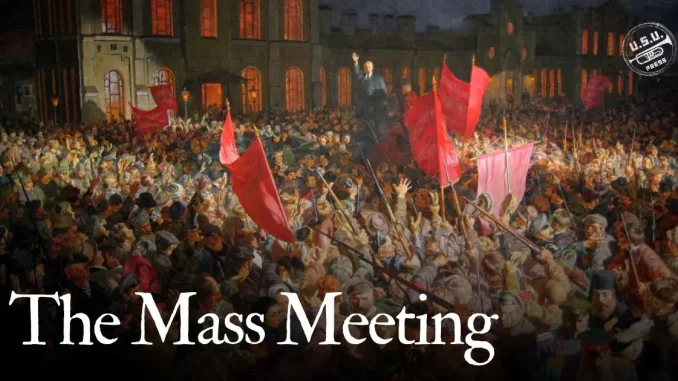
There is, however, an organ of working class power that possesses these features: the Communist-led mass meeting.
What is a Mass Meeting?
A mass meeting is a gathering of people in one place where they are led by the meeting’s organizers to debate and decide on issues that affect them. The character of the meeting will be determined by, in the first instance, the class character of those in attendance and, in the second instance, by the class standing of the meeting’s leaders. We can think of this as, (1) the potential character of the meeting and, (2) as the direction of change or realization of that character.
A single mass meeting occurs over a period between forty minutes to several hours and is a one-time event. There’s no guarantee that it will develop into a standing organ of working class power, but this question depends on whether the organizers have taken care to answer several underlying issues which will be explained below.
There must be advanced preparation. First, it is important to identify the locality from which the meeting’s attendants are to be drawn. This is ideally an urban working class neighborhood with a high number of nationally oppressed workers and a low rate of real property ownership. This is the mass base of our organizing efforts, and focusing on these areas will ensure a good attendance as well as both a receptive class composition at the meeting and increase the likelihood that anyone drawn into the organization as a result of the meeting will have a revolutionary class standing.
Next, efforts must be made to identify the most pressing concerns affecting the community in question. This is traditionally done by conducting a social investigation. During a social investigation, the organizers go into the community and have detailed conversations with residents and workers. The organizers must keep good notes and direct the topics of conversation into the following areas: (1) the biggest problems the interviewees face on a day-to-day, week-to-week, and month-to-month basis; (2) the interviewees’ views on local political figures and bastions of state and civil authority (police, relief workers, religious institutions, local politicians, big politicians, etc.); (3) avenues of relief that are available for community members like local shelters, food pantries, etc.; (4) other local conditions that are particular to that area.
Then, the organizers must analyze the data they’ve gathered. It’s not enough to understand what people say on a surface level. To stop there would be to engage in workerist tailism. The data must be subjected to Marxist analysis, and problems must be understood not only in their surface manifestations, but also in the fundamental contradictions that are causing the problems identified in the reports and investigations. The sharpest contradictions responsible must be sought. The organizers must make explicit the links between these problems, the contradictions that underlie them, and the general tasks of the social revolution in the US bloc: national liberation, sex liberation, and proletarian internationalism. The organizers must have a firm grasp on decolonial, antipatriarchal, Marxist theory in order to avoid the reactionary-opportunist pitfalls that will present themselves.
This analysis is the same kind that’s done when an organization performs other general propaganda work. It is the linking of a particular grievance to the general capitalist system, as embodied concretely in the state and civil society, in such a way as to orient toward proletarian internationalism and a revolutionary outlook.
Once this analysis has been performed and an organizational “line” has been developed which connects the most acute problems of the area with the necessity for organized, antagonistic class action, the necessity to overthrow the bourgeoisie through revolution, the necessity for supporting or attaining national self-determination for the oppressed nations, of national-suicide for the oppressor nation, anti-patriarchal action, etc. — once this has been done, the organization must begin a campaign of mass agitation. A date, time, and place must be set for the mass meeting. Flyers and handbills must be drawn up and copied. Members of the organization must go into the community, armed with this material, and hang posters, have conversations, and hand out literature. The call should be clear: This is the problem; here are its causes; come to a mass meeting to decide (or learn) how to combat it.
If the investigative and analytical stages are carried out correctly, the agitational stage is sufficient, and the date and time are selected with careful attention to the general availability of the masses in the area, then the meeting should be successful. That is not to say that the first few calls for a meeting may not be unattended or sparsely attended. This is not only because of the errors an inexperienced organization is likely to make on their first or early attempts, but also because the organization will not be known and will not yet have currency among the masses.
It is worth noting that the Soviets and councils of the successful Communist revolutions were essentially mass meetings that took on standing form. Indeed, Indigenous nations have been holding mass meetings as the primary method of political engagement for centuries. (See, for instance, Kathleen Duval’s Native Nations: A Millenium in North America, for a survey of Indigenous practices. Random House, 2024).
What Do You Need?
First and foremost, in order to run a mass meeting you must be organized, that is, you must be a member of a Marxist-Leninist cell that has a defined membership in which labor duties are required of members, has regular and consistent meetings and keeps records, and has written internal rules that govern its structure and actions. Without an organization, it’s impossible to direct a mass meeting effectively or to elevate a mass meeting from a one-time event into a mass organization capable of embodying the will of the working class, which is the ultimate goal.
Your organization must have a sufficient number of real, actually-working members to carry out not only the preparatory tasks, but also to run the actual meeting. We have found that five dedicated cadre-level members is an appropriate benchmark. Each of these five members should be capable of mass work, trained in historical materialist analysis, able to conduct searching social investigations and keep detailed notes, perform analysis on the fly, and have training managing a crowd.
You will also need at least rudimentary graphic design and printing capabilities to prepare the flyers and literature. Your organization will require the use of a large space, whether indoors or out-, to hold the meeting and should secure at least a simple PA system — a megaphone with a detachable mic will suffice. Preferably, all organizers should be able to dress in a manner that marks them out as members of your organization, whether it is a single article of clothing or a shared color. This will allow them to stand out at the meeting and help manage it.
Running the Meeting
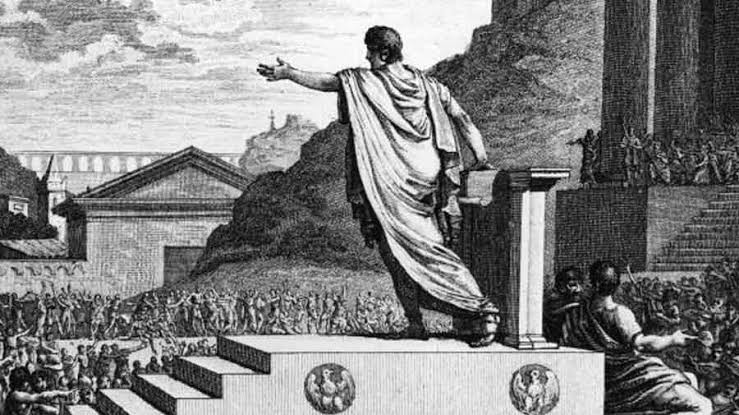
It is wise to formally open the meeting by announcing that it’s beginning and asking the attendees to gather around the speaker. Ideally, the speaker will be elevated above the rest of the crowd for visibility and there will be room for at least one other person to stand up there with them.
A short speech is a good way to open the meeting. This should lay out the main topic, any critical ancillary topics, and connect the issue to the imperialist state and the oppressor bourgeoisie. This is a good time to begin getting the crowd involved. Simple questions that can be easily answered (even with just a “yes!” or “no!”) will prime the listeners for engagement and signal that this meeting won’t be a passive affair.
Once the stage is set, the meeting leader should ask the crowd if anyone present has experienced the issue which is the subject of the meeting. If the organizers recognize anyone in attendance who has a particularly good and demonstrative experience, it can help to call that person to speak first. From this point, tactics will diverge depending on what the organizers intend to do with the meeting. If the goal is just to use the meeting to propagandize, generally elevate class consciousness, test the organizer’s own organization, and make connections with the masses, then the meeting can be comprised almost entirely of calling individuals up to the PA system to speak about their experiences while the meeting leader interposes questions, clarifications, and reframes the issues in a Marxist lens. Once the crowd has been sufficiently propagandized and exhibits a high degree of energy, the meeting leader can deliver a short closing speech to summarize what was said, to draw a broad connection to the capitalist state, to identify the ruling class as the collective enemy, and to stress the need for organization. The meeting leader should propose further meetings and discussions and clearly articulate what organization entails. These somewhat restrained aims are a good target for an organization’s first mass meeting, and may help it develop internal rigor.
That being said, the organizers should never attempt to restrain or repress the organically-occurring maturation of the masses. If the attendees want to engage in debate, discussion, adopt an organizational form, or even settle on concrete steps that can be taken to begin addressing the problem presented, they must not be delayed or put off. The organizers must be ready to capture the energy and foster any kernel of consciousness with real suggestions and real action. This should not turn into a run-away meeting in which the attendees decide to go to war with the state immediately, but neither should the organizers offer platitudes. Real steps may be required.
To that end, it would be wise for the organizers to become familiar with rules of procedure for running mass meetings as an organizational form. These may be home-made, but the latest edition of Robert’s Rules of Order contains good rules for a mass-meeting form that can help an organization run a meeting, maintain a good flow of conversation, and ensure that decisions are made collectively.
The Meeting is Not the End
The most important thing to impart is that the first meeting is only the beginning of organizing. If the organizers wish to push further with their meeting and the mood of the attendees permits it, they should call for a debate on action, set further meeting dates and times, and even consider calling for volunteer officers to serve as an interim executive committee to carry out decisions adopted by the meeting. This body of officers should hopefully contain a mix of the organizers and attendees, and should be subject to elections at the soonest possible opportunity (generally the next scheduled mass meeting).
The organizers should also urge attendees to join any public-facing political education classes they offer. Indeed, this is an excellent opportunity to urge attendees to assist in or join any of the organizers’ other initiatives: Red Aid, community self-defense, etc.
The critical thing is to continue holding meetings, to develop the attendees, and to drive struggle to an ever higher degree. The more meetings are held, the more the class consciousness in the area will be fostered. It is important to ensure that this consciousness does not develop in a reactionary direction, which is why the organizers must be well trained in the most advanced decolonial theory. Armed with the advanced theory and the energy of the masses, the mass meeting is the chief organ of class power available to us at this time.