Estimated reading time: 12 minutes
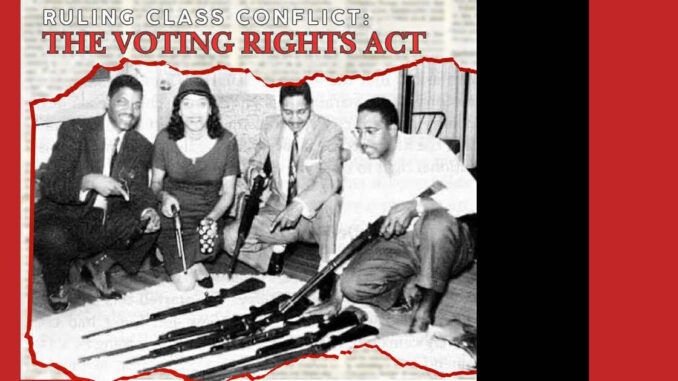
On August 6, 1965, Lyndon B. Johnson, president and chief executor of the federal U.S. government (and, therefore, the chief executive officer of the entire class of U.S. capitalists) signed the Voting Rights Act into law. In the Senate, this law passed with 77 votes for and 18 against, with the overwhelming support of 47 Democrats and 30 Republicans. The 18 votes against (16 Democrats and 2 Republicans) were all senators from the occupied U.S. South, representing the ruling class within the semi-colonial territories of the Black Belt. The passage of the VRA was part of the struggle between two economic systems that had begun when the 13 English colonies on Turtle Island joined into a single state, unified by a common ideology of white (English) supremacy. The conflict was one between slave power and free labor, that same conflict that, one hundred years prior, had erupted into the American Civil War.
By 1965, the old slave power had managed to beat back Reconstruction and establish itself as a constellation of terror-states in the U.S. South. While the capitalist ruling class in the North was content to hide or mystify the national oppression the U.S. system relied on, for the defeated Southern planter class and their petty-bourgeois hangers-on, this sublimation wasn’t enough. They were either ideologically incapable or materially incapable of joining the northern capitalists in adopting grand-sounding language about equality while maintaining the national oppression of New Afrikans and Indigenous Peoples; their deep-seated ideological commitments required them to constantly express their white supremacy in overt and terroristic ways. Sitting atop a semi-colony of brutally oppressed people, the ruling class in the U.S. South had, as the slaver Jefferson said, “the wolf by the ear.” In order to feel safe in that great prison, the Southern ruling class had to maintain absolute, fascistic, political supremacy over the Black population.
Indeed, the southern whites had been more or less permitted to do just that in the long period between the overthrow of radical Republican Reconstruction in 1877 (the period known to the Southern whites as “Redemption,” that is, redemption of the white supremacist power and the defeat of New Afrikan self-governance) and the alliance that emerged between Black World War II veterans returning to the South and the growing Black petty bourgeoisie. This period lasted from roughly 1877 until 1950.
In 1941, the racist policies of the FDR administration were challenged by A. Philip Randolph and his Black March on Washington; in 1954, the Supreme Court ended the legal basis for segregation in public schools when it decided Brown v. Board. Northern capitalists were insistent on bringing the southern slaveocracy into the modern day, not for moral reasons, but for economic ones. In 1957, the federal government passed the Civil Rights Act, the first signed into law since 1875. These decrees from on high were motivated by the need to free up labor in the Black Belt from the regressive agrarian prisons that the colonial relations still kept them in; but none of these decrees changed the balance of power in the South. Black New Afrikans in the semi-colonial states were held in a vice of property and labor theft, rape, arson, lynchings, and undisguised murder. In the U.S. South, the state ruled by terror. Despite the promise of the amended U.S. constitution, Black people who registered to vote took their lives in their hands.
At the end of the 1950s, the militant streams of Black resistance gained more and more currency and began to unite. These were often spearheaded by Black veterans or radical Black students, many of whom were explicitly Communists — Marxist-Leninists or otherwise. This period saw the rise of Malcolm X, the Black Panther Party, and of the Southern Christian Leadership Conference.
The passage of the Voting Rights Act was the result of a tightening labor market in the U.S. at the same time that militancy was increasing and the consciousness was widening for the support of a Black national movement.1 Economic pressure joined with the Black drive for liberation. There was a real fear in the halls of power that the U.S. state could face a Black domestic insurrection and an increasing desire to see the fragments of the Southern planter class and their dependents defeated entirely, to consummate the triumph of free labor, as opposed to low-productivity sharecropping and semi-slave labor that still reigned in the South. Even the former planters themselves had begun to realize that they couldn’t continue to manage their sections of the country by relying purely on terror. They realized they needed to find a way to accommodate the form and appearance of equality while maintaining the white supremacist content of the slaveocracy.2
The VRA established a relation between the planters and the federal government that was similar to that of Reconstruction. Its general provisions under section 2 of the law prohibit state and local governments from enacting any law or rule that denies or abridges the right of any citizen to vote on account of race, color, or membership in a language group. Other general provisions outlaw literacy tests and poll taxes. The special provisions granted the federal U.S. Attorney General and the District Court for DC power over Southern elections, redistricting plans, and so forth, that essentially put the Southern states into a kind of federal receivership for the purposes of voting.
The War on the Voting Rights Act
Although the VRA was a necessary concession to save the capitalist state by creating a veneer of participatory democracy in the US South, it wasn’t fully implemented all at once. This gave the ruling class time to find ways to empty the vote of its power. There remained, however, a significant faction within the broader US capitalist class itself for whom the VRA remained ideologically intolerable. Existence of international pressure from the Soviet Union and the national liberation and Pan-African movements forced the US to maintain this veneer. With the fall of the USSR and the declining world-position of the US ruling class, this clique of ideologically devoted racists has gained more and more adherents from their bourgeois colleagues.
The Federalist Society is one of the bastions of the movement to reverse the changes in the US legal landscape and return to the early 20th century when capital openly ruled the courts.3 In 2013, the US Supreme Court, that bastion of ruling-class power,4 nullified the powerful special provisions of the VRA in Shelby Counter v. Holder. In the 2021 decision Brnovich v. Democratic National Committee, the Supreme Court weakened the general provisions of section 2 of the VRA. Now, the court is poised to rule on the constitutionality of section 2 as a whole. The legal war waged by the growing right-fascist bloc for half a century is nearing its conclusion. We must ask: does it matter if section 2 is struck down? If it does, why and how? Is there any way we can agitate around this issue? Does it mean we Marxists must join hands with Democrats and other fragments of the ruling class?
To briefly answer each in turn: firstly, yes; secondly, it is a sign of how advanced the imperialist decay is; thirdly, yes again; and, finally, absolutely not!
What Will Be the Outcome?
Despite the fact that the VRA in and of itself cannot guarantee anything, and despite the fact that its passage was an accommodation that was fashioned as part of an overall effort to pacify Black militancy and disarm the Black national revolutionary consciousness of the 1950s and 60s, it is actually of great importance to us whether or not the fascist court strikes it down. Oral arguments in Louisiana v. Callais have already signaled that the court does intend to roll back this final element of the VRA. This is part and parcel of the right-fascist drive to restore capitalists to open and undisguised power in all aspects of political and legal life. It dovetails with the same right-fascist attack on the administrative state presently being carried out under the guise of the shutdown, a political “conflict” in which the left-fascist Democrats are playing the role of useful idiot.5 Given the disposition of political forces and the economic situation (increasing inflation and unemployment) it is likely that the VRA’s section 2 will be struck down.
The fate of the VRA is a bellwether for the degree of decay of the old US imperialist system that prevailed from 1991 until today as well as the balance of power between the left- (Democratic/Progressive) and right- (GOP and MAGA) fascist cliques within the ruling class. If the VRA is struck down, Democratic Party operatives will ceaselessly and breathlessly fund raise and proclaim their old doctrines about emergency organization in the face of “Trumpist” fascism and the need to permit people from both sides of the color line to participate in and enjoy the capitalist system. In private, of course, they will signal more cynically that it’s just good strategy to give the nationally oppressed the illusion of democracy. After all, they will say to their donors in closed-door dinners, it’s not as if the masses of Black people — or for that matter, any working-class voters — actually have any way to influence the important policies of the US state.
If the VRA is struck down, it signals the right-fascists are extremely advanced on their path toward carrying out the genocide of the nationally oppressed that they have been preparing for Black and Indigenous people in the US.6 Striking down the VRA would remove entire layers and battlefields of intra-bourgeois political struggle — layers that are “wasteful” in the eyes of the ruling class, just like the “waste” of the administrative state that they are dismantling — but would also strip away the illusion that the US state can be altered by the oppressed voting in any meaningful way.
What Is Our Task?
If the VRA is defeated, the Democrats will attempt to lead the movement that organically emerges in reaction. Many will rightly be afraid of what the loss of the final provisions of the VRA mean for the nationally oppressed and other groups openly targeted by the right-fascist government. We cannot allow this to happen. Democrats will naturally frame the question as one of government participation. They will start new voter registration drives, demand mobilization to defeat the right-fascists at the ballot box, and exercise a full-court press for the election of Democrats to the Congress and in local government.
We must instead first agitate against the new terror-government directly, then propagandize to expand the consciousness of the masses to connect the striking down of the VRA with the entire rotten system. It will be clear to many that there are no self-correcting measures available. With the open and legal disenfranchisement of Black voters in the South and other right-fascist strongholds, the layer of mystification that promised government responsiveness to the people will be gone.
Now is the time to prepare for the VRA to be removed. Now is the time to lay plans. If it is not, and the right-fascists instead uphold the remaining section to buy more time before carrying out a direct assault on the ballot box, then our preparations won’t have been in vain; we can still carry out agitation and propaganda on the basis that the VRA could have been struck down, and likely will be struck down in the near future. We must broaden the call to include other landmark rulings and laws that were offered during the heyday of empire — Griswold v. Connecticut, Lawrence v. Texas, Loving v. Virginia, Brown v. Board, and Obergefell v. Hodges — and warn that they too stand to be struck down by the right-fascists.
The moment is ours; the Democrats must not be allowed to stand at its head.
Footnotes
- The tightening labor market put the pressure on to mobilize and “free” tied up labor; business interests wanted to draw from the pool of sharecroppers in the Black Belt.
↩︎ - “By the 1950s the language of white supremacy was gradually softening in some quarters, becoming less shrill in an attempt to gain respectability for racism. Phrases like ‘states’ rights’ and concepts such as the need to protect ‘constitutional liberties’ from communist subversion and federal intervention were becoming stand-ins for raw racial rhetoric.” Cobb, Charles E. Jr. This Nonviolent Stuff’ll Get You Killed: How Guns Made the Civil Rights Movement Possible. Duke University Press, 2015.
↩︎ - See The Society Behind the Supreme Court’s Fascist Blitzkrieg in the Clarion.
↩︎ - See Capital’s Supreme Defender in the Clarion.
↩︎ - See This Land Ain’t Your Land: The US Government Shutdown in the Clarion.
↩︎ - See DC Occupation: Coming to Your City Next in the Clarion.
↩︎