Estimated reading time: 9 minutes
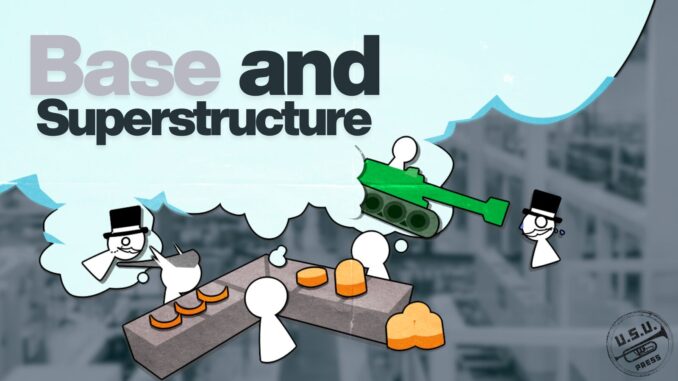
When one mentions “superstructure,” what springs to mind? I imagine a mishmash of culture, philosophy, courts and schools, so on and so forth. Base? Likely machines, perhaps planes carrying goods, maybe even the odd worker or two. This is, in general, how the base and superstructure are understood by those steeped in the Marxist tradition. The base, the hard and objective economy, causes all those ideological and legal things to exist, and the latter serves to reflect the former. In explaining how this topological model isn’t inherently deterministic, Marxists have produced a great number of sophisticated explanations, from “relative autonomy” to “the difference is functional, not inherent.” These explanations have been brilliantly nuanced, if ultimately unable to make sense of the central dualism. I do mean dualism, for the record. This is a dualistic model which assumes two different kinds of things, that thought and matter are separate substances. The economy exists beyond the will of people and people merely react back on it through political and ideological means. No one stops to ask what got the economy going in the first place.
Now, please proceed to forget all of that. The matter is much simpler than you’d assume reading individuals like Althusser or Eagleton. The answer is found in this oft-cited but rarely understood section from Marx’s 1859 Preface to a Contribution to the Critique of Political Economy:
“In the social production of their existence, men inevitably enter into definite relations, which are independent of their will, namely relations of production appropriate to a given stage in the development of their material forces of production. The totality of these relations of production constitutes the economic structure of society, the real foundation, on which arises a legal and political superstructure and to which correspond definite forms of social consciousness. The mode of production of material life conditions the general process of social, political and intellectual life. It is not the consciousness of men that determines their existence, but their social existence that determines their consciousness. At a certain stage of development, the material productive forces of society come into conflict with the existing relations of production or – this merely expresses the same thing in legal terms – with the property relations within the framework of which they have operated hitherto. From forms of development of the productive forces these relations turn into their fetters. Then begins an era of social revolution. The changes in the economic foundation lead sooner or later to the transformation of the whole immense superstructure.”1
Let us narrow in on the key phrase, this time with some asterisks at the end of key words, and with a slash inserted in a key element: “The totality of these relations* of production constitutes the economic structure of society, the real foundation, on which arises* a legal and political superstructure / and to which correspond* definite forms of social consciousness.”
Read carefully and you will see why I have highlighted these words. The “real foundation,” the “base,” refers precisely and exclusively to the relations of production. No means. This has a very important consequence: The base is social. It is interrelational, interpersonal, describing real relations between real individuals. Production itself is a social activity. Therefore, the importance of economics is not “economic determinism,” it is social determinism. Social in a collective sense, beyond any single person’s will, but still social.
And the superstructure is “legal and political.” If the base is the relations of production, it becomes necessary to point out that Marx has said that property relations are merely the same thing as relations of production but in the legal sphere. That appears to be the identity of our superstructure: The legal and political mechanisms by which the relations of production are made stable, which organically arise from the activities of the economy.
So what about ideology, culture, so on and so forth? These are relegated to the third category, “social consciousness.” This “corresponds” to the base, rather than arising from it. That should not be too shocking: Just as language does not change overnight when feudalism becomes capitalism, because language is a medium of communication regardless of class, social consciousness in general exists regardless of class. The concerns of consciousness are inevitably tied into class, however. This is because, as pointed out, the base is already social. The activity of labor, as such, has a huge impact on a person’s consciousness. But so too does everything else a person does. To quote Marx again, this time from Theories of Surplus Value:
“Man himself is the basis of his material production, as of any other production that he carries on. All circumstances, therefore, which affect man, the subject of production, more or less modify all his functions and activities, and therefore too his functions and activities as the creator of material wealth, of commodities. In this respect it can in fact be shown that all human relations and functions, however and in whatever form they may appear, influence material production and have a more or less decisive influence on it.” 2
So what does this mean? It means, functionally, that the base/superstructure model is massively overblown. The base is taken to mean “the entire economy,” when it really means “the relations of production.” The superstructure is taken to mean “everything that is not economic,” when it really just means “legal-political structuring of productive relations.” It’s a metaphor which is very limited in scope. Before you cite Engels, keep in mind that Engels and Marx were not one person. They neither agreed all the time nor disagreed all the time. At any rate, the expansive version of the superstructure used by Engels was used by Marx, but only early on, and after that, he consistently maintained this legal-political definition. Engels simply did not realize this in his own later writings, and used the version Marx had already moved on from. The notion that expansive version is an advancement of the 1859 version is contradicted by the fact that Marx moved from the expansive version to the 1859 version.
As for the forces, the instruments of production, their relationship to the relations stay more or less the same. Their exclusion from the base/superstructure model does not mean they float freely in the void. The only real note is that any notion of determinism stemming from them is undermined by the social nature of the relations of production, social in a manner which is very much impacted by ideology and culture. Culture has genuine weight here. Economics are normative from the start.
The mode of production, often flattened into merely “mode + relations of production,” is much more than economics. It is an overall organic whole of relations which produce societies as wholes. The entire concrete totality of a given society in a given moment. There is no pure “capitalist mode of production.” There is only a self-differentiated social totality laden with endless determinations from economic to legal to conscious, with no separating topology. Social consciousness interpenetrates all elements of life because humans, as a collective, live every element of life. Determination, at best, exists in a law of large numbers. It does not magically come from the existence of a fancy new way of making shoes, even if that is an enabling factor. In practice, productive relations always flow into seemingly non-productive relations and vice versa.
The mode of production as a social totality, which includes all factors which influence production and reproduction of the society writ large, with the economy as the conditioning factor which is nevertheless always already social, ideological, cultural, is the solution.
As for operationalism, I am not demanding one abandon heuristic models for abstracting one element out and examining it. In fact, I’d very much still recommend splitting analysis into matters which are economic, legal-political, and what I call “interpersonal” (such as culture and ideology) for ease of use. But this should be done delicately and temporarily only. Why? Because this model risks implying that the economic and legal-political spheres of society are not interpersonal, are not social, are not ideological. The idea that they are not is precisely the sort of error Marx identifies in commodity fetishism. Treating the economy like it is self-contained and that everything else is merely epiphenomenal is an error we make at our own peril. As such, every effort should be made to be able to interconnect these spheres, in truth mere elements of one sphere, fluidly in analysis once the heuristic separation has outlived its usefulness. Marx’s own analyses never treated these issues as separable. Neither should ours.
- Marx, “Preface to A Contribution to the Critique of Political Economy,’ 2. ↩︎
- Marx, “Theories of Surplus Value, Part 1,” 288. ↩︎

Leave a Reply