Estimated reading time: 12 minutes
A fake approval rating poll. A meme headlined “Down with Claudia!” in white banner text. Another image encourages people to turn out to protest November 15 “for justice and peace.” Instagram photos and Facebook groups claiming to be part of a “Generación Z” movement filled with angry comments and calls to march against corruption and violence.
This so-called movement has various links to the conservative PRI (Revolutionary Institutional Party), the PAN (National Action Party), and multiple parapolitical and civil organizations that have ties to other right-wing operations in Latin America. It is nothing more than a power play by a coalition of political actors fighting the ruling MORENA (National Regeneration Movement) party for control of Mexico.
Background
Around the world, the so-called Generation Z protests primarily target corruption, nepotism, and the disdain ruling classes have for the concerns of new generations. The movements define themselves as decentralized and spontaneous, and organizers of the movements are largely unknown. While the movements present the shallow appearance of revolution, protestors are not seeking a fundamental restructuring of economico-political systems. Rather, they demand the reformation of existing liberal economic and governmental structures to better integrate younger generations.
In Morocco, the construction of World Cup stadiums alongside poverty and lack of opportunity is a key flash point. In Nepal, massive protests forced the government out of office and voted for a new president on social media application Discord. In Madagascar, the armed forces joined young protesters in a coup d’etat against President Andry Rajoelina, who fled the country in a French military airplane. Widely unpopular President Dina Boluarte of Peru was also impeached following pressure from protest groups.
By bringing a “better” liberal democracy, “Generation Z” protestors believe they can successfully reckon with at least some of the contradictions of the capitalist mode of production. Little to no mention is made of the exploitation inherent to capitalism, the role of the West in underdeveloping the Global South, nor the hierarchical ideologies that justify oppression and keep wealth and power flowing to the top.
Mexico
Circumstances in Mexico differ from those in other other countries. The ruling MORENA regime enjoys consistent popularity, while the political opposition (in the form of an alliance between the PRI and the PAN) is disjointed and hopelessly out of touch with the material reality of Mexico.
The enormous failures of previous Mexican federal administrations have allowed MORENA to position itself as a muscular, active political “movement”. MORENA sells itself as a corrective to the towering excesses of those before, a party in tune with the masses, and a trustworthy guide for the future. Through “common sense” reforms, infrastructure projects, and a “tough but fair” approach to dealing with its mercurial counterparts north of the border — MORENA has (much like the Zohran Mamdani mayoral administration) wrapped its liberalism in a modern packaging appropriate for the 21st century.
While many of the projects undertaken by MORENA make for good headlines and better talking points, their ultimate goal is to allow MORENA not only to continue the neoliberal robbery and murder of their predecessors, but also to expand it. Community leaders and citizen organizers are dying, casualties of the relentless advance of the big bourgeois and their extracting armies.
The relations of production have not changed at all. They have remained firmly capitalist, and firmly exploitative. Indigenous communities throughout the country continue to suffer violence at the hands of paramilitary groups acting at the behest of government officials. Even the “regenerative” nature of MORENA is a lie; many MORENA politicians used to be part of other parties, switching affiliation to take advantage of the political opportunity provided by MORENA, rather than out of any desire to “transform” Mexico into something better.
The difference between MORENA and its opposition is that MORENA has a political awareness and aptitude the PRI and PAN never will. So the PRI and the PAN have begun looking for alternatives outside the liberal political establishment. Most support for the opposition comes from extremely online members of the upper-class who view the MORENA political project as simple populism, instead of the repackaged neoliberalism it really is. Many in anti-MORENA circles view the strength of imperial United States hegemony (political and cultural) extremely favorably – both the yardstick by which the failures of MORENA are measured and the ideal to which Mexico should aspire.
The online “Generation Z movement” in Mexico started in earnest in late October. Following the assassination of Uruapán mayor Carlos Manzo, anti-MORENA protest content inundated Mexican social media, demanding a recall of President Claudia Sheinbaum Pardo and, in some cases, a coup d’etat against the entire government. A Discord server was created and photos of the Straw Hat Pirates’ Jolly Roger (from the Japanese anime One Piece) flooded social media. Protests convened, and opposition politicians rushed to declare their support for the “mass movement,” hoping to regain some of the political relevancy they had squandered through rampant nepotism and endless corruption.
The Right-Wing Connection
The MORENA government has claimed the protests are funded by both domestic and foreign political actors attempting to destabilize the MORENA political project. President Sheinbaum has linked foreign interest groups like the Atlas Network, as well as local organizations like Mexicanos Contra la Corrupción to the protests. Government-affiliated news outlet Infodemia published a report estimating that MXN $90 million (USD $5 million) has been spent on online disinformation campaigns.
News outlet Milenio has reported that 8 million profiles, or over half of the online presence of the “Generation Z” protests, are automated accounts. The magazine traced many accounts to bot farms located in Spain, Colombia, and Argentina. Some of the accounts were previously used to promote Venezuelan far-right politician Maria Corina Machado.
Independent journalist AYAX has documented how some of the first accounts to spread information about the protests were previously linked to other right-wing political initiatives, like opposition to reform of the Mexican federal election reform agency. Metadata from a supposed manifesto made in Canva revealed the name “monetiq Agencia”, a PR firm registered in Zapopán, Jalisco to an address linked to former PRI politician José Alfredo Femat Flores.
Despite the massive effort put into the social media campaign, the results have been chaotic, disjointed, and sometimes downright bizarre. One TikTok account posted an AI-generated interview of a young woman accusing the liberal MORENA government of being a dictatorship because they raised the tax on soft drinks. Other accounts sought to position Mexican business magnate Ricardo Salinas Pliego in a favorable light, contradicting the supposed apolitical nature of the protests.
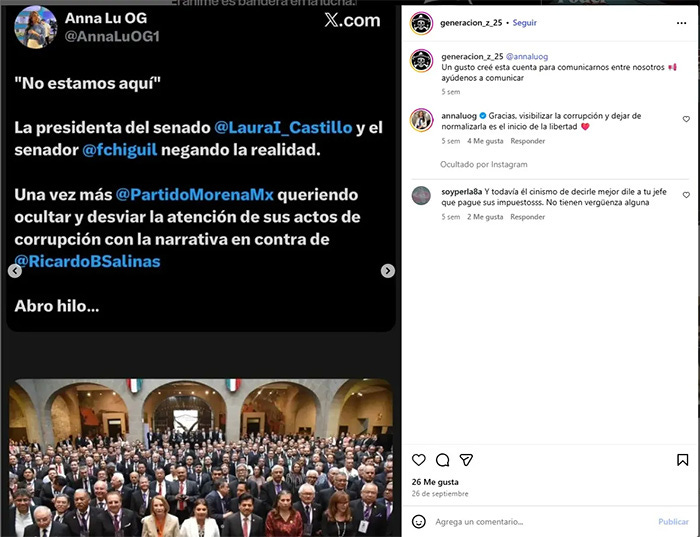
AYAX reported how Discord server members attempted to influence opinion in favor of Salinas Pliego. One user urged their supposed comrades “not to put Salinas [Pliego] on our list of enemies”, claiming Salinas was not interested in money or political power due to his substantial business holdings. Another Instagram account, generacion_z_25, posted a supportive comment on a post decrying the recent attempts to collect back taxes from Salinas Pliego as a politically-motivated MORENA attack.
Opposition politicians in Mexico were also remarkably quick to express their solidarity with the so-called “movement”. News outlets published a photo of PRI politicians holding the Jolly Roger in the federal legislative chamber.
Mayor of the Cuauhtemoc borough of Mexico City, (and former campaign staffer for former PRI president Enrique Peña Nieto) Alessandra Rojo de la Vega, has also proclaimed her support for the movement, saying that “no one can silence a generation awakened.” Even former PAN president Vicente Fox posted a video urging people to join the November 15 march.
Result
On November 8, a protest was scheduled in Mexico City. Paseo de la Reforma, one of the main avenues of Mexico City, was partially closed to vehicular traffic. Despite the enormous social media campaign, only a handful of protesters arrived. Mexico City police officially announced a total of 300 participants, while another news outlet reported attendance of only 150 protesters — even fewer than the 200 Mexico City municipal police deployed to prevent any civic unrest.
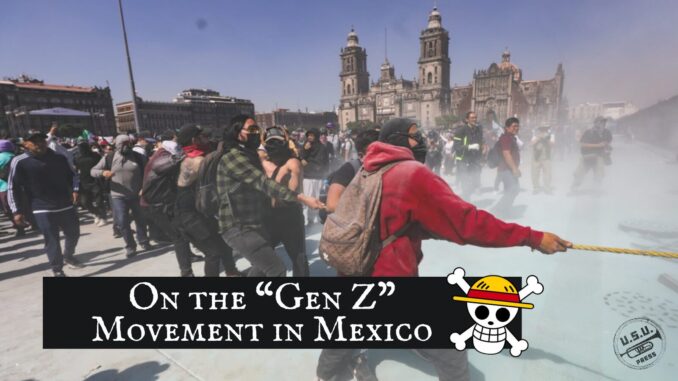
November 15 saw an estimated 17,000 protestors arrive to the Zocalo in the center of Mexico City. Although the march started peacefully, hooded and masked protestors soon attacked police directly. Police responded with tear gas and beatings. A small number of protestors broke through iron barriers and the police line, spraying judeophobic and breaking windows in the Palacio Nacional, where President Sheinbaum has an apartment.
Despite the massive social media campaign, various puff pieces in Mexican mainstream media and the push from the PRI, the PAN, and interests close to Ricardo Salinas Pliego, the protest was a failure. By 5 o’clock most of the protestors had left the Zocalo. The decidedly older makeup of a protest calling itself “Generation Z” was met with ridicule and derision.
Broader Context
The attempt to spark a protest comes against a backdrop of changing geopolitical realities. As United States global hegemony declines, the U.S. government has employed sanctions, unilateral airstrikes, and proxy wars (justified with either “anti-terror” or “anti-narcotics” vocabulary) against other countries in an attempt to maintain its grip on a world that is rapidly slipping out of its control.
While many governments are looking forward to a post-U.S. reality, other political factions see an opportunity. Venezuelan opposition has expressed support for U.S. intervention, and President of Ecuador Daniel Noboa hasannounced his support for the U.S. military reopening bases on Ecuadoran soil. The Milei administration accepted USD $20 billion of relief from the United States government to offset economic disaster resulting from the implementation of neoliberal economic policies.
At a time when unified anti-capitalist resistance is more important than ever, the “Generation Z” movement in Mexico has markedly avoided integration with other traditions of struggle. No civil society organizations or militant anticapitalist groups have said anything about the planned protests, while “Generation Z” movement-associated social media accounts explicitly deny any cooperation or solidarity with other causes. Some posts even went as far as saying Palestinian flags are unwelcome at the protests. The teachers’ union (CNTE) — currently in the midst of its own national protests against proposed MORENA reforms — announced its intention to temporarily vacate protest positions – an express refusal to participate in the “Generation Z” protests.
Conclusion
A movement without solid political ideology and solidarity among a broad sector of society is predestined to fail. From this vantage point of futility, the might of the United States seems welcome – law and order, opportunity and prosperity for the “ungovernable” Third World.
While the slogan of “no political parties” appeals to anti-hegemonic tendencies that have always been present in Mexico (predating even the Spanish colonial presence), the movement lacks anything approaching a political platform. Disguised as a vague, petty bourgeois “anarchism”, the “Generation Z” movement is only a movement of nihilism. It is not hope, it is the death of hope, and in this way, the protests do serve a purpose for MORENA itself. By taking swift action against the protests, MORENA is able to hold up the silliness of the opposition for all to see. This has allowed MORENA to shore up its own political position, both by discouraging potential revolutionary energy and by distracting from the war it is waging throughout Mexico.
For Mexico is a country at war — a war between the capitalists and everyone else. Both the imperial and national big bourgeoisie extract enormous superprofits, rivers of blood and the tears of those mourning the loss of loved ones continue to soak the land. The MORENA political project is an attempt to institute Lazaro Cardenas-esque political hegemony through centralization of power at the federal level within existing liberal governmental structures (and a reformation of those same structures on an as-needed basis). Despite the self-applied moniker of the “Fourth Transformation”, MORENA is just a new hat for the same old liberalism that has always ruled Mexico.
The voices of the dead cry out for justice, and the living bear the responsibility to see clearly. Neither the MORENA reformist project nor the inorganic, capitalist-funded right wing “social movement” will provide justice. The “Fourth Transformation” is nothing more than an attempt to paste a liberal veneer over the horrors of capitalism, while the “Generation Z” protests are a simple power play by politicians incapable of even playing the reformist role. We must not be fooled by superficial rhetoric, misleading statistics, or the performative rage of politicians in the opposition. It is imperative that quantitative capitalist political adjustment is not confused for qualitative, fundamental change. Neither reform nor right-wing anger is revolution.

![not to put Salinas [Pliego] on our list of enemies](https://substackcdn.com/image/fetch/$s_!a2Gi!,f_auto,q_auto:good,fl_progressive:steep/https%3A%2F%2Fsubstack-post-media.s3.amazonaws.com%2Fpublic%2Fimages%2F4e0fda4f-9026-4a4a-94e8-0751231b3317_615x700.jpeg)
Leave a Reply