Estimated reading time: 24 minutes
Local History
The Connecticut River Valley was home to many Indigenous tribes before European settler colonialism. The area now known as Hartford was held by the Suckiag Tribe until they were ethnically cleansed by Dutch and English settlers. Suckiag was valuable due to its prominent position along the Connecticut River. Ever since the displacement of its Indigenous populations, the city now known as Hartford has been a “rearguard garrison”1 for settler colonialism in Occupied North America and imperialism across the globe. When English Hartford was founded in 1636, the Connecticut colony consisted of scattered settlements along the Connecticut River. These towns acted in self governance for the first time to declare war against the Pequot Nation, which governed what is today southeastern Connecticut. Settlers from the river valley towns sent delegates to Hartford, where the colonial court issued its decree to recruit 30 men from each town to commit genocide of the Pequot. The English also recruited hundreds of soldiers from the Narragansett and Mohegan Nations to assist in the war effort. Together, they killed most of the Pequot and forced the survivors into slavery, with the English seizing all their land. The English successfully took advantage of the competition between Indigenous nations in Connecticut, a tactic of exploiting existing contradictions the modern U.S. state now regularly employs to destabilize nations. Of course, the temporary allies, the Narragansett and Mohegan, also saw all of their land – at first slowly, then all at once – stolen by settlers in the ensuing, decades-long land grab.
Hartford’s dominant industries at this time were agriculture and rum distillation. Both were dependent on slave labor; in Hartford, Black and Indigenous enslaved people worked the farms, while in the Caribbean they harvested sugarcane that was fermented and shipped up the eastern coast to Hartford and other northern cities. These Caribbean plantations were made dependent on such cities for food supplies, because even though the islands could grow ample food, sugar was the only crop produced on the land since it was more profitable to sell. The Caribbean experienced waves of manufactured famine that continue to this day. Census data for slavery in Hartford only goes back to 1791. In that year there were 263 enslaved people in Hartford out of 2,764 in the state. There were 430 “free persons” (free Black citizens) in Hartford who were members of the city’s proletariat and sub-proletariat. The first recorded murder victim in Hartford was a Black man named Louis Berbice, murdered by his enslaver in 1639. The enslaver, Edward Opdyck, faced no punishment.
From Garrison Town to Inventor’s Workshop
Hartford became a manufacturing city beginning around the 1850s, when Samuel Colt opened the largest private gun factory in the world. Colt revolvers were key to westward expansion, used by both individual settlers and the U.S. army. A half century earlier, Eli Whitney initiated the local mass production firearms industry with the interchangeable parts design, developed out of a factory in New Haven. A year later, he would invent the cotton gin, kickstarting an exponential expansion of slavery production and New Afrikan misery. Additional companies, such as Billings and Spencer, Spencer Arms, Winchester Repeating Arms, and Smith & Wesson have bestowed a historic tie between settler militarism and Connecticut.
The city’s role in colonial occupation did not change, but its form of service took on a new, advanced appearance. Amerika’s new settler armies needed advanced, mass-produced weaponry that could overwhelm the western Indigenous nations still fighting for their national territory. Tucked away safely in the Northeast and bolstered by several centuries of superprofits, Hartford was well-positioned to serve as an inventor’s workshop for the next era of military technology.
We see the same transition fulfilled today by “israel” in Occupied Palestine. The zionist entity is both a garrison launchpad for the U.S. in Asia, and the empire’s principal inventor of military technology. Their weapons are primarily used against Palestinians to continue the Zionist occupation of Palestine. Their secondary purpose is that of testing and experimentation; advanced technology is exported from occupied Palestine to wherever in the world the empire needs them for asymmetric violence, including U.S. cities such as Hartford.
From Inventor’s Workshop to Financial Hub
Hartford’s modern image as a finance center is characterized by massive insurance companies whose offices take up most of the city skyline. Connecticut’s capital is the birthplace of the insurance business itself. River captains, dealing in enslaved people and foodstuffs for slavery plantations, wanted to avoid the expectable financial hits from the dangerous sailing business; storms, piracy, and disease were threatening enough to the capitalists’ fortunes that it benefited the overall class to compensate one another when an individual merchant lost their investment. Thus, they created a system of profit and risk sharing among the merchant class. The financial logistics of slavery laid the foundation for the emergence of the insurance industry. Hartford is still considered the insurance capital of the world, although there are fewer actual insurance employees working in the city than in the past. 150 of these companies generate $16 billion a year combined. They are centered in the downtown area and housed in the largest office buildings. This industry is, of course, white dominated.
Lastly, Hartford and Hartford county continue to serve the U.S. war machine with several weapons manufacturers. In West Hartford, the Colt factory produces M4 rifles that are continuously sent to Occupied Palestine. The modern “inventor’s workshop” has moved across the Connecticut River to East Hartford, where Raytheon operates a five-story “research” facility to engineer new weapons systems like radars, missiles, and drones for the US and its vassals. A short walk away, Pratt & Whitney builds engines for the F35 fighter jet. While many of these weapons workers are commuters, it is also the perception among community members that the companies are too powerful and entrenched for anti-imperialists to challenge them. Tracking the city’s development from garrison fortress, to inventor’s workshop, to financial hub of global imperialism, can we really say Amerika was ever not fascist? No, we cannot; it is only the form and proximity to genocide that has changed.
Demographics
The city has 17 neighborhoods, which are more sharply segregated by national and class contradictions than the average U.S. city. Population maps show that the New Afrikan population is primarily segregated to the north end of the city. The New Afrikan neighborhoods are separated from the Hispanic neighborhoods by insurance offices and the I-84 highway, constructed in 1964 to connect the downtown offices with the white suburbs in West Hartford. As in many cities, the construction of the giant highway through the city devastated the “minority” neighborhoods it crossed over.
National Groups in Hartford according to 2020 census
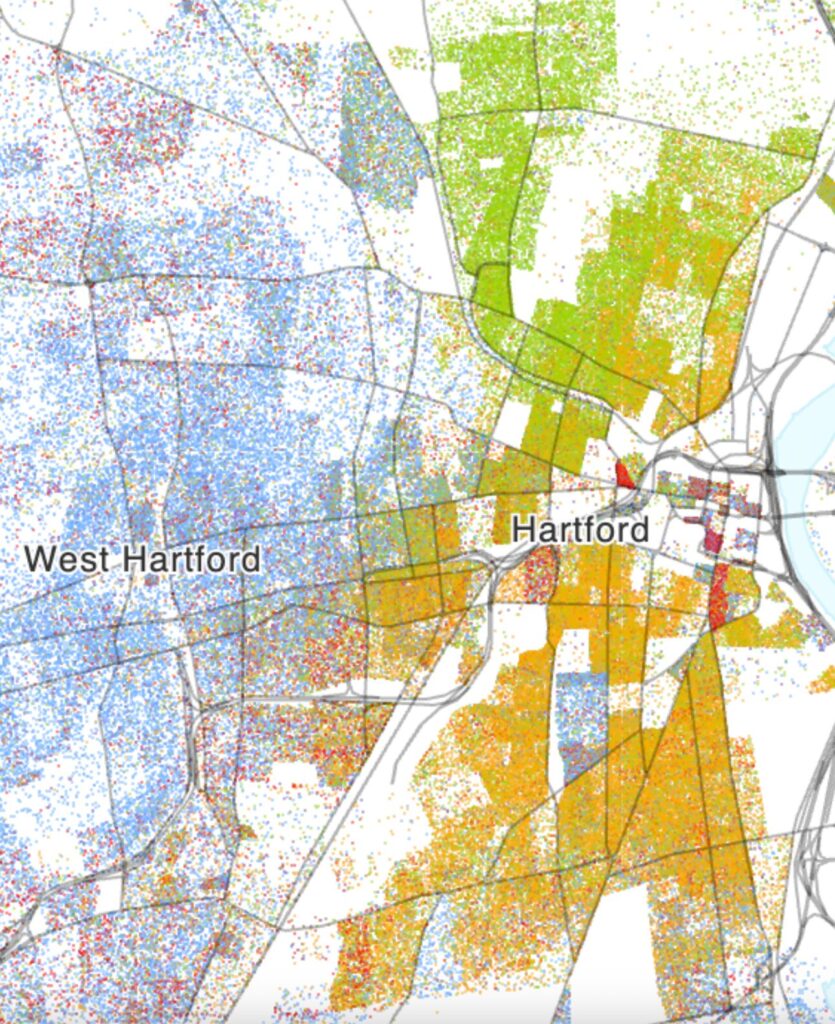
Orange = Hispanic
Blue = White
Red = Asian
Map of the I-84 Highway through Hartford
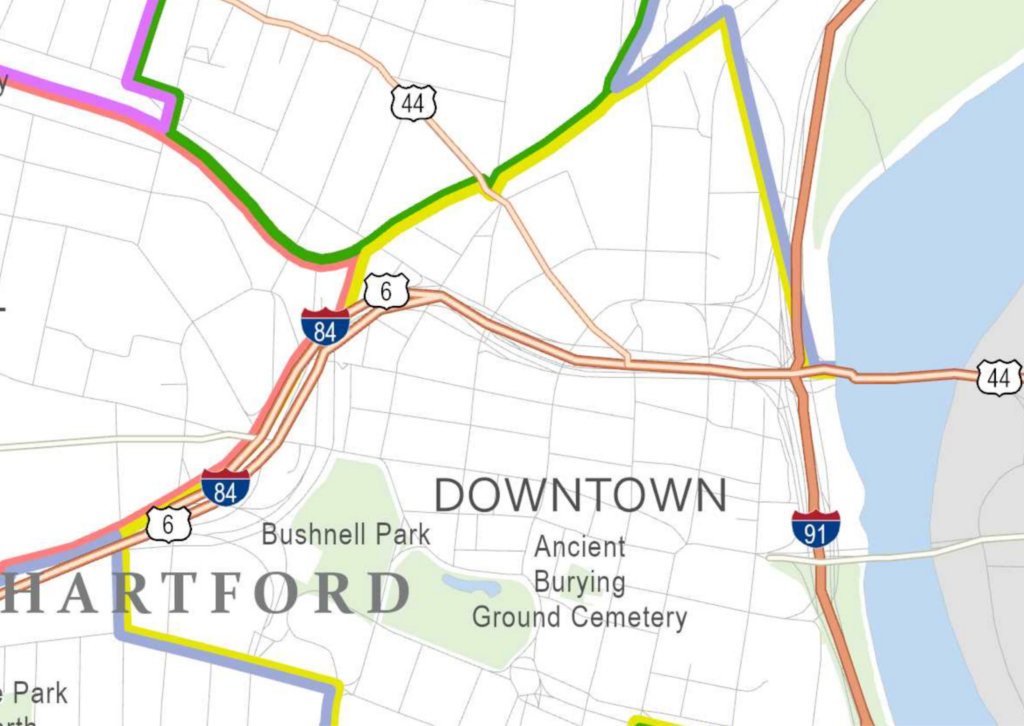
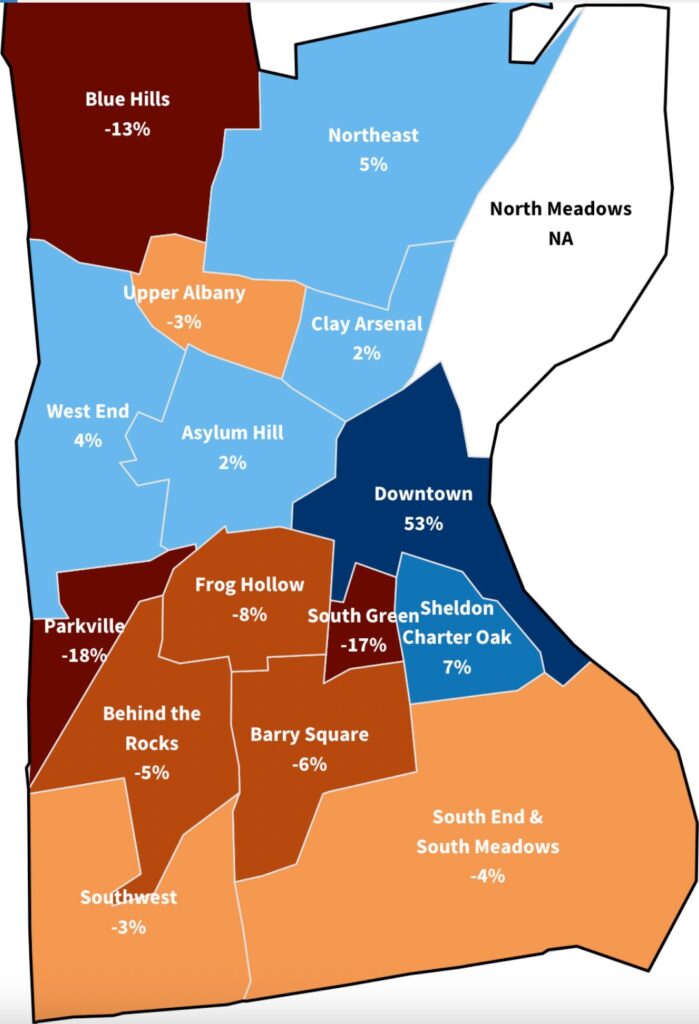
Although the downtown area saw the highest rate of population growth between 2010 and 2020 (increasing by 53%), this area is still notoriously empty at night and on weekends, when office commuters leave for the suburbs. Downtown is the only neighborhood with a majority white population in Hartford. Note that the North Meadows neighborhood has no official population, since the area contains the Hartford Prison and commercial businesses. (See below.)
Hartford Neighborhoods, Population Change 2010 – 2020
We began our social investigation at the intersection of Park and Main St. In 1969, this intersection was the site of an uprising of the Puerto Rican community against a white biker gang. As the story goes, a white man belonging to the Comanchero biker gang assaulted an elderly Puerto Rican, and the community decided they had had enough. The groups confronted each other in the streets, but Hartford police only arrested Puerto Ricans. This agitated the community even further. The cycle of protesting, followed by police repression, followed by even heavier protesting, would continue for weeks, until an even greater escalation occurred. On August 29, 1969, West Hartford police shot Dennis Jones, a 16 year old New Afrikan, to death. Two days after the murder, a slumlord tenement building burned down, killing three people. These two events were too much for the community to bear, and people took to the streets against both police and white-owned businesses in the north end. But unlike the “Comanchero clash,” this time New Afrikans and Puerto Ricans fought together. The protests spread from the Clay Arsenal Neighborhoods, through downtown, and into Charter Oak and South Green. By September 5, over 500 people had been arrested and 4 people were shot.
1969 Hartford Uprisings, August-September 1969
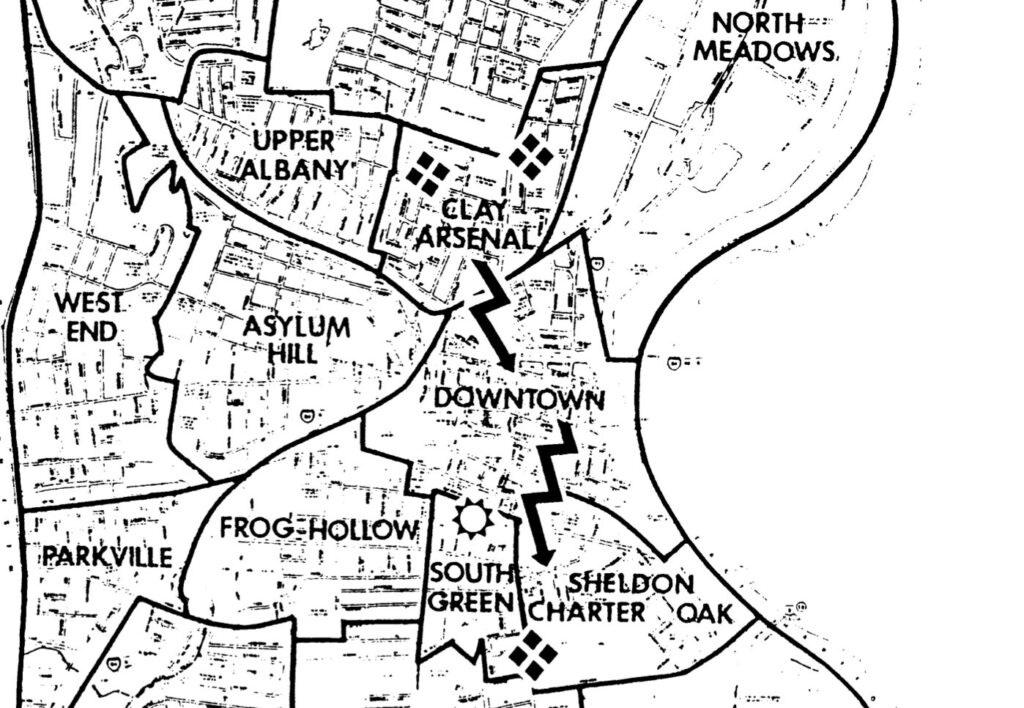
Squares: Labor Day Riots
Arrows show the protest’s physical movement
This one and a half month period marks the most significant uprising of the oppressed communities in Hartford. Since then, Puerto Ricans have gained representation on the Hartford City Council, giving the community a chance for a larger “piece of the pie” of imperial superprofits. They now have a place in government to address economic inequalities and police oppression. Of course, representation in local politics has not smoothed over the glaring contradictions between different nations in Hartford. Puerto Ricans are still concentrated in specific neighborhoods that receive lower investment ratings than nearby white neighborhoods, and the contradictions of homelessness, drug addiction, and poverty are more present in the Hispanic neighborhoods than in the white-dominated West End. Puerto Ricans make up 74% of the Hispanics in Hartford, but there is a significant Dominican population (8%) now as well.
Beginning each outing with a briefing of goals and logistics, we set out in both directions along Park Street and the surrounding area. Below are the major contradictions we observed.
A Note On Methodology
Methodology refers to a system of methods used in a particular area of study or activity. As Scientific Socialists, our area of study is the material world. Our activity is Social Revolution. This means that we study the material world in order to apply the data we perceive — creatively and usefully — towards our material goals. In the context of a social investigation in Occupied North America, our methodology guides us to find those pockets of space and human groupings which could be the situs of a Communist beginning.
In practice, this means we need to do a cursory study of the local area before committing to a social investigation on the ground. This introductory investigation may require more than just visual information (the phenomena we can see with our eyes in a community). Most often, we will need to study economic and political data as well. For example, studying that an area has an average household income which is significantly less than bordering neighborhoods could clue us in towards an investigation in that area.
We chose Park St. for several reasons:
- The area has a high proportion of nationally oppressed people, primarily from Occupied Puerto Rico, but also from the Dominican Republic and other Spanish speaking countries.
- ICE has kidnapped more immigrants in Hartford than in any other city.
- Most of our political education work occurs in Hartford, making it the best area from which to draw labor.
- Visibly, we observe a high degree of homelessness in the Park St. area.
- The street has a number of empty residential buildings, indicating ongoing gentrification.
Homelessness
Roughly one third of the people we interviewed were experiencing homelessness of some sort. Some were living in a shelter or a halfway house. Others reported living outside in parks or under building edifices. One person reported an incident of homeless displacement by the city. According to the community member, a group of people were previously sleeping in tents at Barnard Park. The city reportedly moved them and their belongings to a larger park elsewhere in the city, after complaints of drug use. Of course, these community members reported huge difficulties finding housing in Hartford and Connecticut.
For every one homeless person, there are 28 abandoned properties. At the site of the Comanchero riot, a new luxury apartment building sits empty. Buildings just like it are being built in several neighborhoods, increasing rent beyond what people can afford. For example, in the North End Blue Hills neighborhood, aging and starved of government investment, the Bowles Park Public Housing Complex was torn down to be replaced with Willow Creek. The new development having fewer dwellings is part of the reason why the Blue Hills population decreased 13% between 2010-2020.
Of the people we spoke to who did have housing, many reported homelessness as the biggest issue in the city. Some had been homeless previously themselves. We also spoke to people who disparaged the homeless, to varying degrees, for presumed drug use and lack of social etiquette. Most, however, assign blame in both directions; they might blame the individual for poor choices, while the government is blamed for not helping them. There was a common understanding that the shelter and post-incarceration assistance programs do not help people find permanent housing. To this, several people brought up abuse that takes place within the shelter system.
In connection with the lack of housing, another major contradiction we observed is the dominance of slumlords. Just about everyone we spoke to who had housing was a renter. Most, if not all, complained about their rents going up every year. We could have asked more follow up questions about people’s specific living conditions, such as whether repairs are made, whether security deposits are returned, etc. At times, our investigators were too focused on getting a general sense of the neighborhood’s problems, and this likely caused us to leave certain wells of information untapped. One reason for this error was that we were looking for broad themes of oppression, themes that could take center stage in a future agitation program. But any possible theme would depend on the experiences of individuals in the Park St. area, therefore we should have sought a detailed explanation of exactly why housing access is such an issue in the neighborhood. The individual and the whole are two ends of the same dialectic, and we should ruthlessly investigate both if we expect to organize in any community. Going forward, we have a better idea of when we need to ask more follow-up questions, and we declare our intention to do so in the future. As part of our investigation process, some of our investigators created a hotline for community members to report incidences of abuse by the structures that be. People can now report slumlords, police brutality, ICE activity, and other instances of oppression to this hotline. This reporting would not only continue the investigation process, but refer us toward material injustices which could form the basis of a future program. A future program could take on one of several forms: agitation, Mass Meetings, Community Defense or CopWatch, Red Aid (Communist form of Mutual Aid), or another experimental program that solidifies our contacts with the masses.
Police
Several community members reported feeling a sense of danger on and around Park St., especially at night. They reported high rates of crime and heavy drug use. When asked about solutions to these problems, several responded that more police were needed. This was a relatively prominent idea of a solution for many people. A slightly lower number of people had nothing but bad things to say about the Hartford police. They reported corruption, harassment, and a lack of material assistance from the police. Based on these conversations, the contradiction between police and the oppressed communities is not the sharpest contradiction in this part of the city, currently. However, this is an issue that needs to be “brought back” to the people in subsequent outings. Hartford currently has 3.42 police officers for every 1,000 residents, while the national average in cities of similar size is 1.6. Hartford already has over twice as many police officers as comparably sized cities. The city spends 8.8% of its budget on police. Hartford is happy to throw as much money as possible into the police force.
However, the community either does not perceive this outsized number of police, or the police do not prevent crime in the way community members expect. We know that the latter is the case, and that police do not prevent crime. In order to bring this issue back to the community, our investigators need to explore some tactical questions that get to the heart of the fundamental antagonism between the community and the police force. Some questions we may wish to put forward are:
- What kinds of crime do you perceive most in the community?
- If the current number of police is not enough to prevent crime, how would increasing their numbers address the problem?
- How could the community itself perform the task of protecting local residents?
We should also bring forth the current statistics that show an already outsized police force to cast doubt on the idea that more police would reduce crime.
Occasionally, the people we were interviewing would ask us about our ideas for solutions to these contradictions. We generally responded with a critique of state institutions and the fact that they do not help the people. We highlighted the need for grassroots organizing that did not simply participate in the election cycle. Most responded positively to these ideas, and were happy to share their contact info to keep up with our progress. On this note, we could have done a better job at seeking the community’s participation in the social investigation itself. A common goal of social investigation is to recruit those you are interviewing – the people who actually live there – into the project itself.
Individualism
Individualism was a very common outlook among the people we spoke to. In regards to problems in the city, one person phrased it as “caring but not caring.” We have heard nearly verbatim reports from other social investigations in the past. Previously, someone phrased it as, “It’s like I give a fuck but at the same time I don’t.” This tells us that community members perceive the contradictions around them, but do not believe there is any movement currently capable of addressing them. The result is a recognition of existing oppression, and perhaps feeling bad about it, but not yet taking the crucial step of organizing the community.
Mutual Aid Groups
We encountered one mutual aid/ charity group, Food4Lives, conducting a free lunch program in Barnard Park. The organizers were from a different area, considering the large amount of cars they brought. They serve meals once a week, drawing crowds of over 50 people each time we see them. We did not interact with the group, mainly because all of the members were busy serving meals to the large crowd. We were also somewhat skeptical of what information the organizers could provide on the local community. In hindsight, this was an error on our part because we should not neglect interacting with organizers who may be from outside the community, especially considering we are also not residents of the Park Street neighborhood. We did speak to some community members who were waiting in line for food, who reported that the group has been serving meals consistently for several months.
Based on their website, Food4Lives does not appear to have a firm ideological standpoint besides feeding the homeless through regular meal services. Their vision is “a community where homelessness is addressed with compassion, empowering every individual to rebuild their lives.” We will make sure to interact with the group the next time we see them in person. In the meantime, our investigators should brainstorm ways in which we can constructively struggle alongside existing charity groups such as Food4Lives.
From Investigation, to Agitation, to Organization
Social investigation is an important first step to community organizing, but we cannot investigate forever. Once enough information has been gathered and the key contradictions are identified, the organizers should collectively synthesize this information before returning to the community with the “new” information. To “synthesize” means to combine a number of things into a coherent whole. By synthesizing contradictions, we are taking the reported issues and connecting them to the capitalist system as whole. Therefore, when we return to the community with this synthesized information, it is not “new,” but it is being presented in a different form.
The agitation stage can take the form of speaking with people, posting flyers, or other creative means of propaganda. Whereas social investigation is primarily about listening to the concerns of community members, agitation requires a more mutual conversation. Social investigation is listen, listen, listen, while agitation is listen, respond, listen, respond. It is a conversation in which we expose the contradictions in their barest form, while gauging the community member’s own opinions and political consciousness.
For example, we know that homelessness is a fundamental law of capitalist development, that this sub-proletariat serves as a reserve labor pool for the capitalist, and that the Amerikan welfare system tries to paper over this contradiction with a small percentage of imperialist superprofits. In the social investigation phase, we hear all varieties of opinion on the homelessness question. We hear both sympathy and chauvinism from property owners. In the agitation phase, we may push back on chauvinist ideas from the petit-bourgeois, in order to investigate which, if any, progressive causes can be used to organize small property owners. For example, a renter may say something along the lines of, “I feel bad for the homeless and I know pushing them out won’t solve the problem, but I hate it when they trespass on my property.” A statement like this shows at least some level of consciousness on the homeless question, but there is still a clear element of respect for private property and a short term interest in labor discipline against the homeless. This sentiment is also another example of individualism; empathy for the homeless person is subverted because they are being personally impacted in a negative way. While we may not fully challenge these ideas on a social investigation, we should challenge them when we return to the community for agitation.
Among those already displaying a revolutionary, or at least anti-state, consciousness, we can take the conversations much further, and even begin to approach the person’s thoughts on organization.
We should expect the politically advanced individual to hold unacknowledged contradictions in their ideology. For example, a person may agree with the need to organize the community, and to hold mass meetings outside the electoral framework. In this same conversation, the same community member might express the long term goal of setting up a non-profit organization, applying for grant money, and other forms of integration with the state. We would agree with the need for grassroots organizing and mass meetings, but would almost certainly disagree with the notion of embedding ourselves in the non-profit complex. Those grants generally come with strings attached. The agitation stage is the correct time to pose these problems to the community member, to start a conversation around correct organizing models.
The agitation phase should be used as a precursor to more grounded and collective forms of organization. We have identified the mass meeting as one possible method having significant potential in many oppressed localities. The mass meeting is not a new concept, having been utilized by Indigenous nations for centuries, as well as among the “heretics” in Medieval Europe. In more recent times, both the American Indian Movement (AIM) and the Black Panther Party (BPP) took their original forms through a series of mass meetings. For more information on the Mass Meeting, read The Mass Meeting by the Red Clarion.
Investigation Never Truly Ends
While we emphasize the need to create organizing models that extend beyond the initial investigatory phase, there is also the need to continuously analyze the situation through a dialectical lens. The contradictions are fluid; they may be exacerbated or reduced by a number of factors, especially the state, which may or may not make concessions depending on the situation. To say that the investigation never truly ends means to affirm our role as dialecticians, always looking to criticize and improve our past analyses.
The All-Empire Worker’s League encourages all its member organizations to conduct propaganda among the masses with revolutionary potential. If you or your organization are interested in beginning or refining a social investigation, do not hesitate to reach out.
Dare to Struggle, Dare to Win!
- A garrison refers to a fortified location from which military campaigns are planned and enacted against outside groups.
↩︎

Leave a Reply