Estimated reading time: 12 minutes
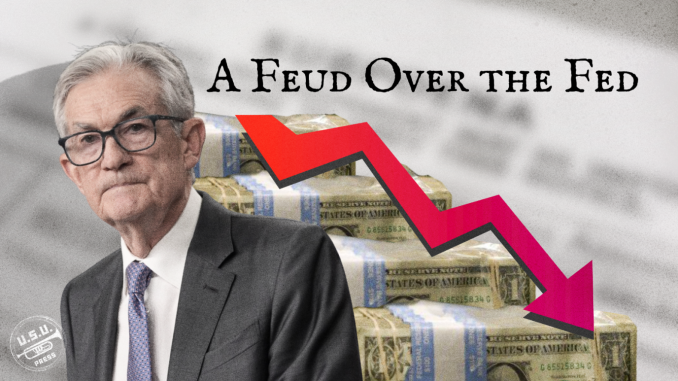
On Friday, January 9, 2026, Jerome Powell, the chair of the Federal Reserve,1 was served subpoenas by the Department of Justice for a grand jury investigation of the Federal Reserve itself. These subpoenas are the beginning of criminal proceedings against Powell, ostensibly related to his testimony in a Congressional hearing last year, but actually to bring the Fed’s policy into line with the goals of the White House. To understand the importance of this news, we have to understand the role and purpose of the Federal Reserve and how it regulates the US economy.
The modern executive branch of the US government is designed to work in the general interests, not only of the entire class of US capitalists, but also for the general welfare of the US economy and, as a result, manages the interests of the entire petty bourgeois and labor-aristocratic classes. But what does this mean? There are three classes that directly benefit from the US empire’s stability and economic success: 1) the big imperialist bourgeoisie, the finance capitalists invested in US firms like Bill Gates, the Kochs, etc.; 2) the petty bourgeoisie, those who own their own capital but also have to work; and 3) the labor aristocrats, roughly defined here as those proletarians who receive more than the global average pay for their labor-time.2 It is the political expectation that the executive branch will look out for the interests of these three classes. Affordable college and healthcare and access to purchasing land (usually in the form of housing) is part of that understanding. Most division between the Republicans and the Democrats actually comes down to which section of these classes to favor the most.
The Fed has generally played a neutral role in these feuds, leaning toward the Democratic camp of stability to benefit the petty bourgeoisie and labor aristocrats. The reserve system regulates the country’s money supply, which has a direct impact on the velocity of exchange (how quickly money or credit changes hands; in other words, how many transactions occur in any given time), on the total price of all commodities produced in the US market, and on the total number of those commodities produced. These figures are interdependent and related to one another on a push-pull basis, and they trend toward an equilibrium. That equilibrium can be expressed through the following equation:
(p * q) / v = m
Where p = the price of all commodities produced in the economic unit (the US market), q = the total number of commodities in that unit, v = the velocity of money, and m = the total money supply.3 Changes in any of these variables will cause subsequent changes in the others as they move toward the above equilibrium.
Inflation is reflected in the variable (p). For instance, all things remaining equal, if (m), the money supply, increases, either (p) or (q) must increase, or (v) must decrease. The regulation of this process is central to the purpose of the reserve system to prevent, on the one hand, runaway hyperinflation, and on the other, the velocity of money trending toward zero, either of which would cause a catastrophic collapse in the US economy, freezing transactions and halting production. For more details on the role of the Fed, see “The Inevitable Capitalist Crisis Looms” in the Red Clarion.
The thing now under dispute is the Fed’s overnight bank funding rate,4 the rate of interest which other banks must pay to one another or to the Fed if their own money supply is below the reserve amount required by the Securities and Exchange Commission (SEC) for large broker-dealers to ensure the bank can cover its loans at the end of any given day. This rate determines the interest rate for all lending in the US economy. All other lending rates are set somewhere higher than this Federal rate. The lower the lending rates, the more speculative investments will become as money can be loaned with less risk to the lender and thus the borrower. The reason this number is the source of conflict among the ruling class is because it embodies a contradiction in the interests of the major classes invested in the performance of the US economy.
For the big bourgeoisie, it is objectively better for their capacity to invest and make profits if the interest rates are zero. Although the Fed had historically always maintained some interest rate, in the wake of the 2008 crash the Fed set the interest rates to 0%. The US economy had been on this “life support” rate from 2008 until the 2020 economic crisis triggered by COVID-19. An interest rate of zero, however, will not remove excess money from the economy. At the beginning of 2020, the money supply was at 4,000 thousand billion USD. Today, the money supply is at 19,000 billion USD, reflecting a nearly five-fold increase.5 It also tends to make banks more unstable (as they will lend far more than they can safely cover), and increase the velocity of money by encouraging increased lending and investment. As a consequence, either the total number of commodities in US markets must fall (and why would they? There has been no change in production) or the price of commodities must rise. This rise is inflation.
The rise in the price of articles of consumption – consumer commodities – has a negligible effect on the big bourgeoisie. They can afford any increase, however large, because personal consumption is a marginal amount of their overall money. Even the rise in the price of means of production – raw materials, machines, factories, land, etc. – would lag significantly behind the gains made as a result of zero-percent lending at the federal level. Indeed, even if the banks should fail and the economy collapse, history has proven that the big bourgeoisie are shielded from the worst effects of that crash and would be able to buy up the resources of those smaller bourgeoisie and petty bourgeoisie that are driven into bankruptcy, default, or foreclosure for pennies on the dollar, further concentrating their stranglehold on the country’s economic resources.
Conversely, the labor aristocrats cannot weather such a storm and consumer inflation, particularly of necessary staples like food and healthcare. It can drive labor aristocrats into the ranks of the working proletariat and cost them their comfortable class-basis – their homes, their long-term investments, etc. It is in their interests to keep interest rates high, reduce or slow the rate of inflation, and ensure that the banks remain stable.
The petty bourgeoisie, possessing economic relations that are both bourgeois and proletarian, tend to be more like the labor aristocracy when it comes to this question than the big bourgeoisie. Inflation in the costs of the means of production will inevitably drive a significant portion of the petty bourgeoisie out of their class and down into the proletariat as the continued running of their businesses becomes financially untenable. The upper ranks of the petty bourgeoisie – those able to draw on reserves of credit or who are becoming regionally powerful and are on the cusp of entering the lower ranks of the big bourgeoisie – tend to prefer the lowering of the interest rates so they can attempt to grow their money-capital and progress out of their class and enter the big bourgeoisie.
What, then, does this grand jury indictment mean? The Fed has consistently kept the interest rates higher than they had been since 2008 for the past several years. President Trump, acting as the hammer of the big bourgeoisie, has made repeated demands that the Fed lower those interest rates.
On Sunday, January 11, the chair of the Federal Reserve, Jerome Powell, released a video statement in which he said that the subpoenas are an attempt to force him to capitulate to the White House’s political demands. That, in essence, Trump will force him out unless he does not agree to lower the federal interest rate. This matters for three reasons. First, it is an unprecedented breaking of ranks and airing of internal political differences between the Fed and the White House. Second, it suggests a continued feud within the ruling class over how to distribute the spoils of empire. Third, if the Fed does lower the interest rate and if, as a result, inflation explodes more than it already has done, this will result in the proletarianization of large numbers of labor aristocrats and petty bourgeoisie, the closure of many routes available to students and young people intent on entering those classes, and an overall increase in the size of the revolutionary mass base.
For us, the first issue means we have an opportunity to expose the machinery of the state and how it functions. We must also be aware of the concurrent risk here; the left-liberals, the Democrats mostly, will use the extraordinary nature of this rupture to bang their anti-Trump drum and try to recuperate their ramshackle coalition. This risk is real and requires our active intervention to minimize the number of petty bourgeoisie and labor aristocrats who are ideologically drawn back into their orbit.
As to the second reason, we must be extremely wary of declaring that the imperialist bargain between the big bourgeoisie and the upper ranks of the working class is breaking down.6 However, we do have the benefit of the bourgeoisie’s own mouthpieces such as the Wall Street Journal and the Financial Times to help understand their perspective. Although both sources have been moderate in their reporting of the Powell investigation, both have taken soft pro-Powell and anti-Trump stances.7 We can also look to the stock market, which has registered constrained disapproval as investments were moved from stocks into gold.8
If there is a fracture between elements of the big bourgeoisie, that group supporting Trump’s nationalist position (as opposed to the old neoliberal internationalism of capital) is growing and the neoliberal position is dwindling.9
Therefore, we must begin to prepare for our third conclusion. Trump has rarely allowed himself to be stymied by decorum or procedural niceties. He now holds the US Supreme Court by a wide margin should any of his actions be enjoined by a federal judge. We should first prepare immediate agitation, not demanding that Trump step back and allow Powell to continue as chair, but exposing the manner in which the Federal Reserve serves to stabilize an inherently unjust and exploitative world order. We must do our utmost to ensure the masses correctly understand that any complaints from the Democrats about Trump’s behavior aren’t on their “behalf,” but rather are intended to secure the supply of anesthesia with which they have been dulling the class struggle for a century; that the Democrats are attempting to lull US workers and petty bourgeoisie back to sleep so the empire can continue to burn, loot, and rape the world in their name.
In the intermediate term, we should prepare for a potential economic crash that may result in the unleashing of the contradictions contained by the Fed and its policies since 2020: a collapse in the real estate market and a subsequent depression triggered by numerous bank failures.
Careful attention must be paid in the coming weeks to the way in which this mini-crisis is handled by the state and by the political actors. We must continue to weigh evidence of one kind or another, and determine where the chips will fall so we can formulate a concrete plan of action. As of today, it seems that Trump is routing the supporters of neoliberal stabilization and preparing to enter a new phase of class warfare. This aligns with the White House strategy on increasing friction with ICE and the kidnapping of President Maduro: a global assault on behalf of the big bourgeoisie and the upper ranks of the petty bourgeoisie to repudiate the imperialist power-sharing that had been achieved during the last century.10 Washington has exploded the “rules-based order” it went through pains to establish over the last hundred years by acting unilaterally, in defiance of international law, and stating the geopolitical-economic interests which it is pursuing, rather than hiding its maneuvers behind high rhetoric of “democracy.”
- The US central banking system.
↩︎ - Here we are using the term labor aristocracy, as elsewhere in pieces published by Clarion staff, to mean anyone who is paid more for each hour of labor than the global average. For more, see Lauesen, Torkil. Unequal Exchange: Past, Present, and Future (Iskra Books, 2025). ↩︎
- See Marx, Karl. Capital, Chapter 3. This is consonant with Adam Smith’s understanding of the velocity of money.
↩︎ - Also called the “Federal Funds Rate.”
↩︎ - The M1 money supply over ten years, as reported by the Federal Reserve Bank of St. Louis. Accessed at https://fred.stlouisfed.org/series/M1SL.
↩︎ - See, for instance, H.W. Edwards’ groundbreaking work Labor Aristocracy, Mass Base of Social Democracy. ↩︎
- The Economist, which represents British capital, has much more firmly presented an anti-Trump position on Powell as well as on the ICE killing of Renee Good. The re-emergence of national (as opposed to international) capitalist planning in the US empire has rattled many cages in Europe. See, for instance: Financial Times, “Justice department’s probe into Jay Powell galvanizes Fed leaders to repel Donald Trump’s attacks,” Jan 12; Wall Street Journal’s, “The Fed Fights Back,” Jan. 13.
↩︎ - On the following Monday, the day after Powell’s video, trading was muted and the DOW opened down 500 points. The transfer of money out of the stock market and into commodities represents a fear that the value of the stock market may fall.
↩︎ - Hatred of the Federal Reserve’s regulatory power has been poured into the Libertarian movement and thus embodies a certain kind of right-liberal settlerism. This has been the preserve of an alliance of right-leaning big capitalists and upper ranks of the petty bourgeoisie since at least the early 2000s. It seems this logic is now winning over more and more of the big capitalists themselves.
↩︎ - The neo-liberal position on immigration has always been the Democratic party line: “We need immigrants to do the jobs no one wants to do, that are too difficult, grueling, intense, or low-paying for real Americans!” The ICE sweeps represent a new ideology that flatly denies this rather grotesque logic and embodies instead the naked nationalist nativism in Washington.
↩︎
Leave a Reply