
Estimated reading time: 3 minutes
By H. W. Edwards
$24.99
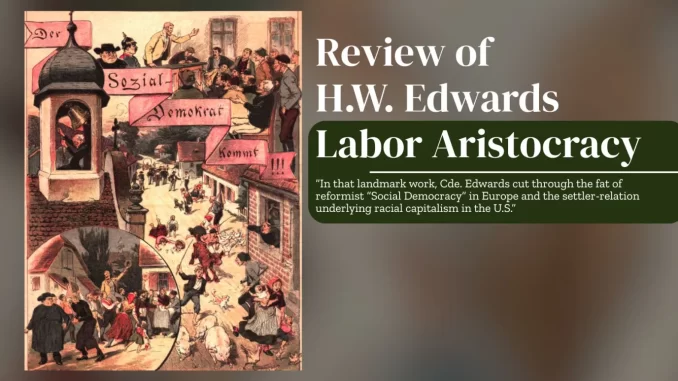
In 1978, Hodee Edwards’ Labor Aristocracy first saw print with Aurora Press of Stockholm. In that landmark work, Cde. Edwards cut through the fat of reformist “Social Democracy” in Europe and the settler-relation underlying racial capitalism in the U.S. She revealed, through economic analysis of the presence and source of imperial superprofits, that Lenin’s thesis about the labor aristocracy of the imperialist countries holds more true than ever before — and has been completely obscured by the so-called Marxist-Leninists since the mid 30’s of the last century.
This was work that had begun by Communist luminaries like Samir Amin (Accumulation on a World Scale, 1971; Unequal Development, 1973). Edwards’ book is a thoroughgoing analysis of the imperialist system as it existed in the 1960s and 1970s. It unsparingly excoriates the Marxists who have refused to heed Lenin’s words that “Capitalism has now singled out A HANDFUL (less than one-fifths at the ‘most generous’ and liberal calculation) of exceptionally rich and powerful states which plunder the whole world simply by ‘clipping coupons.’” (V.I. Lenin, Imperialism, the Highest Stage of Capitalism)
Cde. Edwards divides the imperial metropoles into two types: those with semi-colonies physically present within them (like the United States) and those who have no internal semi-colonies. She convincingly, correctly, maintains that Social Democratic (reformist, anti-Communist, and revisionist) parties flourish in the second type of country. In the first, open, reactionary, racist terror flourishes instead. The basis for both is the material benefit, the super-wages, the suppressed prices of luxury goods, that come as a bounty of imperialist exploitation and which are shared with the imperialist’s “own” workers.
This book is a critical text. Without understanding the problem of why revolution has not yet been successful in a developed imperialist country (or even attractive), we cannot begin to assault the bastions of capitalism. Cde. Edwards’ work comports with the practical information gathered over ten years by social investigations and organizing among the staff of Unity–Struggle–Unity Press and all of its affiliates. We can confirm that Cde. Edwards’ analysis explains the reality of organizing in the imperialist centers almost precisely.
This new, second edition printed by Estuary Press, is vital to study. Unfortunately, it introduces a number of irritating formatting errors (mis-numbered end-notes, mysterious extra blank pages, bs where there should be hs, indicating the use of an OCR method) which detracts somewhat from the overall reading experience — but nevertheless, all those who would claim Marxism-Leninism in the imperial centers must read this book and other works that address this problem.

this is fun, following along as you dig up obscure 70s texts from organizers/organizations that didn’t get anywhere and promote them as dividing lines for the communist movement in the us. i wonder how long it’ll take you to catch up to real communist theory
what is “real communist theory” to you? a book is not “fake theory” because it was written a while ago, nor is it “fake theory” because of its obscurity.